


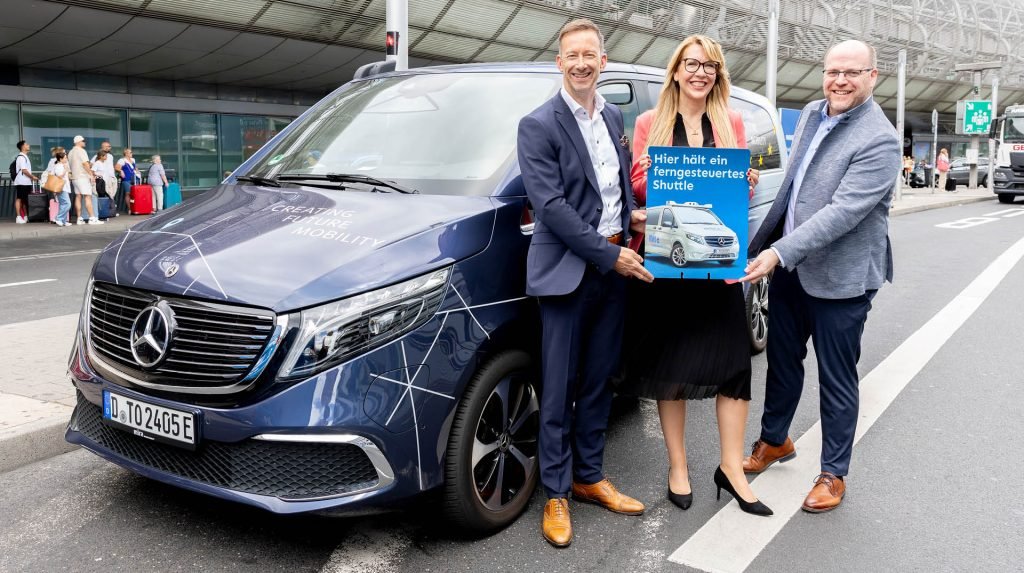
A real-world pilot of teleoperated shuttle vehicles began on public roads at Düsseldorf Airport on July 13, run jointly by Rheinbahn, Rheinmetall and its subsidiary MIRA, together with Düsseldorf Airport. The partners are evaluating the deployment of remotely supervised and teleoperated vehicles under real operating conditions.
The shuttles operate between the airport railway station and the terminal area, with the surrounding environment – combining high traffic density, diverse mobility needs and interaction between transportation modes ranging from e-scooters to the Airbus A380 – providing what the partners describe as a demanding real-world test environment.
The pilot is designed to evaluate teleoperated mobility services under everyday conditions, focusing on operational performance in real traffic, integration into existing transportation networks, system reliability and acceptance among passengers and professional drivers. The insights gained will help assess the potential of teleoperated vehicles for future public transportation applications, as well as internal use cases such as vehicle movements within transit depots.
Win Neidlinger, managing director of MIRA, said, “Teleoperation has the potential to help public transportation providers maintain reliable service despite growing driver shortages, while enabling new mobility services in an economically sustainable way. The Düsseldorf Airport pilot is an important milestone in validating the technology under real operating conditions.”
Lars Redeligx, chief executive officer of Düsseldorf Airport, said the airport already has experience operating fully automated public transportation through its SkyTrain system, adding, “This pilot represents the next step as we evaluate how teleoperated ground vehicles can further improve operational efficiency. We see potential not only for enhancing passenger transportation to and from the airport but also for integrating teleoperated systems into logistical and operational processes on the airport apron.”
The shuttles are remotely operated from a control center at the EUREF Campus Düsseldorf, with a trained safety operator on board each vehicle able to assume control at any time. Members of the public can ride free of charge; the pilot runs through August 28, 2026, with service Monday to Friday between designated hours.
The pilot forms part of the PoQuaSIA research project, funded by the German Federal Ministry for Economic Affairs and Energy under the European 6G-RIA initiative, aimed at developing secure digital infrastructure for safety-critical applications such as vehicle teleoperation.
In related news, UK backs Fusion Processing to explore driverless airport transportation
