


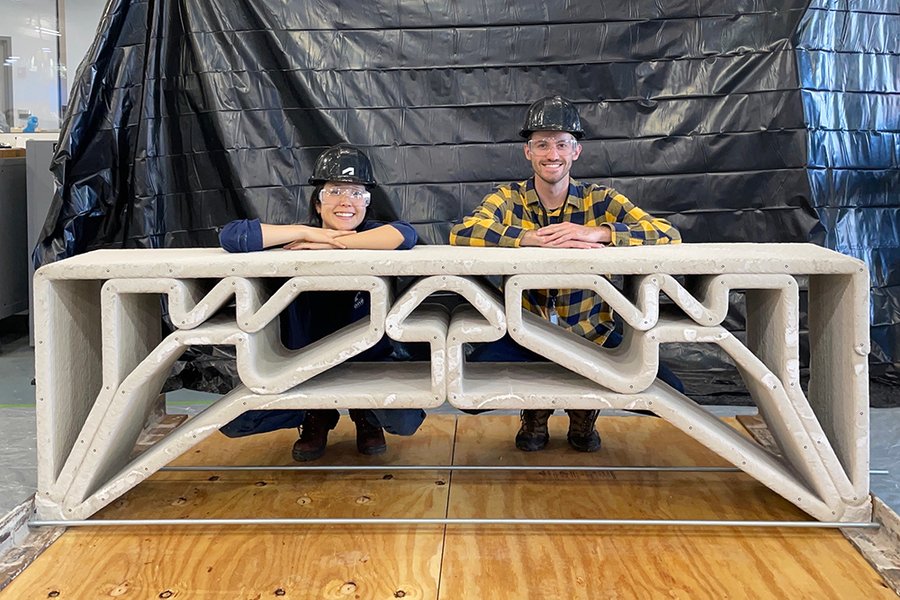
Researchers at MIT have developed a design framework that optimizes concrete structures while accounting for the physical limits of 3D printers. The research also reveals that printer hardware, not concrete, is the key bottleneck to achieving lighter structures.
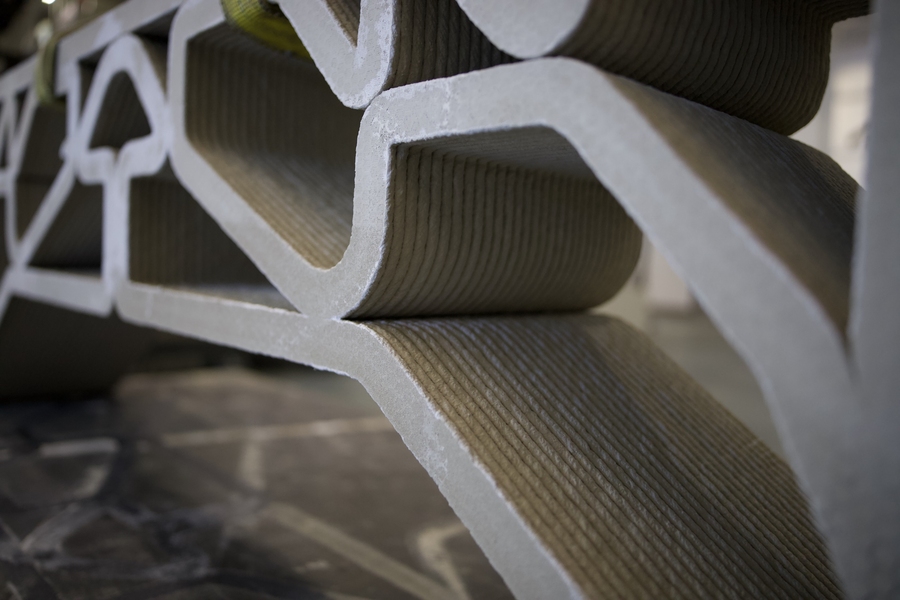
Concrete is the world’s most-used construction material and one of the single largest sources of carbon emissions. Printing it bead by bead, like a large robotic icing pipe, is one route to a smaller footprint: it removes the labor of pouring into moulds and deposits material only where a structure actually needs it. The catch is that the leanest computer-generated designs are often impossible to print. Engineers use topology optimization to find the strongest shape for the least material, but the delicate, web-like results ignore the realities of large-scale printers, with their thick nozzles, restricted turning and requirement to lay down concrete in one unbroken path.
Designing for what a printer can actually build
The MIT team, writing in the journal Additive Manufacturing, built those fabrication limits into the optimization itself, so the output can be printed with little or no manual reworking.
To identify the real constraints, the researchers joined the Autodesk Research Residency Program and worked alongside the operators of the large-scale printers at Autodesk’s Technology Center in Boston. “They pointed at some of our sharp angles, and they went, ‘I don’t feel safe printing something like that,’” Kim-Tackowiak recalled. Those exchanges pinned down three limits, the required thickness of each printed bead, how sharply the nozzle can turn, and the need to print continuously, each of which was translated into the framework’s mathematical rules.
Speed set the approach apart. Older methods optimize the shape first and then demand, in Kim-Tackowiak’s words, “a massive amount of post-processing” that can run for days; the new framework produced fully printable designs in roughly two minutes on a laptop, and a last-minute size reduction on printing day took only five to 10 minutes to rerun.
The enabling math, mixed-integer optimization, was long dismissed as impractical. “Reaching that speed at all is recent,” said co-first author Zane Schemmer, a CEE PhD student. “You go back five, 10 years ago, the solver we used, even three years ago, could not solve these problems. This field has been avoided, because everyone thinks that’s not an avenue we can go down. But with new algorithms and resources, it’s becoming a way we can start to frame problems.”
A bridge that exposed the real bottleneck
To validate the method, the team printed and load-tested a 2.3-meter bridge at Autodesk’s facility. “The bridge took about 30 minutes to make and was built from off-the-shelf mortar,” said senior author Josephine Carstensen. The roughly 900-pound structure held more than 2,000 pounds spread across it with no measurable bending, closely tracking the team’s simulations.
The test’s biggest surprise was how much strength went unused. “What we found was our result was super over-engineered,” Kim-Tackowiak said. “From zero to 200,000 pounds, your design is entirely driven by these ‘can I build it or not’ constraints. And then, after 200,000 pounds, you can start to think about the physics.” In short, the printer’s limits, not concrete’s strength, dictated how efficient the bridge could be.
Because the framework finds the mathematically optimal design, the researchers could price each hardware limit in material. “With mixed-integer optimization, we can find the global optimum, the best solution there is, as opposed to just a good solution,” Carstensen said.
The decisive factor was bead width: the bridge used a 4-centimeter bead, but the analysis showed a printer laying a 1-centimeter bead could cut material use by as much as 76 percent while staying “well within safety margins.” That upended expectations. “I thought the continuous path would be the problem, the one that had the highest effect,” Carstensen said. “But it wasn’t. It was the bead width.” The finding effectively hands printer-makers a roadmap, showing that modest hardware upgrades could yield large efficiency gains and shrink concrete’s carbon footprint.
Built for compression, and what comes next
The bridge works because every part is under compression. “With concrete, it’s really good when you push on it, really bad when you pull on it,” Schemmer said. “We’re able to guarantee that every piece of concrete that you see is in compression, there’s no part that’s being pulled on.” Savings come both from using less material and from skipping molds altogether, an edge that grows for one-off shapes; Carstensen sees early promise in disaster relief, where “you can quickly put up new infrastructure without needing to make formwork.”
That compression-only nature was demonstrated vividly after testing. The bridge had held over 2,000 pounds unmoved, but when a worker lifted one corner a few inches to sweep beneath it, it snapped, as the lift placed parts of the structure in tension they were never designed to bear. “It’s optimal in one way, but it’s definitely not optimal in every way,” Kim-Tackowiak said.
The next step is reinforced concrete: “We know a pure concrete structure is not necessarily going to be the most optimal thing, so we’re moving it more into the world we live in today, which is reinforced concrete,” she said, adding that “working out how to feed rebar into a printed concrete structure is proving its own challenge.”
The work was funded by the National Science Foundation and supported by the MIT Center for Advanced Production Technologies.
Designing out concrete’s carbon before it is poured
MIT’s move is strategic, not just material. Rather than change what concrete is made of, the team changes how its shape is chosen, tying the optimizer to a printer’s real limits so lean, mould-free structures can actually be built. By pricing each limit in wasted material, it turns sustainability into a hard number and shows machine-makers exactly what to fix.
That approach dovetails with recent low-carbon printing work. In 2025, University of Pennsylvania professor Masoud Akbarzadeh and Swiss materials firm Sika unveiled Diamanti, a 3D printed concrete bridge in Venice whose hollow, patterned geometry is designed to cut both material use and embodied carbon; its post-tensioned, adhesive-free assembly also makes it demountable and recyclable, echoing MIT’s emphasis on placing material only where a structure needs it.
Other groups have attacked the same problem through chemistry. Also in 2025, Thailand’s SCG completed a 3D printed pedestrian bridge using LC3, a low-carbon blend that swaps part of the cement for calcined clay, while Oregon State University researchers introduced a rapid-setting clay that cures instantly on extrusion and sidesteps the cement whose production accounts for roughly 8 percent of global CO₂ emissions.
Geometry, materials and machines are converging on the same goal: less carbon per structure. MIT’s insight is that the printer is now the limiting factor. Better hardware, not just better concrete, may unlock the largest gains.
3D Printing Industry is inviting speakers for its 2026 Additive Manufacturing Applications (AMA) series, covering Energy, Healthcare, Automotive and Mobility, Aerospace, Space and Defense, and Software. Each online event focuses on real production deployments, qualification, and supply chain integration. Practitioners interested in contributing can complete the call for speakers form here.
To stay up to date with the latest 3D printing news, don’t forget to subscribe to the 3D Printing Industry newsletter or follow us on LinkedIn.
Explore the full Future of 3D Printing and Executive Survey series from 3D Printing Industry, featuring perspectives from CEOs, engineers, and industry leaders on the industrialization of additive manufacturing, 3D printing industry trends 2026, qualification, supply chains, and additive manufacturing industry analysis.
Featured image shows A close-up of the bridge shows the stacked layers, or beads, of extruded concrete, laid down in a single continuous path with no molds. Photo via MIT.
