


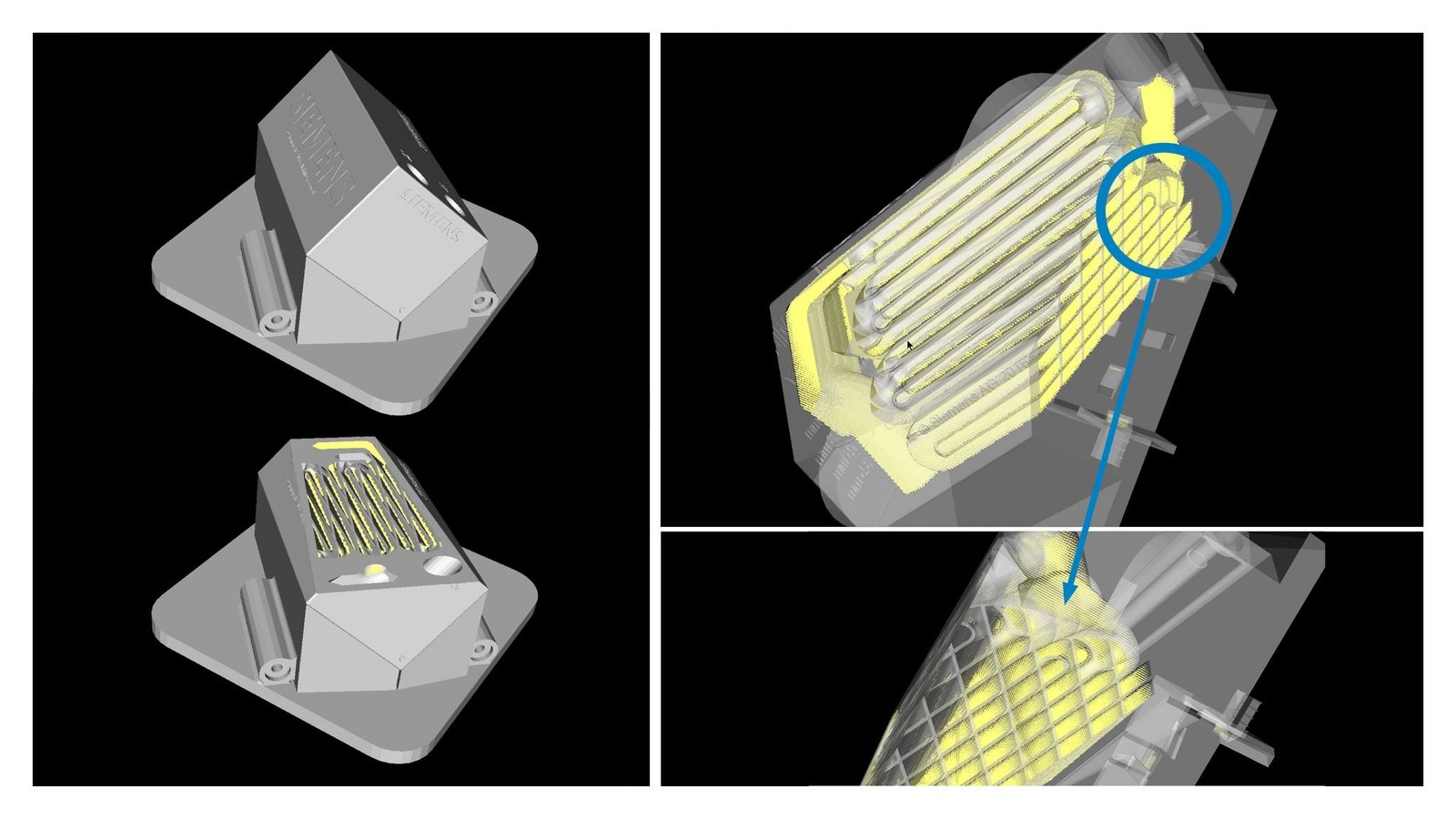
Solukon, a German manufacturer of automated depowdering systems, has launched SPR-Pathfinder PRO, an upgraded software package for planning and simulating powder removal from complex laser powder bed fusion parts. The software is intended particularly for components with fine internal channels and densely packed surfaces.
The PRO edition removes the previous voxel limit, increases the particle-simulation count to one million and allows engineers to inspect internal powder movement before a part is printed. Solukon says this can help identify potential powder traps in complex geometries during the design stage.
Alongside it, Solukon launched SPR-Pathfinder BASIC, a lower-cost alternative that automates movement calculations for moderately complex parts but does not include PRO’s detailed simulation and cross-sectional inspection capabilities.
Increased simulation depth
The previous version supported a maximum of 2.4 million voxels. According to Solukon, this limited its ability to represent sub-millimeter channels and densely packed internal surfaces.
SPR-Pathfinder PRO removes this ceiling. It can also simulate up to one million powder particles, a 20-fold increase from the earlier limit of 50,000.
The increased simulation depth is intended to provide a more detailed representation of how powder moves through narrow and complex internal routes.
Andreas Hartmann, CEO and CTO of Solukon, said the upgrade was driven by customers whose components had exceeded the simulation limits of the previous software.
Inspecting powder traps before printing
SPR-Pathfinder PRO adds cross-sectional views along the X, Y and Z axes, as well as adjustable model transparency. These tools allow users to inspect bottlenecks, powder traps and other difficult-to-reach internal regions while the component remains a digital model.
Design teams can then modify channel dimensions, reposition outlets or adjust component orientation before committing to a build.
Solukon describes this approach as Design for Depowdering. Conventional Design for Additive Manufacturing considers whether a geometry can be produced. Design for Depowdering also evaluates whether unfused powder can be reliably removed after printing.
Hemank Raj, Product Owner for SPR-Pathfinder, said the software allows manufacturers to evaluate depowderability during the design stage rather than discovering inaccessible channels after production.
Once the simulation is complete, the resulting movement program can be transferred to a compatible Solukon depowdering system for execution.
Predicting depowdering time
SPR-Pathfinder PRO also estimates the time required to calculate the movement program and complete the physical depowdering process.
Solukon is positioning this capability as a production-planning tool. Manufacturers can use the estimate when scheduling equipment and forecasting the total processing time for a build job.
The company describes the predictions as accurate but has not disclosed error margins or published comparisons between estimated and actual depowdering times.
Process data can also be recorded and transferred to higher-level production systems through OPC UA. Solukon says this can support traceability, repeatability and the analysis of process deviations.
BASIC and PRO software packages
SPR-Pathfinder BASIC automates movement programming for moderately complex parts, removing the need for operators to manually enter the required rotations.
SPR-Pathfinder PRO builds on this with higher-resolution simulation, internal cross-sectional views, transparency controls and process-time prediction. Both packages run on a standard Windows computer or server.
Compatible Solukon systems include the SFM-AT350, SFM-AT350-E, SFM-AT800-S, SFM-AT1000-S and SFM-AT1500-S.
Existing Solukon machine users can request a free 30-day trial licence. Pricing for both software packages was not disclosed.
Depowdering becomes a design-stage constraint
In November 2025, Nikon Corporation, a Japanese precision-technology company, installed a Solukon SFM-AT1000-S at its AM Technology Center Japan to process components produced on the large-format NXG XII 600. Designed for parts weighing up to 800 kg, the system uses SPR-Pathfinder to calculate depowdering movement paths from CAD data. It also connects to Nikon’s wider digital workflow through OPC UA to capture process data.
Simulation can identify inaccessible routes and calculate movement sequences, but it cannot address every form of trapped material. In April 2026, surface-finishing specialist REM Surface Engineering presented a chemical process designed to remove stubborn, sintered powder from fully enclosed metal powder bed fusion passages. X-ray CT analysis reportedly demonstrated near-complete removal from TPMS-based heat exchanger structures without damaging critical thin walls.
The development illustrates the distinction between designing a part so loose powder can escape and removing material that has partially fused to an internal surface. SPR-Pathfinder PRO addresses the former by moving depowdering assessment into the design stage, while sintered material may still require a separate physical or chemical removal process.
3D Printing Industry is inviting speakers for its 2026 Additive Manufacturing Applications (AMA) series, covering Energy, Healthcare, Automotive and Mobility, Aerospace, Space and Defense, and Software. Each online event focuses on real production deployments, qualification, and supply chain integration. Practitioners interested in contributing can complete the call for speakers form here.
To stay up to date with the latest 3D printing news, don’t forget to subscribe to the 3D Printing Industry newsletter or follow us on LinkedIn.
Explore the full Future of 3D Printing and Executive Survey series from 3D Printing Industry, featuring perspectives from CEOs, engineers, and industry leaders on the industrialization of additive manufacturing, 3D printing industry trends 2026, qualification, supply chains, and additive manufacturing industry analysis.
Feature image shows SPR-Pathfinder PRO cross-sectional views reveal simulated powder inside a component’s internal channels and highlight a potential powder trap. Image via Solukon.
