


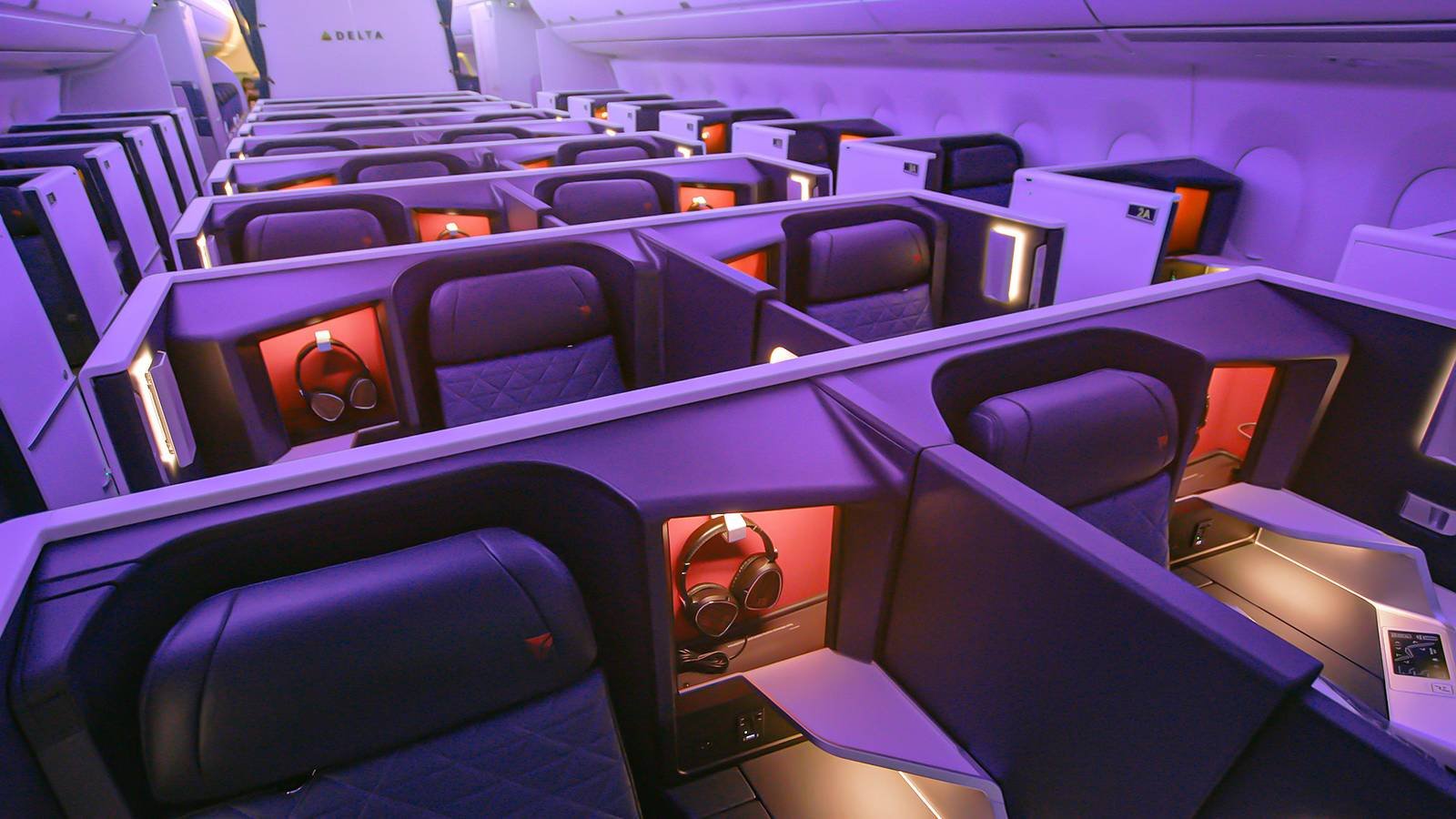
Delta Air Lines has spent years building Delta One into one of the most recognizable premium products offered by a US carrier, but knowing that an aircraft has lie-flat seats is no longer enough to win over hesitant travelers. For passengers crossing the Atlantic, probably one of the most important questions is which version of Delta One will actually be waiting at the boarding gate. The airline’s Airbus A350-900s and A330-900neos offer its flagship enclosed suites, while older Boeing 767s and legacy Airbus A330s provide different experiences under the same Delta One branding.
If you are planning to book with points, there is another complication: the routes receiving Delta’s best aircraft are often precisely those where finding reasonably priced award seats has become exceptionally difficult. Delta is concentrating premium-heavy widebodies on major business markets and routes supported by its transatlantic joint ventures while deploying older aircraft to thinner leisure destinations. The result is a clear map showing where Delta’s best business class seats have migrated, and why the elusive 50,000-point Delta One redemption through Virgin Atlantic Flying Club has become one of the biggest “unicorns” in award travel.
Delta’s Best Suites Following The Money

If you are searching for Delta’s best business class experience, the airline’s fleet deployment strategy provides the first clue about where to look. Its Airbus A350-900s and A330-900neos represent the core of its newest long-haul fleet, and both offer a significantly more modern premium experience than the aging Boeing 767-300ER. Delta uses these aircraft to reinforce important international gateways and high-value long-haul markets rather than spreading them evenly across its network.
The strategy can be seen across some of Delta’s most important international hubs. Routes linking  Hartsfield-Jackson Atlanta International Airport (ATL),
  New York JFK Airport,
  Boston Logan International Airport (BOS), and
  Detroit Metropolitan Wayne County Airport (DTW) with major European business and connecting centers are natural candidates for the carrier’s most capable widebodies. Markets such as Atlanta-Frankfurt (FRA), New York-London (LHR), and Detroit-Amsterdam (AMS) combine premium local demand with connecting traffic, while Delta’s relationships with Air France-KLM and Virgin Atlantic feed passengers into larger networks on both sides of the Atlantic.
Delta executives have connected the deployment of newer widebodies with their additional premium seating and cargo capacity. Speaking to The Points Guy, Delta Senior Vice President of Network Planning Paul Baldoni explained that the carrier’s decision to concentrate newer aircraft at Seattle reflected, among other factors, the opportunity to sell more premium seats and carry additional cargo. The same economics help explain why Delta’s newest widebodies are valuable on major international corridors.
Secondary European Routes Are Playing A Different Role

The other side of Delta’s strategy becomes visible beyond Europe’s largest business centers. The airline has expanded its transatlantic network to include seasonal and leisure-focused destinations such as Olbia, Malta, and Porto. However, launching an unusual new destination does not necessarily mean Delta will assign one of its newest aircraft to the route.
Many thinner markets are better served by older and less premium-heavy aircraft such as the Boeing 767-300ER and Airbus A330ceo variants. These jets have the range required to cross the Atlantic, but deploying them to seasonal leisure markets allows Delta to preserve its premium-heavy flagship aircraft for routes where business travelers, corporate contracts, connecting passengers, and cargo demand may generate higher returns. Air Service One’s coverage of Delta’s network highlights the carrier’s growing presence in secondary destinations, but these routes perform a different role from major corridors linking Delta hubs with Europe’s largest airports.
The Boeing 767-300ER remains particularly important to this strategy, although its time at Delta is gradually running out, as the average age of this airframe in the fleet is approaching 30 years. Delta confirmed that the aircraft will not receive a complete Delta One Suite retrofit because the airline is retiring examples each year. Delta instead plans to replace retiring 767s with Airbus A330-900neos and A350s equipped with enclosed suites. In the meantime, the 767 remains useful for serving long-haul markets that may not require the capacity or premium density of Delta’s newest widebodies.
Delta Is Turning The A350 Into An Even Bigger Premium Trump Card

Delta’s Airbus A350 strategy is particularly revealing because by adding more of the type, it is working toward a more consistent, premium-heavy fleet. The carrier operates A350-900s with different cabin layouts, partly because some aircraft were acquired secondhand from LATAM Airlines. However, Delta is moving toward standardizing its A350 fleet around the ’35H’ configuration.
The 35H layout features 40 Delta One Suites, 40 Premium Select seats, and 36 Comfort+ seats, significantly increasing the amount of premium inventory available on each flight. According to The Points Guy, Delta plans to convert all its A350s to this configuration, with the additional premium capacity coming partly at the expense of economy seating. For passengers, that means more opportunities to encounter Delta’s flagship enclosed suite. For Delta, it means more inventory to sell to travelers willing to pay substantially more for premium cabins. You can see Delta’s seat maps here.
This strategy represents the latest stage in Delta’s long-running investment in enclosed business class seats. As Travel Weekly reported before the product’s introduction, Delta became the first airline to launch an all-suite business-class cabin with a sliding door on every seat. The carrier’s future fleet plans will further expand that strategy. Delta has ordered 20 larger Airbus A350-1000s beginning in 2027, while additional A350-900s and A330-900neos will further modernize its widebody operation later in the decade, according to Live and Let’s Fly.
Catch what other flight trackers miss
Emergency squawks, holds, NOTAMs — live signals, no signup.
Open tracker
Catch what other flight trackers miss
Emergency squawks, holds, NOTAMs — live signals, no signup.
Open tracker
Joint Ventures Help Explain The Aircraft Allocation

Delta’s transatlantic network cannot be understood by looking at the airline in isolation. Its relationships with Air France-KLM and Virgin Atlantic create extensive connecting networks centered on hubs including Amsterdam Schiphol (AMS), Paris Charles de Gaulle (CDG), and London Heathrow (LHR). That makes routes such as Detroit-Amsterdam and New York-London strategically different from flights to smaller seasonal destinations.
A passenger boarding an A350 in Detroit may be traveling only as far as Amsterdam, but others can connect onward across KLM’s extensive network. Similarly, Delta passengers arriving at Heathrow gain access to a major business market and Virgin Atlantic’s network, while flights to Paris feed Air France’s global operation. Premium demand is therefore generated not only by passengers traveling between the two cities printed on the ticket.
This network effect helps justify deploying aircraft with larger Delta One cabins on major joint-venture corridors. Delta can sell premium seats to local business travelers, connecting passengers, corporate clients, and customers originating within its partners’ networks. For passengers, this creates a useful booking rule: the most glamorous and exotic destination does not necessarily receive the most glamorous and modern aircraft. Unfortunately for points collectors, the routes where Delta can most effectively monetize its premium cabins are also those where reasonably priced Delta One awards can be exceptionally difficult to find.
Why Saver-Level Delta One Awards Have Become Unicorns

So, what happens when travelers try to book one of these premium-heavy aircraft using points instead of cash? This is where Delta’s fleet strategy and loyalty economics collide. The airline may be adding more Delta One Suites, but additional seats do not automatically translate into more affordable award availability, particularly on high-yield routes where Delta expects to sell much of the premium cabin.
Delta’s SkyMiles program uses dynamic award pricing, meaning there is no fixed mileage requirement for a Delta One ticket to Europe. As Upgraded Points explains, premium award prices can vary enormously, with Delta sometimes charging hundreds of thousands of SkyMiles for a one-way redemption. That can create situations where a passenger is asked to spend 200,000, 300,000, or more SkyMiles for a seat that occasionally becomes available through a partner program for a fraction of the price.
The difficulty is finding that partner availability. Live and Let’s Fly has described Delta’s saver-level premium award availability as a “unicorn,” reflecting how rarely desirable Delta One seats are released to partners. This is particularly relevant on routes linking Delta’s largest hubs with major European gateways, where the carrier has little incentive to release discounted premium inventory if it believes those seats can be sold for cash.
Booking method | Typical one-way Delta One price to Europe | What travelers should know |
Delta SkyMiles | Often 200,000–320,000+ miles | Dynamic pricing can make premium awards extremely expensive |
Virgin Atlantic Flying Club | 50,000 points to non-UK Europe when saver space appears | Exceptional value, but availability is extremely limited |
Cash ticket | Frequently several thousand dollars | Strong paid demand reduces Delta’s incentive to release saver awards |
The aircraft themselves make the problem more noticeable. A 35H-configured A350 may have 40 Delta One Suites, but Delta’s objective is not necessarily to fill those seats with passengers redeeming partner miles. The larger cabin gives the airline more opportunities to sell premium tickets, accommodate corporate demand, and manage inventory as departure approaches.
The 50,000-point Redemption Is Still The Prize Worth Chasing

The common question, then, is whether searching for Delta One partner awards is still worthwhile. Despite the scarcity, it can be because the difference between Delta’s dynamic SkyMiles pricing and Virgin Atlantic Flying Club’s partner pricing is extraordinary. When eligible saver-level inventory becomes available, Flying Club can offer one of the cheapest ways to cross the Atlantic in Delta’s flagship business-class product.
According to The Points Guy, Virgin Atlantic Flying Club can charge just 50,000 points for a one-way Delta One flight between the United States and Europe outside the United Kingdom when partner inventory is available. AwardWallet has similarly highlighted the value of these redemptions compared with the dramatically higher prices Delta can request through SkyMiles. The catch is that Delta controls how much saver-level inventory reaches its partners.
That makes flexibility essential. Travelers may need to consider multiple US departure points, European destinations, and travel dates rather than concentrating on a single route. The United Kingdom is also an important exception because Delta One awards to London can attract substantially higher taxes and surcharges, reducing the value proposition compared with flights to continental Europe.
Delta’s widebody strategy has consequently created two very different maps for premium travelers. The first shows where its best seats are concentrated: major hubs, high-yield business markets, and strategically important joint-venture corridors. The second shows where those seats can be booked cheaply with points, and that map is far less predictable.
That distinction will become even more important as Delta adds modern widebodies, converts its A350 fleet to the 40-suite 35H layout, and introduces the larger A350-1000. The airline will have more enclosed Delta One Suites to sell, but many will operate precisely where premium demand is strongest. For award travelers, the 50,000-point Flying Club redemption therefore remains one of the best deals in transatlantic aviation, but finding it may require accepting that Delta One’s most valuable seats have become true unicorns.
Simple Flying Quiz
Think you really know Delta Air Lines?
Answer 10 questions and put your knowledge to the test
Think you really know Delta Air Lines?
Answer 10 questions and put your knowledge to the test
Easy (15s)Medium (10s)Hard (5s)
