


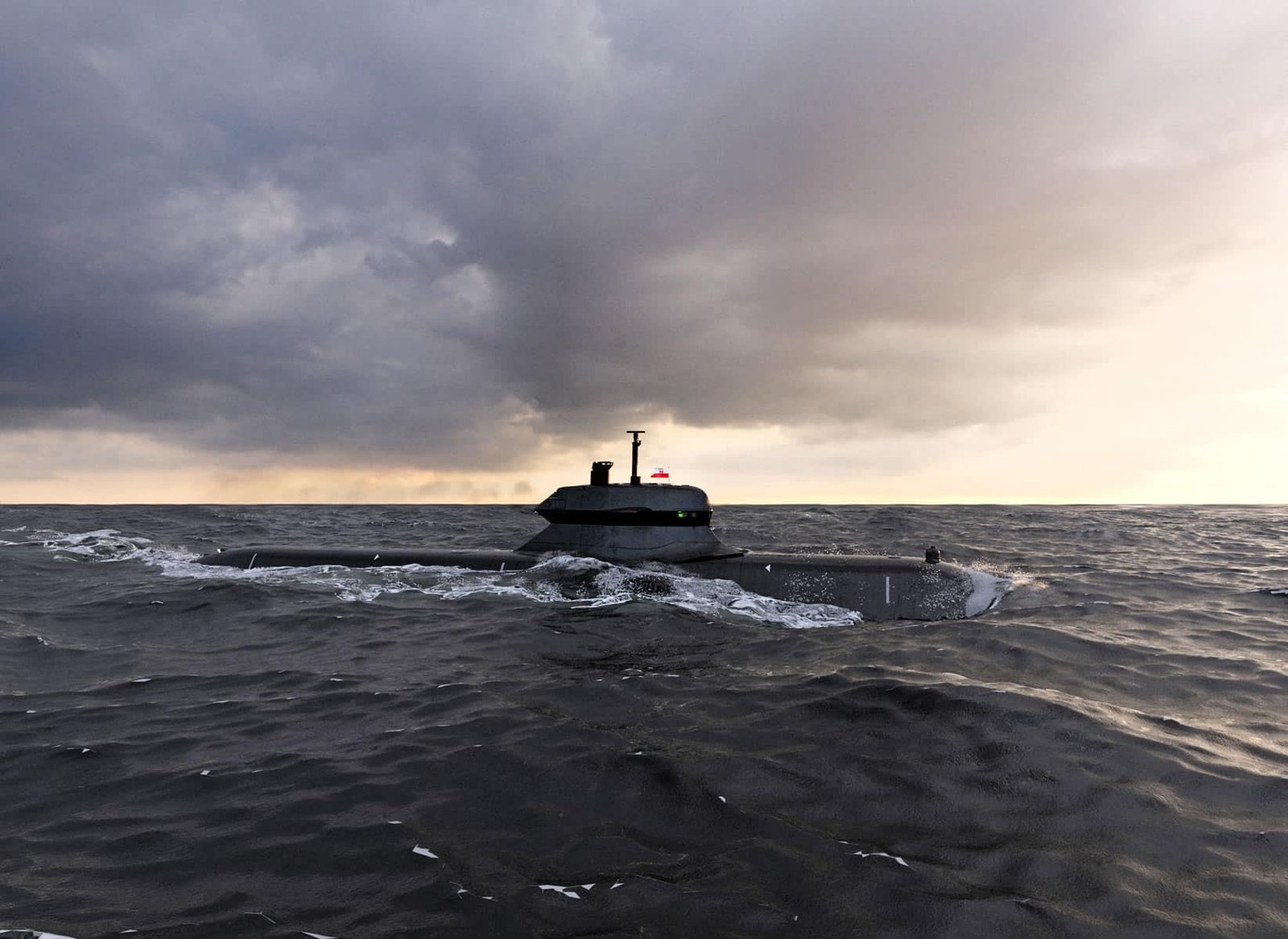
Following Poland’s order for Saab A26 submarines, Naval News breaks down the weapons package, undisclosed missile integration, HMS Södermanland lease, and 2031 delivery timelines.
The long-running Polish Orka-submarine program has finally resulted in a firm order, with the order to Saab for production and delivery of three A26-type submarines, or the Blekinge-class as it will be known in Swedish service. The contract also encompasses a weapon package and a training- and support package, with a total value of approximately SEK 47 billion (4.26 Bn EUR) and deliveries taking place between 2031 and 2038.
The down-select took place in November last year following a long and protracted process to find a replacement for Poland’s ageing submarine fleet, made up of the single Project 877E Kilo-class submarine Orzel. Orzel entered service in 1986 and hold the distinction of being the first Kilo-class submarine ever exported. The current order will see not only the procurement of three Swedish-built submarines, but is part of a broader strategic cooperation, which included a number of additional agreements signed.
HMS Södermanland lease
These include the lease of the HMS Södermanland, an older A-17 class submarine originally launched as part of the four-strong Västergötland-class in the late 1980’s. While the Södermanland might be of the same age as the Orzel, she underwent a radical mid-life update in the early 2000’s which saw her lengthened and fitted with air-independent Stirling-propulsion. There were discussions already back in 2019 about the possibility of Södermanland and her sister HMS Östergötland (since retired) being transferred to the Polish Navy as stop-gap submarines, but at that time nothing came from the talks.

Under the current agreement, training of Polish submariners will start already in August, and Södermanland will be performing operational missions in the Baltic Sea during the training period as well, ensuring that while the Swedish submarine fleet will dip to just three boats, there will still be ten AIP-submarines operating for NATO in the Baltic Sea throughout (the other six being the German Type 212A-class).
Another key agreement was signed between Saab and Polish defence industry heavyweight PGZ, covering the establishment of “the legal and organizational framework for Polish-Swedish cooperation in implementing the Coordinated Tender procedure for the acquisition of a submarine rescue vessel”. Poland is currently in the process of building a new submarine rescue vessel in the form of a 96 meter long and 6,500 t design as part of the Ratownik program, and with the Royal Swedish Navy’s rescue vessel HMS Belos starting to show its age, a Swedish order for either a sister vessel or a vessel sharing key technologies and subsystems would be a logical next step in their cooperation in the underwater domain.
Poland’s A26 Delivery timeline
The three Polish submarines will as mentioned start arriving in 2031, which is the same year Sweden expect the delivery of the first of their two submarines, HMS Blekinge. Both HMS Blekinge and her sister HMS Skåne are currently under production at the yard in Karlskrona, as shown during Naval News’ visit to the shipyard last fall. Due to this tight schedule, the Swedish Minister for Defence Pål Jonson has floated the idea that the second hull, HMS Skåne, could be diverted to become the first vessel for the Polish Navy.
Poland’s A26 weapons package
A notable detail is that in an interview with Swedish paper Dagens industri, Saab’s CEO Micael Johansson not only confirm that the Polish submarines will be delivered with a weapons package that include both light and heavy torpedoes, but also that Saab is under contract to perform integration work for an unspecified missile that isn’t included in the package and that “isn’t a cruise missile”. The light and heavy torpedoes are almost certainly Saab’s own Saab Lightweight Torpedo (SLWT), already in Swedish service as the Tp 47, as well as the company’s heavyweight Torped 62. However, it is worth noting that recent plans seem to indicate the upcoming Torped 63 might in fact enter service on a timetable that would fit with the Orka-deliveries, as discussed by Sweden’s Defence Materiel Administration (FMV) last year, meaning it could be a mix of Torped 62 and 63 on offer.
The undisclosed missile is more opaque, but can be either an air defence system such as the IDAS – though the TKMS connection might be a difficult pill to swallow for both Sweden and Poland – or more likely the Norwegian JSM-SL. This weapon is currently under development, and will be a torpedo-tube launched member of the highly successful NSM/JSM-family of missiles. The JSM-SL has already created significant interest in a number of European countries. If ordered for the A26, it would give the submarines not only a potent anti-ship missile, but also provide the submarines with a secondary land-strike capability.
