



At Euronaval 2026 in Paris, Safran Electronics & Defense unveiled the NGDS HK (Hard Kill), a new hard-kill evolution of its trainable naval decoy launcher fitted with guided and unguided rockets, alongside the new PASEO Master D electro-optical sighting and laser designation system.
Building on the two-axis NGDS (New Generation Dagaie System), the NGDS HK expands the launcher’s role from electronic warfare self-protection into multi-domain hard-kill engagement. While retaining compatibility with infrared, radar, and acoustic decoys as well as active off-board countermeasures, the modular mount can carry a one-ton payload of up to four rocket pods—each housing 22 standard 70 mm NATO or 68 mm French rockets, for a total of 88. Designed for single- or dual-mount installation across surface combatants, the fully trainable system delivers a short reaction time, ergonomic loading, and multi-threat processing from any bearing direction.
Speaking to Naval News in our Euronaval 2026 video report, Pierre-Olivier Nougues, VP Sales and Marketing Naval Solutions at Safran Electronics & Defense, noted that the launcher can fire rockets singly or in salvos against unmanned aerial vehicles (UAVs), uncrewed surface vessels (USVs), and small fast craft across anti-air, anti-surface, anti-submarine, and counter-UAS missions.
The unveiling marks the next step in Safran’s push to turn its decoy launcher into a multi-purpose close-in defense asset. At Euronaval 2024, Safran previously showcased an NGDS configuration armed with MBDA Mistral 3 missiles
, while the baseline decoy launcher continues to attract international interest—including recent trials aboard the Japan Maritime Self-Defense Force test ship JS Asuka.
To engage maneuvering targets with laser-guided rockets, Safran pairs the NGDS HK with the newly introduced PASEO Master D (“D” for Designator). Derived from the ITAR-free, combat-proven PASEO optronic family (which counts more than 3,000 units in service or on order worldwide, including recently with Bofors’ Tridon) the gyro-stabilized, six-sensor turret integrates a Color Day Camera (CDC), mid-wave infrared (MWIR) and short-wave infrared (SWIR) imagers, a high-repetition-rate laser rangefinder, and a laser target designator. Enhanced with ACE artificial intelligence, autotracking, passive threat detection, see-spot capability, and true on-the-move stabilization, PASEO Master D provides precision laser designation against both sea and airborne targets, completing Safran’s passive-to-active naval sensor-to-shooter chain.
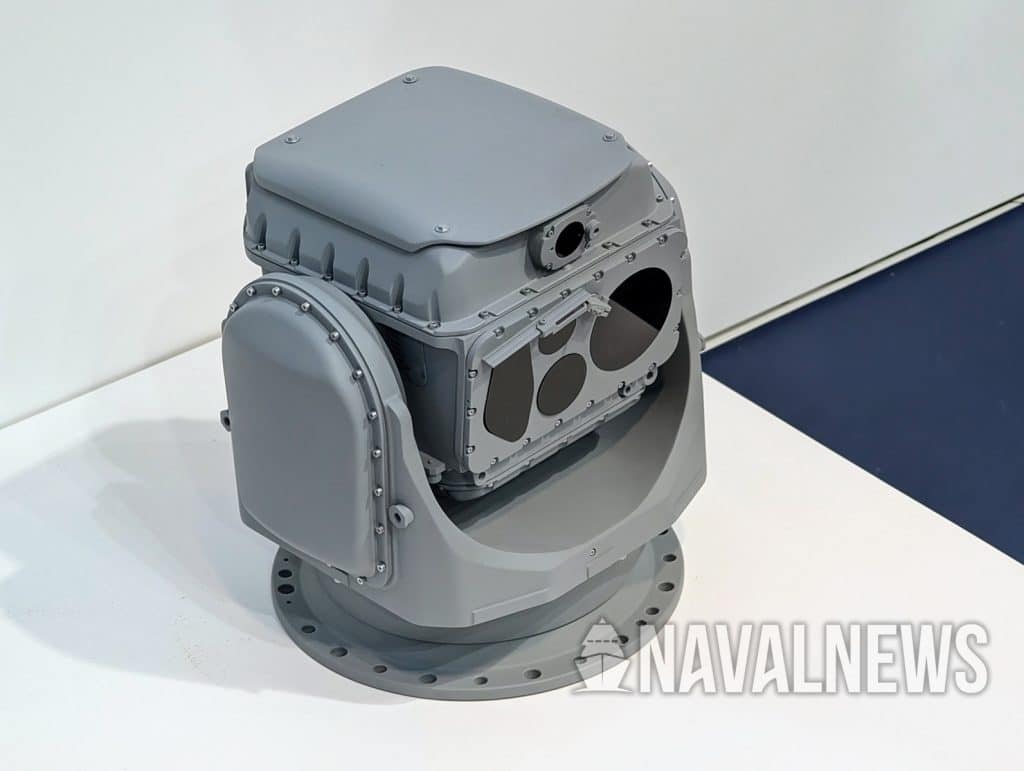
Naval News comments:
From an operational standpoint, the NGDS HK directly addresses the French Navy’s growing requirement to shield its first-rank surface combatants against saturating asymmetric threats such as uncrewed aerial and surface vehicles. In doing so, Safran’s concept positions itself as a direct competitor to Naval Group’s modular Rampart close-in weapon system. Despite this competition, the two companies are also cooperating as Naval News understands a PASEO Master D prototype was used during Rampart’s at-sea trials to designate the targets for the Thales guided rockets. Adding guided and unguided rockets into the close-in defense mix significantly lowers the cost per kill. This is a critical lesson drawn from the French Navy’s Red Sea deployments roughly two years ago, when frontline frigates were forced to expend high-value Aster surface-to-air missiles to intercept far cheaper one-way attack drones such as Shahed-type UAVs.
