


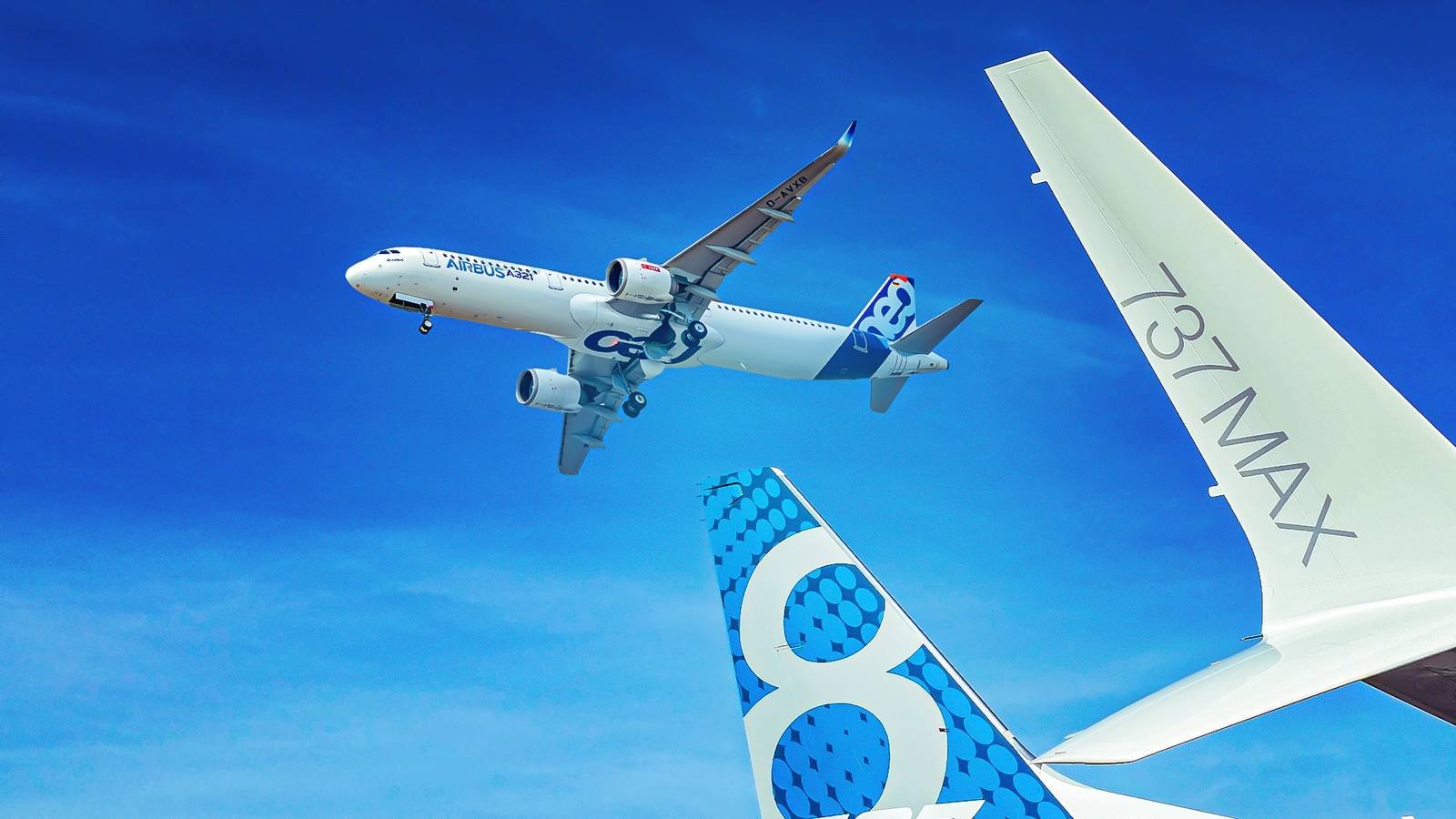
Miles per gallon (MPG): a metric typically measured for cars and imperative during the car-buying process. However, MPG is a metric that applies to aviation as well. Frankly, any gas-powered engine (or hybrid engine) benefits from an MPG reading. It is useful for comparison for customers. Whether it’s deciding between a Honda and a Mercedes-Benz, or an Airbus and a Boeing, MPG is a key factor for determining fuel economy.
In 2026, short- to medium-range aircraft routes will be dominated by the Boeing 737 MAX product line and the Airbus A321neo product line, which are the two bestsellers in this market segment today. Airlines around the world conduct their own due diligence in determining which aircraft is appropriate to their business model.
Airbus A321neo Most Efficient Per Passenger

According to Airbus, the Airbus A321neo conducted its first flight on February 9, 2016, and is assembled at one of several production locations, covering 3 main areas of the globe:
- Hamburg, Germany
- Mobile, AL, United States
- Toulouse, France
- Tianjin, China
According to Aircraft Commerce, the A321neo boasts an impressive range profile. Airbus conducted an 11-hour and 4,750 NM (8,797 km) flight while carrying a payload equivalent of 178 passengers and crew from the Seychelles to Toulouse, France. The most comparable MAX flight on record is the Seattle – Madrid delivery of an Air Europa 737 MAX 8, which flew 3,873 NM over ~10 hours — an endurance profile approaching the Airbus test, though still shorter in both distance and time. Note that this flight did not contain any passenger payload, but was near the top of its range profile.
According to Analytic Flying, the Boeing 737-800 was measured as a control group: the B737 MAX 8 is between 15% and 24% more efficient than the B737-800 in terms of the seats per gallon of fuel. In contrast, the A321neo is between 31% and 39% more efficient than the B737-800 in terms of seats per gallon of fuel. This metric, seats per gallon of fuel, is measured in seats; the MAX 8 averages about 95, where the A321neo averages over 100 in every example.
Notably, the A321neo gains more by this measure (seats per gallon of fuel) than the B737 MAX 8 because of its larger size. The Airbus A321 features a larger passenger capacity than the Boeing 737, accommodating between 180 and 244 passengers depending on the variant and airline configuration, compared to the 737’s capacity of 124 to 230 passengers.
Example: Boston To Toronto Or Seattle

When comparing the two aircraft types, it is worth considering two independent variables, one dependent variable, and five resultant metrics. The engine variant and seat configuration are both constant, independent variables that are conditional to their supporting aircraft type. The payload is a resultant dependent variable of the seating configuration, assuming it is a full flight.
ESAD (NM), ASMs, Block Time, Block Fuel, and Fuel Burn per ASM are core airline performance metrics that describe how efficiently an aircraft moves people and burns fuel. ESAD (NM), also known as Equivalent Still Air Distance, is the adjusted distance an aircraft effectively “feels” after accounting for winds; it represents the true performance distance rather than the simple point‑to‑point mileage.
ASMs are known as Available Seat Miles. This is a measure of total passenger‑carrying capacity by multiplying the number of seats by the distance flown, making it a foundational unit of airline productivity. Block Time (mins) captures the total minutes from gate pushback to arrival at the destination gate, reflecting real operational duration including taxiing. Block Fuel (gal) is the total fuel consumed during that same gate‑to‑gate period, covering taxi, climb, cruise, descent, and landing. Finally, Fuel Burn/ASM expresses fuel efficiency by dividing total fuel burn by total ASMs, showing how many gallons are required to fly one seat one mile; airlines use this to compare aircraft efficiency, route performance, and environmental impact.
Boston (BOS) — Toronto (YYZ)
Aircraft Variant | Engine Variant | Seats | Payload (lbs) | ESAD (NM) | ASMs | Block Time (mins) | Block Fuel (gal) | Fuel Burn/ASM |
|---|---|---|---|---|---|---|---|---|
A321neo | CFM LEAP-1A32 | 170 | 39,270 | 483 | 82,110 | 104 | 1,060 | 0.0129 |
737-8 | CFM LEAP-1B27 | 150 | 34,650 | 482 | 72,300 | 111 | 989 | 0.0137 |
Boston (BOS) — Seattle (SEA)
Aircraft Variant | Engine Variant | Seats | Payload (lbs) | ESAD (NM) | ASMs | Block Time (mins) | Block Fuel (gal) | Fuel Burn/ASM |
|---|---|---|---|---|---|---|---|---|
A321neo | CFM LEAP-1A32 | 170 | 39,270 | 2,517 | 427,890 | 375 | 4,615 | 0.0108 |
737-8 | CFM LEAP-1B27 | 150 | 34,650 | 2,517 | 377,550 | 379 | 4,218 | 0.0112 |
On both routes, the A321neo carries more seats, more payload, and delivers lower fuel burn per ASM, while the 737‑8 shows slightly shorter block fuel on the long‑haul, but still worse efficiency per seat‑mile.
Why Opt For The 737?

Even though the A321neo is more efficient per seat‑mile, an airline might still prefer the 737‑8 because it can be cheaper to operate, easier to schedule, and better matched to certain network strategies. In terms of fleet commonality, operators with existing 737 fleets may be more compelled to opt into the 737 MAX product line, as this greatly reduces overall maintenance costs. Shared supply chains, cross-compatible parts, and similar type ratings are reasons that the MAX family integrates well with existing 737 fleets. Examples of this phenomenon exist within Southwest Airlines, Ryanair, and United Airlines.
According to Aviationfile, in general, airlines will choose the 737 to meet three priorities:
- Operating cost per seat is the primary focus
- You operate in regions where Boeing support and historical connections are strong
- A versatile narrow-body option for medium-haul flights with low fuel costs is desired
The 737 MAX is made by Boeing, and airlines may make special considerations if a maintenance base is geographically close to a Boeing 737 MAX assembly line or service center. Being in close proximity to Boeing’s spare parts supply chain can prove to be of massive benefit to carriers in Aircraft-on-ground (AOG) situations. For example,  Alaska Airlines operates several hundred Boeing 737 aircraft across several variants. They are headquartered in Seattle, Washington, near the home of the 737 MAX’s assembly plant.
Another strategic but possibly more coincidental example may be that of Sun Country Airlines. Sun Country’s main operating base is in Minneapolis, MN. They have a fleet comprised of all Boeing 737, although no MAX variants. Minneapolis is close to two massive Boeing component repair facilities: St. Charles, IL, and Crown Point, IN. Both of these shops are geographically close enough to the Minneapolis base, aiding in short delivery times and easy courier routes to remedy AOG situations for the Minnesota-based airline. On the opposite end of the spectrum, a company like  Aerolíneas Argentinas is geographically distant from any Boeing OEM facility; the closest Boeing Distribution center is located in Miami, FL.
Devil’s Advocate: 737 MAX

Wikimedia Commons, Simple Flying
Airlines may choose the 737‑8 not because it beats the A321neo on pure efficiency, but because it often delivers a better overall mission fit. Its lower trip cost on short and medium routes, combined with the right‑sized 150‑seat capacity, makes it ideal for markets where flying a larger jet would dilute yields. On thinner or seasonal routes, the MAX 8 keeps load factors high and protects revenue, offering a practical alternative to the A321neo’s higher‑capacity model.
The MAX 8 has a few unique strengths that are not measurable under the aforementioned metrics: lower total fuel burn, better performance at short‑runway or hot‑and‑high airports, easier acquisition, and a large pool of qualified pilots. These reasons may be enticing enough for airlines to choose the MAX family instead of the A321neo.
In contrast, airlines leaning toward the A321neo typically prioritize maximum efficiency, higher capacity, and long‑range flexibility. The 737‑8 instead excels where cost control, operational simplicity, and demand matching matter most. Ultimately, the choice reflects an airline’s broader strategy: the A321neo optimizes per‑seat economics, while the 737‑8 optimizes the economics of flying the right airplane for the right market.
A321neo Has Higher MPG, But Lower ASM

The data proves it: the A321neo is the clear winner with respect to fuel burn per passenger. However, when solely looking at MPG, the Boeing 737 MAX wins. This can be a good thing for airlines looking to reduce overall fuel burn. But as it relates to fuel burn with respect to the number of passengers, the A321neo is the better choice. For airlines that operate key trunk routes and plan to fill their aircraft near or at capacity for each flight, the A321neo is a no-brainer. In contrast, for carriers operating niche, long-and-thin, or variable-demand routes, the Boeing 737 MAX may be a better choice; fuel burn will, as a result, be less than the net fuel burn of an airline’s A321neo fleet.
It is worth mentioning that from a passenger perspective, both airframes have solid reviews overall. The A321neo is larger and provides more space for passengers overall. United Airlines has stated that some A321 aircraft will even be equipped with a snack bar in the rear of the aircraft. However, the 737 MAX also presents a quiet cabin and interior LED lighting that appeals to passengers from a comfort perspective.
The practical caveat is that the result depends heavily on how densely an airline configures the cabin and how long the route is, so a lightly seated MAX 8 on a short flight can look competitive while a high-density A321neo on a long flight looks clearly superior. A company such as easyJet may prioritize having the absolute maximum number of seats onboard, whereas an airline such as la compagnie may tend to focus on the opposite, reducing its efficiency but heavily capitalizing on its range and passenger comfort. The MPG of the 737 MAX and the A321neo present many nuanced situations and unique variables. Each airline examines its own set of operating characteristics and chooses the product line best equipped for such situations.
