


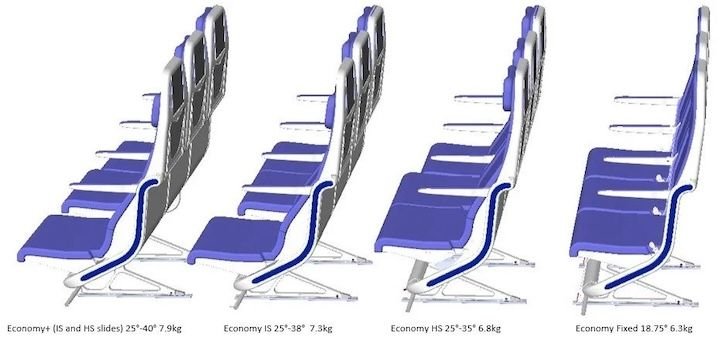
Paradigm Aerospace, a UK-based aviation engineering firm, claims to have created a new airline travel class that fits between economy and premium economy. The concept, named BlueSky SuperEconomy, is based around a fixed-back economy-class seat that passengers can opt to be converted into a comfortable lounger through an inexpensive upgrade.
A target market is leisure carriers operating all-economy-class layouts that are looking to expand their customer offer and gain extra revenue.
Key to the design is a seat geometry with an internal recline mechanism that can create an internal recline of up to 40°. When deployed, the mechanism creates a claimed increase in passengers knee and leg room of up to 3 inches, and up to 12 inches of extra under-seat floor space to stretch out into without encroaching into other passengers’ personal space.
Paradigm says the seats can be converted from standard economy into a comfortable lounger within the same cabin footprint, but because the architecture uses the space under the seat in front, they become 140% space efficient. By comparison Paradigm’s figures indicate that a premium economy seat can occupy more than twice the cabin footprint of a standard economy seat, which would equate to 43% space efficiency (though the economics aren’t quite such a straightforward equation).
Paradigm Aerospace has not confirmed the process required to convert a seat into a lounger, but similar to flexible seats such as Air New Zealand’s Economy Skycouch, presumably it will be a simple process carried out by cabin crew.
A new business model for existing cabin layouts
Paradigm Aerospace does not propose that the BlueSky SuperEconomy seats be added to an existing economy-class cabin. Instead, the concept would work as a package of standard and convertible seats, replacing an airline’s existing seat inventory to extract the full value from the seating.
However, there would be no need to alter the existing cabin LOPA (Layout of Passenger Accommodations), which is an important point as it means the seats could be installed without requiring changes to the overhead lighting, attendant call buttons and oxygen masks. The idea is that airlines can generate more revenue per seat, rather than fitting more seats.
Airlines would choose how many convertible seats they wish to install in the cabin and whether they would like to place those seats in a dedicated zone or throughout the cabin. If an airline customer wishes to add more convertible seats in the future, the remaining standard seats, which are visually identical, are upgradeable.
Similar to extra-legroom options, it is envisioned that the ancillary revenues gained from passengers paying to upgrade to a lounger seat could earn airlines millions of extra dollars. 97% of all airline seats flying are economy class, and 4.90 billion passengers travelled in economy class last year, including an estimated 1.63 billion that flew on long-haul, overnight, and on early and late sectors. That’s a lot of people who may be tempted to spend a little more for a chance of sleep.
A key element of the BlueSky SuperEconomy seats is that they can be offered with the BlueSky Cabin Layout Management System (CLMS), a technology that varies the ratio between standard and upgraded seats on every flight according to passenger demand. Passengers would have the flexibility to upgrade online during the booking process, upgrade at check-in, or even upgrade on board.
Paradigm Aerospace’s internally generated estimates claim that airlines equipped with these seats could potentially earn an extra GBP £2.4 million to £7.1 million per aircraft, per annum (depending on aircraft type, sectors and frequency).
Paradigm Aerospace says the BlueSky SuperEconomy seats would be compatible with the Airbus A320, A330 and A350 aircraft families (and the A380), as well as most Boeing narrowbody and widebody aircraft.
Paradigm is seeking foundation airline partners and investors to fund the certification and entry into service of the seat, and is opening additional options for licensing or sale of the technology.
