


Welcome to Taste Test, where every week our critic Jonah Flicker explores the most buzzworthy and interesting whiskeys in the world. Check back each Sunday for his latest whiskey review.
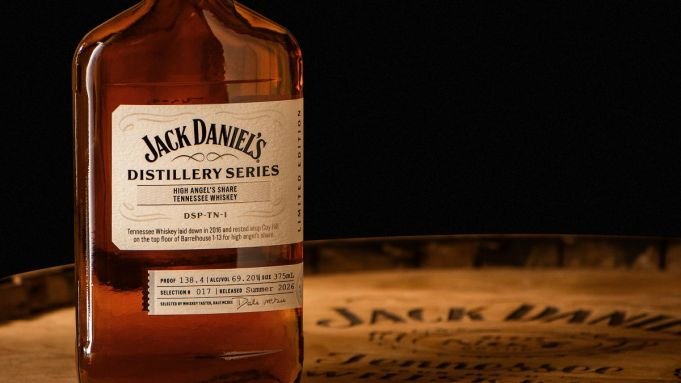
Do we really need another near-hazmat whiskey from Jack Daniel’s? Maybe the question is really whether or not we need another near-hazmat whiskey, period. Well, whether we do or we don’t, it’s here in the form of the new Distillery Series #17 High Angel’s Share Tennessee Whiskey, which was bottled just shy of 140 proof and drinks like a boozy flamethrower.
“High angel’s share” is a term you’ve probably heard before from Old Forester, a brand and distillery that is also owned by Jack Daniel’s parent company Brown-Forman. It refers to whiskey aged in barrels that, because of where they were positioned in warehouses, experienced extremely high evaporation rates due to elevated temperatures and decreased humidity (most often on the upper levels of these rickhouses). Most recently, Old Forester released High Angels’ Share Rye as part of its limited-edition 117 Series. That whiskey was bottled at 110 proof, the same as past High Angels’ Share bourbon expressions from the distillery. The new High Angel’s Share from Jack, however, was bottled at cask strength of 138.4 proof (also notice the apostrophe placement—apparently just one angel drank from these barrels as opposed to many).
Of course, Jack is no stranger to really high-proof whiskeys, and occasionally those do enter hazmat territory. The most famous examples come with Coy Hill on the label, referring to particular warehouses at the distillery in Lynchburg that often yield super high-ABV barrels with very little whiskey left in them after close to a decade of maturation. Distillery Series #17 (part of Jack’s limited-edition series of distillery-exclusive smaller bottles) was distilled in 2016 using the same mashbill as regular Jack: 80 percent corn, 12 percent malted barley, and eight percent rye. The barrels spent their lifetime maturing on Coy Hill on the top floor of Barrelhouse 1-13, soaking up flavor and making at least one angel very drunk.
The resulting whiskey is intense, to say the least. A fellow whiskey writer who I admire pointed out that part of the reason for releasing a whiskey like this is likely to “help fans understand the process more.” And she’s right about that—this offers a look at how warehouse placement and longer maturation times can affect a very popular and familiar whiskey, and it’s especially useful when comparing it to regular Old No. 7. That being said, I’m not sure how much I enjoy actually drinking this whiskey, which for me is the most important thing. It’s certainly packed with flavor, revealing big berry, vanilla, and oak notes that don’t obscure the signature Jack Daniel’s banana flavor. But at such a high proof, the heat ultimately wins out and overshadows everything else.
Sure you can add some ice or water to tamp this whiskey down, but I think Old Forester had it right when it released its High Angels’ Share expression at 110 proof—you still get the intensity, but at a much more drinkable level. By all means go ahead and try this new whiskey, especially if you’re a fan of Jack’s experiments, many of which have been outstanding over the past few years. But this Distillery Series expression is more of an endurance test than a pleasure cruise, and it’s one that I probably won’t be pouring again any time soon.
Score: 84
- 100 Worth trading your first born for
- 95 – 99 In the Pantheon: A trophy for the cabinet
- 90 – 94 Great: An excited nod from friends when you pour them a dram
- 85 – 89 Very Good: Delicious enough to buy, but not quite special enough to chase on the secondary market
- 80 – 84 Good: More of your everyday drinker, solid and reliable
- Below 80 It’s Alright: Honestly, we probably won’t waste your time and ours with this
Authors

Jonah Flicker

