


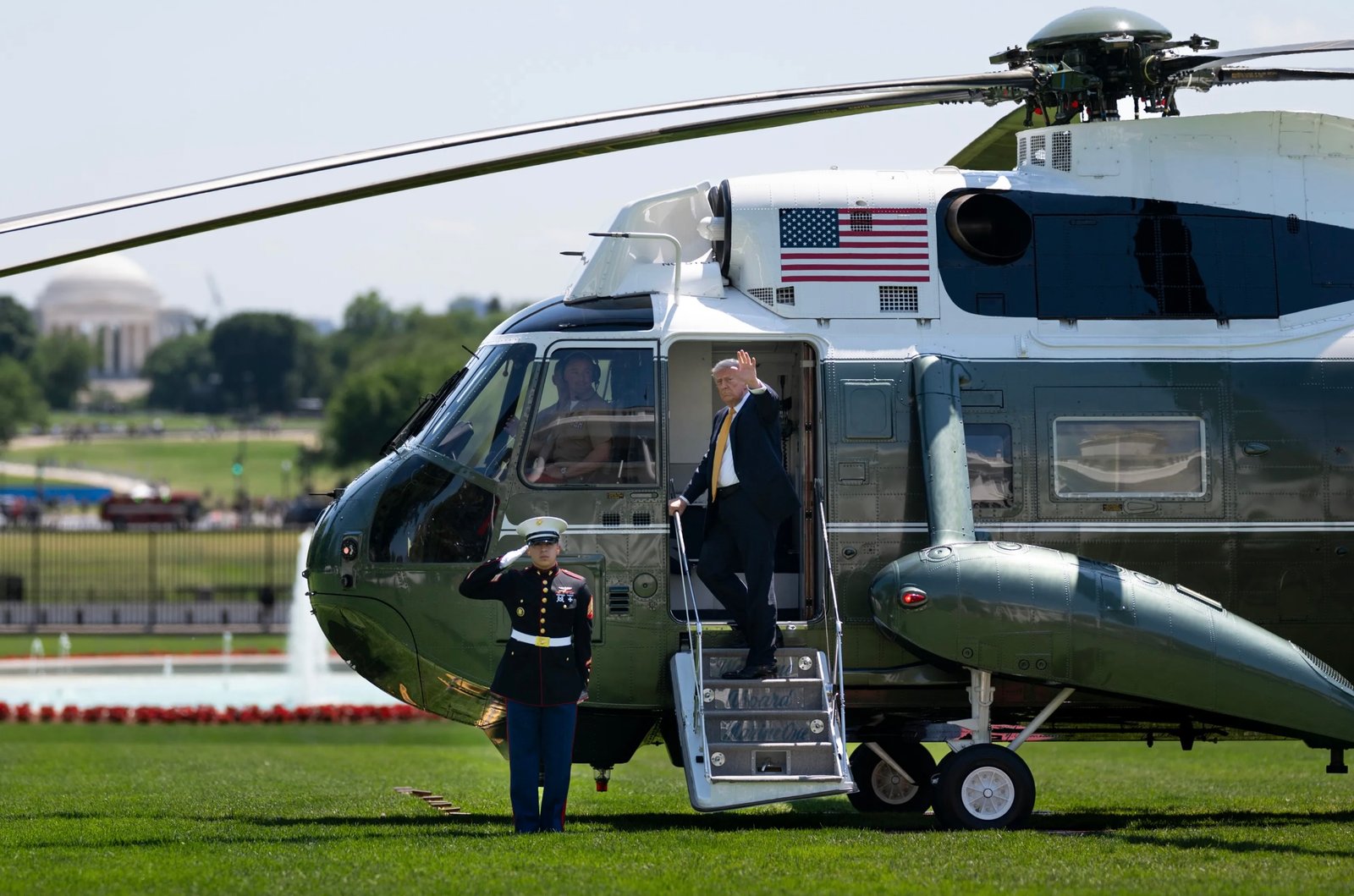
The new landing structure on the South Lawn will prevent the Sikorsky “Marine One” presidential transport from scorching the verge at the executive manor.
The Trump administration is constructing a helipad at the White House that will alleviate a non-safety issue with engine exhaust from the US Marine Corps fleet of Sikorsky VH-92A presidential transport helicopters.
Despite entering US service in 2021 and Sikorsky having delivered the final planned aircraft in 2024, the VH-92A is still operating alongside older presidential transport helicopters, including the Sikorsky VH-3D and VH-60N. Both of those types are expected to keep flying until 2030, when the VH-92A will assume full duties.
That delay is due in part to the VH-92’s two GE Aerospace CT7-8A6 turboshafts and auxiliary power unit scorching the South Lawn of the White House, from which the president and his entourage typically depart.
The issue has lingered for years without a solution, until now.
US President Donald Trump held an impromptu press event outside the executive mansion on 19 August to show off a new granite helipad on the South Lawn that will enable the VH-92A to land without harming the verge. The structure, which is still under construction, will also serve as a surface for outdoor White House social functions.
“This is going to be used for a lot of different celebrations, a lot of different big meetings,” Trump said from the helipad site, flanked by construction workers.
Trump indicated the space will be used to host Chinese president Xi Jinping during an upcoming state visit to Washington in September.
The cost of the new helipad, which Trump puts at $5-6 million, is apparently being footed by Sikorsky, according to the president himself.
“Sikorsky is paying for it,” Trump said in July. “Because they didn’t tell us how powerful these helicopters were.”
The president has recently opted to use the older VH-3D Sea King “white top” when travelling to and from the White House, although the VH-92A has been able to operate from the nearby Elipse park, which borders the White House grounds.
The ageing VH-3D is powered by two GE Aerospace T58-GE-400B turboshafts, which offer significantly less power than the more modern CT7 engines used on the VH-92A but cooler exhaust temperatures. The VH-92A also features downward-venting exhaust, which has exacerbated the scorching issue.
Former president Joe Biden took the first presidential flight aboard the VH-92A in 2024. The distinct green-and-white rotorcraft, which are operated by the US Marine Corps’ Helicopter Squadron One (HMX-1), assume the callsign “Marine One” when carrying the president.

The USMC has a fleet of 23 VH-92As, along with eight VH-60Ns (a derivative of Sikorsky’s UH-60 Black Hawk) and 10 VH-3Ds, according to fleets data from aviation analytics firm Cirium. HMX-1 also operates 12 Bell-Boeing MV-22 Osprey tiltrotors configured for executive transport, including the iconic Marine One livery.
Sikorsky was awarded the $5 billion contract for the VH-92 fleet in 2014.
The post New White House helipad under construction to address VH-92A exhaust issue first appeared on FlightGlobal.
