


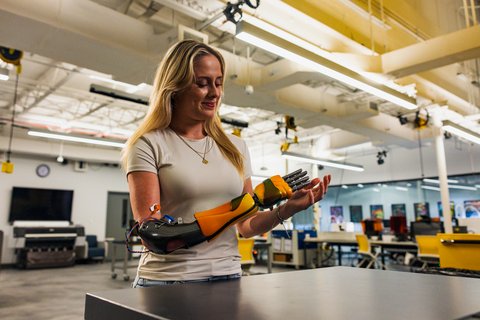
3D printer OEM Stratasys and Limbitless Solutions, nonprofit research facility at the University of Central Florida (UCF), have expanded their 12-year collaboration to provide 3D printed prosthetic devices to children with limb differences, with a renewed focus this year on sustainability, education and wider access.
As part of the expansion, Stratasys donated one of its Certified Pre-Owned (CPO) F370 3D printers to support Limbitless’s ongoing operations, student education and community outreach. Rosa Coblens, VP Sustainability & Communications at Stratasys, said the partnership reflects “the best of what Stratasys has to offer,” adding that reconditioning equipment through the Certified Pre-Owned program helps the company “reduce waste but also enable purpose-driven organizations like Limbitless to extend their reach and empower more lives.”
A decade of prosthetic development
Since 2014, Stratasys has supported Limbitless through donations of materials, additive manufacturing technology and engineering expertise. The relationship traces back to a phone call from Albert Manero, PhD, Executive Director and Co-founder of Limbitless Solutions, then a UCF student, asking for help building a prosthetic arm for a child whose family couldn’t afford one, Stratasys donated two cartridges of materials on the spot. Jesse Roitenberg, an education segment sales leader at Stratasys who has worked with Limbitless since those early days, has recalled the moment simply: “He had me at hello.”
In the years that followed, Limbitless grew from a small university lab into an organization with an internship program, a manufacturing facility running four or more printers, a storefront near the UCF stadium, and a portfolio of prosthetics delivered to children in need.
In May 2018, the organization launched the first 3D printed prosthetics clinical trial for children in the United States, a step toward FDA market clearance, a shift Roitenberg said could reshape the industry, replacing prosthetics costing around $15,000 with $300 devices whose components are swapped for roughly $20 as a child grows, rather than families buying an entirely new device each time.
Using Stratasys systems, Limbitless has produced end-use prosthetic components and 3D printed molds for thermoformed cosmetic elements, while also using rapid prototyping to accelerate development ahead of injection-molded production. Devices are built from ABS material chosen for being safe, strong, lightweight and paintable, allowing each arm to be customized to a child’s own interests, something Roitenberg said gives children “a sense of pride.”
Beyond function, the devices are designed to help children build confidence and self-expression, as seen with recipients like Annika, whose prosthetic limb features color-shifting paint, and Zachary, who received a customized limb through the program.
A hands-on training ground for engineers
The partnership also includes a dedicated Limbitless lab at the UCF, equipped with multiple Stratasys systems, where students gain direct experience applying 3D printing to real-world engineering problems while contributing to the organization’s social mission.
“Stratasys has been with us since day one,” said Manero. “What started as a short phone call while I was in graduate school turned into a decade-long partnership that shows how additive manufacturing can create a tangible impact for the children we serve and the future engineers and designers working to build a more accessible world.”

Lowering the Cost and Wait for Children’s Prosthetics
The Stratasys-Limbitless partnership signals the use of 3D printing to close the gap between what children with limb differences need and what traditional prosthetics can affordably deliver. Conventional limbs are expensive, slow to produce, and quickly outgrown, making low-cost, rapidly manufactured alternatives especially valuable for a population that changes size year to year.
Other organizations have taken a similar path recently. At Yale, a student-led team developed a set of six interchangeable 3D printed prosthetic hands, each purpose-built for a different task, drawing on the same open-source model pioneered by the e-NABLE community, which lets families enter a few measurements and receive a print-ready design at no cost.
At Queen’s University in Canada, engineering students spent three years developing an open-source, electronics-free above-elbow prosthetic with the Burma Children Medical Fund, aimed at migrants along the Thailand-Myanmar border who had no other access to prosthetic care.
Stratasys and Limbitless show what that same strategy looks like at scale, sustained over more than a decade.
3D Printing Industry is inviting speakers for its 2026 Additive Manufacturing Applications (AMA) series, covering Energy, Healthcare, Automotive and Mobility, Aerospace, Space and Defense, and Software. Each online event focuses on real production deployments, qualification, and supply chain integration. Practitioners interested in contributing can complete the call for speakers form here.
To stay up to date with the latest 3D printing news, don’t forget to subscribe to the 3D Printing Industry newsletter or follow us on LinkedIn.
Explore the full Future of 3D Printing and Executive Survey series from 3D Printing Industry, featuring perspectives from CEOs, engineers, and industry leaders on the industrialization of additive manufacturing, 3D printing industry trends 2026, qualification, supply chains, and additive manufacturing industry analysis.
Featured image shows The beneficiary Annika, whose prosthesis has color-changing paint. Photo via Stratasys.
