


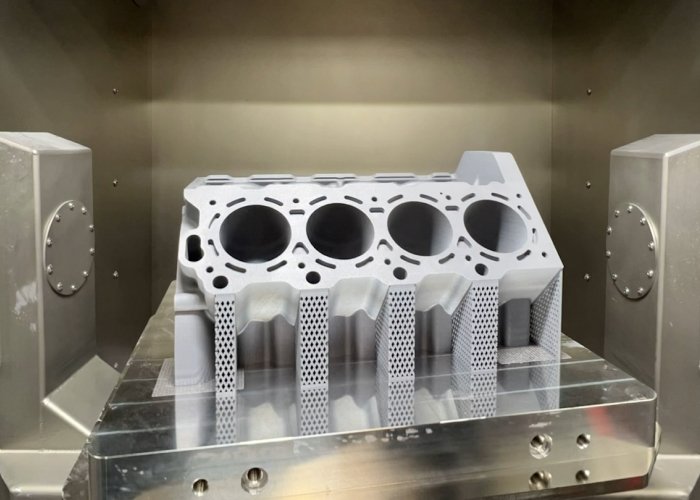
Bosch‘s manufacturing consulting arm Bosch Industry Consulting and German metal 3D printer manufacturer Nikon SLM Solutions have produced a complete V8 engine block as a single 3D printed piece in aluminum, using the NXG XII 600 metal additive manufacturing system at the Bosch Additive Solution Center in Nuremberg, Germany.
The block was built in AlSi10Mg, a standard aluminum alloy for structural automotive parts, and was produced without tooling or casting, a scale and complexity Nikon SLM Solutions describes as pushing additive manufacturing “into the kind of complex, high-value automotive applications where it can genuinely compete with and complement conventional manufacturing methods.”
No tooling, no casting
The build demonstrates what additive manufacturing removes from the automotive production equation. A cast cylinder block normally requires tooling that takes weeks or months to develop and validate before production can begin, and any design change forces a tooling revision, adding further cost and delay. Casting also limits the geometry a part can take.
Producing the block additively eliminates both constraints. Parts are built directly from a digital file, without tooling and without casting lead times, enabling geometries that casting cannot economically achieve, integrated cooling channels, topology-optimized structures, and consolidated multi-component assemblies among them.
Weight savings are among the most immediate benefits of the approach. Using design-for-additive-manufacturing (DfAM) principles, material is placed only where structural analysis shows it is needed, producing components lighter than cast equivalents without sacrificing performance, a benefit the companies frame as a genuine competitive edge in motorsport and high-performance powertrain applications.
The workflow behind the part
Nikon SLM Solutions’ role in the project extended beyond supplying the NXG XII 600 hardware. The company says its contribution spanned materials development and qualification, process parameter optimization, data preparation and quality-assurance software, application engineering, and ongoing process support.
For a component as large and complex as a V8 block, that full-workflow involvement was necessary: process parameters had to be tuned to the specific alloy and geometry, DfAM expertise applied to optimize the design, and quality assurance systems used to verify the build throughout production.
Bosch Industry Consulting contributed decades of automotive manufacturing knowledge to the project. The companies say pairing that applications-specific domain expertise with deep additive manufacturing process knowledge is what made the build possible, and what is required more broadly to turn one-off demonstrator projects into repeatable production.
The V8 block is not the first automotive project built on the NXG XII 600. Fundamental Motorsports used the same system to produce a single-piece IN718 shock housing for off-road racing, consolidating a part that traditionally required multiple components into one design with integrated bypass channels and cooling structures. The redesign cut weight, improved thermal performance, and delivered reliability gains under extreme racing loads, a project Nikon SLM Solutions points to as evidence the platform performs at the far end of durability and heat demands, not just geometric complexity.
Tier 1 Suppliers Are Powering Metal AM’s Automotive Push
Automotive supply chains are heavily tiered, with most of a finished vehicle’s content coming from tier 1 and tier 2 suppliers, not the OEM itself. That means additive manufacturing’s path into mainstream automotive production runs through that supplier network rather than through automaker development centers alone. The V8 block builds on this strategy. Bosch opened its Nuremberg facility around the same NXG XII 600 system, positioning itself as the first Tier-1 automotive supplier in Europe running metal additive manufacturing at this scale.
Other automakers are pursuing the similar supplier-integration logic. Jaguar Land Rover has described how it already sources metal AM parts through a Tier-1 supplier for low-volume components like the Range Rover SV 460’s rear-table, while working toward higher-volume applications.
Separately, Honda folded laser powder bed fusion (LPBF) into its existing workflow, using systems from Nikon SLM Solutions to produce components such as pistons and turbine housings for Oracle Red Bull Racing’s F1 cars. Honda’s role here is as a powertrain partner, not a conventional tier 1 supplier, but it still illustrates the same direction: metal AM’s foothold in automotive is increasingly coming through applied, supplier-level production beyond isolated OEM prototyping.
3D Printing Industry is inviting speakers for its 2026 Additive Manufacturing Applications (AMA) series, covering Energy, Healthcare, Automotive and Mobility, Aerospace, Space and Defense, and Software. Each online event focuses on real production deployments, qualification, and supply chain integration. Practitioners interested in contributing can complete the call for speakers form here.
To stay up to date with the latest 3D printing news, don’t forget to subscribe to the 3D Printing Industry newsletter or follow us on LinkedIn.
Explore the full Future of 3D Printing and Executive Survey series from 3D Printing Industry, featuring perspectives from CEOs, engineers, and industry leaders on the industrialization of additive manufacturing, 3D printing industry trends 2026, qualification, supply chains, and additive manufacturing industry analysis.
Featured image shows V8 engine block. Photo via Nikon SLM Solutions.
