


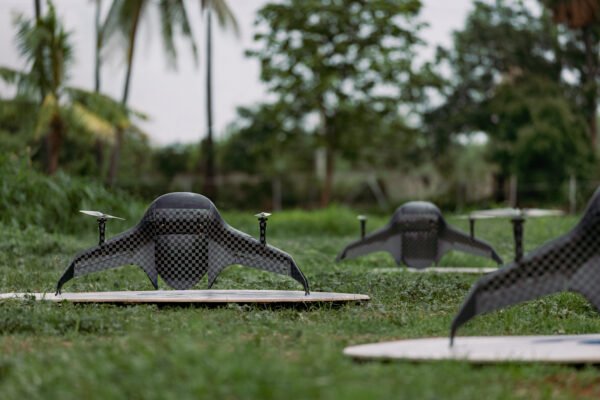
The Bengaluru aerospace startup, led by Greenoaks with DoorDash participation, targets a payload-to-aircraft ratio three times better than industry norms.
Bengaluru-based Airbound closed a $37 million Series A round on August 25, 2026. The aerospace company also signed a commercial drone delivery agreement with the Indian state of Andhra Pradesh. Greenoaks led the round with participation from DoorDash, Lachy Groom, Lightspeed and Humba Ventures. Airbound has raised nearly $50 million since launching in March 2023.
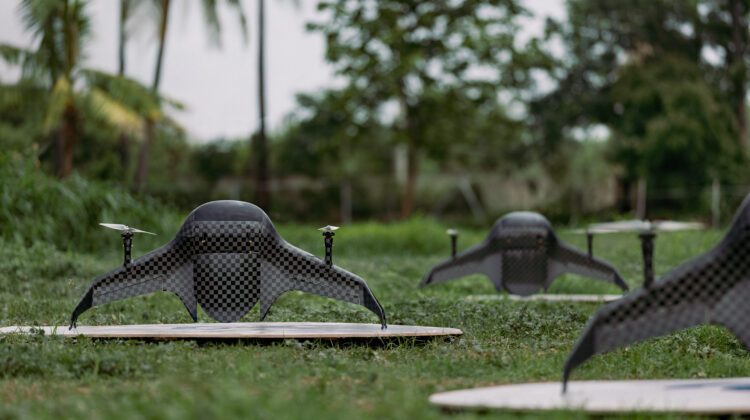
Airbound designs and manufactures a blended-wing-body tailsitter. The aircraft takes off vertically and cruises on fixed wings. The current V1 weighs 1.5 kilograms (3.3 pounds) and carries 1 kilogram (2.2 pounds) of payload. That payload-to-aircraft ratio runs three times better than the industry norm of 4:1. The airframe spans 1.4 meters (4.6 feet) and weighs about 130 grams (4.6 ounces) before motors and electronics. Airbound built its RUDRA fleet ground control system in-house. A single operator manages 100 or more aircraft with real-time deconfliction.
“The bar for delivery in India is high. The benchmark is 10 minutes to your doorstep, at an extremely low cost. That’s the complexity here,” said Naman Pushp, founder and CEO of Airbound. “If you can build something that works in India, it tends to work anywhere.”
Narayana Health drone delivery corridor
Airbound has flown more than 13,000 autonomous missions with zero failures. The flights support Narayana Health, India’s fourth largest hospital network. The first commercial corridor spans 4 kilometers (2.5 miles) in Bengaluru. The route links the network’s Chandapura Clinic and Narayana Health City in Electronic City. The corridor has operated since January 2026. Each aircraft carries up to 40 diagnostic samples per flight over 10 round trips daily. Narayana Health canceled ground transfers on the route within one week of launch. A second corridor between Electronic City and Banashankari is under development.
Andhra Pradesh drone delivery network
The Andhra Pradesh agreement calls for an aerial network across three districts that scales to 10,000 flights per day. The network will serve retail, e-commerce and healthcare deliveries. Airbound has scaled production from two aircraft per month to two per day in under a year. The company targets 20 per day.
“Moving goods has always forced a choice between fast and cheap. Trucks are cheap and slow, planes are fast and expensive, and nothing has broken the trade-off in more than a century. Airbound does,” said Neil Shah, partner at Greenoaks.
More information is available at Airbound.
Read more:

Ian McNabb is a journalist focusing on drone technology and lifestyle content at Dronelife. He is based between Boston and NH and, when not writing, enjoys hiking and Boston area sports.
