


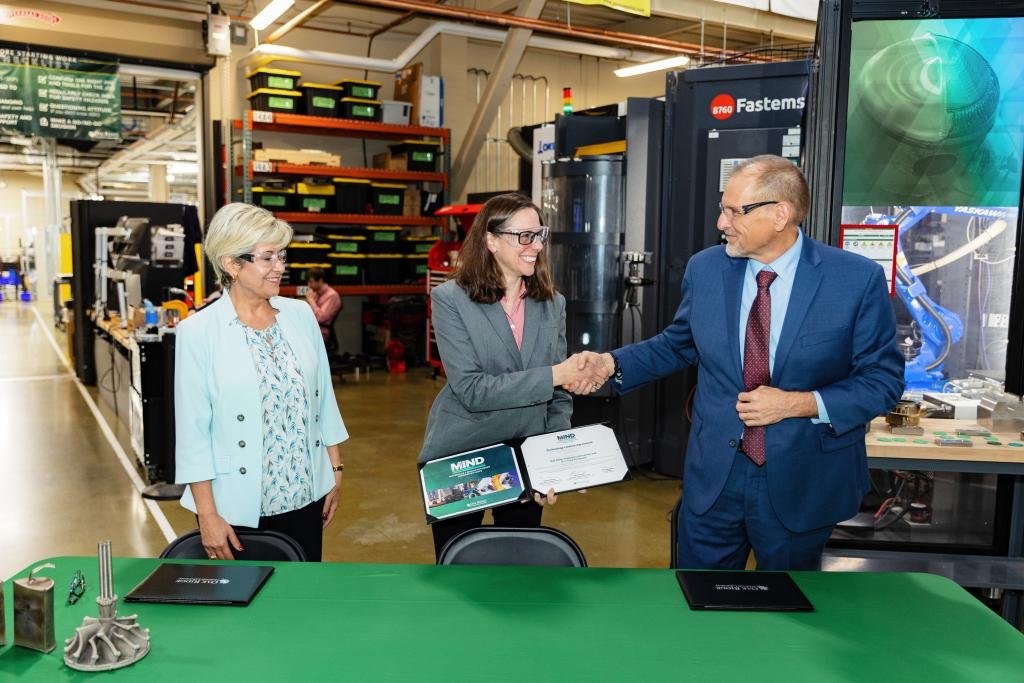
Oak Ridge National Laboratory and A.J. Tuck Company have developed a hybrid manufacturing process, combining 3D printing, electroforming and hot isostatic pressing, that produces leak-free containers used to build critical components for advanced nuclear reactors, cutting a step out of a supply chain that has long depended on forging capacity concentrated outside the United States.
The partnership, formalized through a cooperative research and development agreement and a subsequent licensing agreement, was marked at Materials and Manufacturing Innovation Days, held August 19–20 at ORNL’s Manufacturing Demonstration Facility (MDF).
A Faster Way to Build the Container, Not Just the Part
The technology addresses a specific manufacturing step: producing HIP cans, the sealed containers that hold metal powder during hot isostatic pressing (PM-HIP), a process that fuses powder into a fully solid component under heat and pressure. Conventionally, building these cans requires multiple fabrication and assembly steps. ORNL and A.J. Tuck’s approach compresses that into a single streamlined workflow.
The process starts with a 3D printed polymer mandrel, shaped to match the final component’s geometry. That form is submerged in an electrolyte bath, where electroforming, a technique A.J. Tuck brought to the partnership, builds up a nickel shell roughly 2 to 3 millimeters thick around it. The polymer core is then dissolved with acid, leaving a hollow metal shell that gets filled with metal powder, sealed, and processed through HIP to form a dense, solid part.
Because the mandrel is printed in plastic rather than metal, the team avoids the heat-related strain and distortion that come with printing directly in metal at extreme temperatures, while also cutting material costs, easing design changes, and reducing post-processing work. The design also integrates ports directly into the can, eliminating a separate step of welding process tubes onto it, which the researchers identified as a common point of failure in traditional HIP can assembly.
“This project shows that electroforming can successfully produce leak-free HIP cans for advanced nuclear energy applications,” said Vanshika Singh, ORNL research associate staff scientist. “This approach could make it easier to produce these components in the U.S., reducing supply chain challenges for advanced nuclear energy systems.”
ORNL mechanical engineer Amiee Jackson said the method’s scalability comes from how it’s built, not how big the part is: “Because the process depends mostly on how thick the metal layer needs to be, not how large the part is, we can scale production efficiently and even batch multiple components in a single process.”
Results So Far, and What’s Next
In the project’s first phase, the team produced five leak-free cylindrical HIP cans, each 6 inches tall and 4 inches in diameter. Using one of those cans, ORNL fabricated a 15.7-pound solid nickel component. A second phase, now underway, will apply the process to a more complex shape, either an impeller, used to move fluid in pumps and turbines, or a valve relevant to nuclear energy systems.
The labs see broader applications beyond HIP cans themselves: the same combination of printing and electroforming could produce large, high-precision metal parts such as reactor pressure vessels, valves and turbine components, categories where U.S. forging capacity has become a limiting factor as demand for advanced and small modular reactors grows.
A.J. Tuck Company president Dara Williams framed the collaboration as an entry point into a new market for the firm’s core expertise. “Working alongside ORNL allowed us to bring our deep electroforming expertise into an entirely new domain,” Williams said. “Demonstrating that this process can produce leak-free HIP cans at this level of precision opens real doors for domestic nuclear manufacturing — and we’re just getting started.”
Beyond Singh and Jackson, the ORNL team includes Srikanth Allu, Rangasayee Kannan, Peeyush Nandwana, Amirkoushyar Ziabari, Parans Paranthaman and Brian Post, alongside Tracy Yoho, Brandon Yoho and Jared Williams from A.J. Tuck Company.
An invention disclosure and provisional patent covering the process have been filed. The ORNL portion of the work was carried out at the MDF, supported by DOE‘s Advanced Materials and Manufacturing Technologies Office; ORNL is managed by UT-Battelle for DOE’s Office of Science.

A Domestic Answer to a Forging Capacity Gap
The ORNL–A.J. Tuck partnership targets the physical chokepoint upstream of it: the U.S.’s shrinking domestic forging and casting capacity for large, dense metal components. By printing the mandrel rather than the final part, the two organizations sidestep the tooling, lead times, and specialized facilities that forging and casting demand, giving nuclear and defense programs a domestically controlled path to components that would otherwise sit in a foundry backlog.
The pressure is concrete. The Navy’s Nuclear Propulsion Program was built specifically because conventional casting and forging can no longer meet demand, and the Army’s only operational foundry, at Rock Island, has seen its workload quadruple in the past 18 months as domestic casting and forging capacity keeps shrinking.
The Navy is chasing the same fix elsewhere in its nuclear fleet. The Navy issued a letter of intent to WAAM specialist AML3D for up to 100 additive manufacturing systems and 1,600 components by 2030, aimed squarely at cutting dependence on cast and forged parts across nuclear-powered shipbuilding.
Printing the mandrel is a small step. Closing the forging gap is the goal.
3D Printing Industry is inviting speakers for its 2026 Additive Manufacturing Applications (AMA) series, covering Energy, Healthcare, Automotive and Mobility, Aerospace, Space and Defense, and Software. Each online event focuses on real production deployments, qualification, and supply chain integration. Practitioners interested in contributing can complete the call for speakers form here.
To stay up to date with the latest 3D printing news, don’t forget to subscribe to the 3D Printing Industry newsletter or follow us on LinkedIn.
Explore the full Future of 3D Printing and Executive Survey series from 3D Printing Industry, featuring perspectives from CEOs, engineers, and industry leaders on the industrialization of additive manufacturing, 3D printing industry trends 2026, qualification, supply chains, and additive manufacturing industry analysis.
Featured image shows From left, ORNL’s Gina Tourassi, A.J. Tuck Company President Dara Williams and ORNL’s Robert Wagner mark a license agreement on day two of Materials and Manufacturing Innovation Days at the MDF. Photo via Shawn Poynter/ORNL, U.S. Dept. of Energy
