


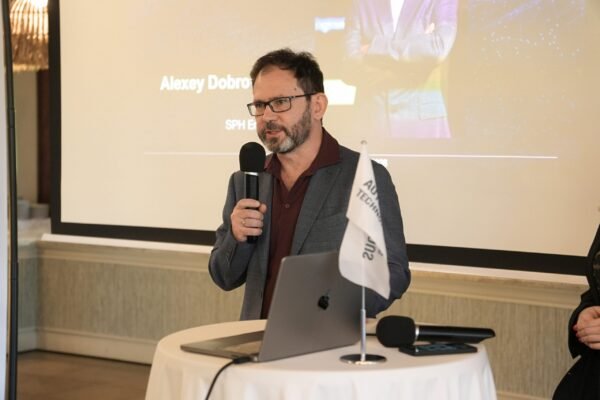
The inaugural awards recognized drone-borne GPR at a Chilean mine, gamma-ray peat mapping in Ireland and contact-free orca health research, plus a special recognition for remote drone education.
SPH Engineering announced the winners of its inaugural Global Drone Operations Awards on October 12, 2026 during SPH Drone Camp in Budapest, Hungary. Following review by an expert jury, the Latvian drone survey and mapping company presented awards in three categories: Mining Operations; Construction and Site Intelligence; and Academia and Research. A fourth project received Jury Special Recognition.
SPH Engineering created the awards to move advanced drone work beyond individual project reports and into wider professional discussion. Submissions covered industrial infrastructure, glacier investigations, wildlife research and education, and each project applied drones to problems that conventional mapping alone cannot solve.

Global Drone Operations Awards category winners
In Mining Operations, AB Surveying Solutions SpA won for underground utility mapping at an operating mine in Chile. The work supported the relocation of a primary crusher. By comparing ground-based and drone-mounted ground-penetrating radar, the team produced a cross-validated utility map for excavation planning. It also reported shorter survey times and less personnel exposure in operational areas, all without disrupting plant operations.
Medusa Geoservices took the Construction and Site Intelligence award for testing drone-borne gamma-ray spectrometry to estimate peat thickness at an onshore wind development in Ireland. Over two days, the team surveyed 118 hectares (about 292 acres) and compared results against 110 existing cores. The aerial map matched peat-thickness patterns and added detail between sampling locations. However, ground validation remained essential, and moisture effects were among the uncertainties the team identified.
San Diego Zoo Wildlife Alliance won in Academia and Research. Working from research vessels, the team combined thermal imaging with drone-mounted breath sampling to study wild killer whales without physical contact. It reported sub-degree precision in repeated thermal measurements and gathered microbiological and molecular data from breath samples. Researchers then built those findings into individual health profiles, creating a baseline for monitoring the endangered population over time.
Jury Special Recognition for drone education
Separately, the jury recognized Embry-Riddle Aeronautical University Worldwide and Online Campus for its Remote Split Operations model. Using UgCS mission planning software, students in different locations research unfamiliar sites, plan faculty-supervised missions and analyze the resulting data. As a result, students gain experience across the full operational workflow without each participant needing to own aircraft and sensors.
The jury included Cian B. Dawson, hydrogeophysicist and editor-in-chief of EEGS FastTIMES; Jan Francke, GPR specialist and Geolitix co-founder; Becky Bodger, geoscientist and technical solutions manager at CE&E; Matt Collins of Commercial UAV News and Commercial UAV Expo; and Alexey Dobrovolskiy, chief executive of SPH Engineering.
“We congratulate the winners and thank every team that shared its work. The most useful projects give others something to build on. We want to help that knowledge travel further, so that more engineers and researchers can test new ideas and put them to work,” said Dobrovolskiy.
Winning teams received their awards at SPH Drone Camp on October 12-13, with participation sponsored by SPH Engineering.
More information is available at SPH Engineering.
