


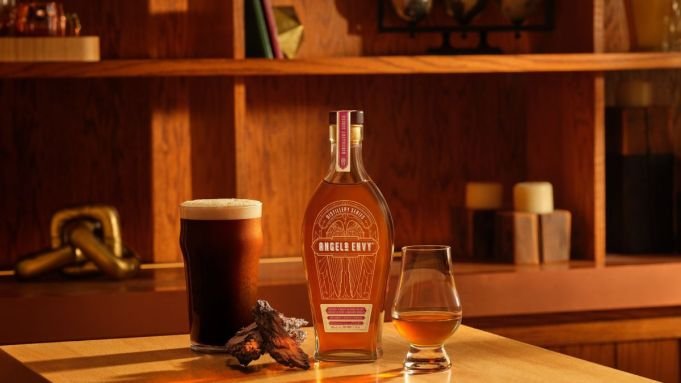
Welcome to Taste Test, where every week our critic Jonah Flicker explores the most buzzworthy and interesting whiskeys in the world. Check back each Sunday for his latest whiskey review.
If something’s better than you expected it to be, does that make it good? I am sometimes confronted with that question when reviewing a whiskey, especially one that I anticipate will taste a certain way based on factors like the types of barrels used for maturation. So when I got a sample of the new Angel’s Envy Distillery Series release and found out it was partially aged in amburana barrels, red flags immediately went up. As it turns out, this is not the potpourri bomb I would expect from a whiskey aged in this type of wood, but it’s a perplexing sipper nonetheless.
Amburana is a type of wood from Brazil that is often used to age cachaça, the rum-adjacent spirit that is very popular in its home country. It has also been used to age American whiskey over the past few years, and while of course taste is entirely subjective, I’m far from the only one who doesn’t like what it does to the liquid—generally giving it intense cinnamon notes that remind me of potpourri, as I mentioned before. WhistlePig used amburana for one its Boss Hog releases, and other brands and distilleries have tried it out as well, including Penelope Bourbon, Barrell Craft Spirits, Starlight, Rare Character, and Hard Truth (that last was kind of successful, but still not great).
And now Angel’s Envy has entered the conversation. After aging for six to seven years, master distiller Owen Martin finished the distillery’s bourbon in two types of barrels: stout beer and amburana. The stout barrels came from Trellis Brewing in Louisville and Goose Island in Chicago, the latter of which were used to mature Angel’s Envy x Goose Island Bourbon County Stout that came out in 2023. According to a rep for the brand, Martin used a 40/60 split between first-fill and second-fill stout barrels, and the whiskey spent between six and 24 months in those casks for the secondary maturation.
Then there are the amburana barrels. The whiskey spent just a month in these casks, and it comprises only 1 percent of the final blend. Okay, so that’s just a drop of amburana-finished whiskey in the mix, but a little bit goes a long way when it comes to this type of wood. If you’re familiar with regular Angel’s Envy bourbon, which is finished in port barrels, this ain’t it—and it’s not meant to be, of course. What we have here is a 100-proof whiskey that is, for better or worse, very unique. Earthy, musty aromas greet you on the nose when you first raise your glass, followed by more earthy cinnamon notes as well as Hershey’s chocolate (specifically Hershey’s for some reason), root beer, R.C. Cola (specifically R.C. for some other reason), bitter licorice, Mexican mole, and cherry syrup on the palate.
I’m all for experimentation, and sometimes the results can be thrilling in unexpected ways. Well, this whiskey is unexpected because it doesn’t provide the smack-you-in-the-tongue quality of most amburana finishes, but I wouldn’t call it thrilling. I revisited the whiskey several times to see if my opinion might change as I got more familiar with it, but my feeling remained the same—this just isn’t a whiskey I really want to drink. Kudos to Martin for not playing it safe and taking a chance here, and there are certainly going to be many whiskey drinkers who enjoy what this release has to offer. I’m just not one of them.
Score: 82
- 100 Worth trading your first born for
- 95 – 99 In the Pantheon: A trophy for the cabinet
- 90 – 94 Great: An excited nod from friends when you pour them a dram
- 85 – 89 Very Good: Delicious enough to buy, but not quite special enough to chase on the secondary market
- 80 – 84 Good: More of your everyday drinker, solid and reliable
- Below 80 It’s Alright: Honestly, we probably won’t waste your time and ours with this
Authors

Jonah Flicker

