


This story is from an installment of In the Loupe, our weekly insider newsletter about the best of the watch world. Sign up here.
“We’ve been diving into the data more the last few months—we’ve got a new chief marketing officer on now and he’s a big data guy,” Altieri tells Robb Report. “The numbers don’t lie: Ref. 6917 is up huge, same with the 179174—these are all ladies’ watches. We’ve heard for years that smaller watches are in vogue, and the numbers bear it out.”
Altieri says the climbing secondary-market prices are a sign of how hot these watches have become. “The more you’re selling, the more the price goes up because we have to pay more to get more,” he says, adding that Bob’s has a single Rolex Ref. 6827 for sale at the moment (for $6,500). “In normal times we’d have six or seven. This watch maybe doubled in the last three years.”
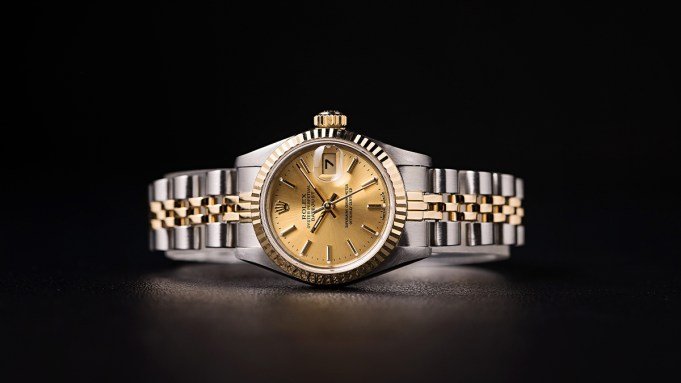
Eugene Tutunikov, CEO of SwissWatchExpo, a pre-owned dealer in Atlanta, is seeing a similar phenomenon. “The growth velocity in classic mid-size and ladies’ references is genuinely outpacing the traditional Professional models this year,” he says. “While heavyweights like the Daytona, GMT-Master II, and Submariner remain high-volume cornerstones with steady liquidity, their market prices have stabilized after years of aggressive runs. The real excitement and transaction acceleration right now are happening in the classic lines—particularly the Datejust in 31 mm and 36 mm.”
Tutunikov attributes the trend to two somewhat related factors: the rise of the self-purchasing female collector and a shift to unisex sizes such as 31 mm and 36 mm. “We are seeing a substantial rise in women buying luxury timepieces for themselves, choosing classic configurations with fluted bezels, Jubilee bracelets, and diamond markers that function seamlessly as daily signature pieces,” Tutunikov says. “Women are increasingly stepping away from ultra-petite 26 mm/28 mm sizes and embracing 31 mm and 36 mm cases. Because the 36 mm Datejust is also a staple for men, it has become the ultimate unisex sweet spot, creating compounding demand from both sides of the market.”
Rolex Datejust
The evolution of demand—from the steel sport models that peaked during the hype years of the early pandemic to smaller, more feminine references—reflects the changing nature of watch collecting in the 2020s.
“It used to be very much a boys’ club,” Linden Lazarus, founder and CEO of Collectible, which owns the digital repair platform WatchCheck, says. “A decade ago, most women would have been looking at watches as additions to a larger jewelry portfolio. Now, many more women are interested in a watch for its value as a watch. It used to be, if you had a very special women’s watch, it was very difficult to find someone to appreciate it. Now we’ve seen an evolving trend of women interested in the space just as much as watch-collecting men. It’s led to higher transaction volume, higher interest, and higher collectability, much like we saw for Professional models five and six years ago.”
At European Watch Company, where Rolex represents about a quarter of sales, CEO Joshua Ganjei says sales of Rolex ladies’ styles have indeed been robust, emphasizing the rising interest in 31 mm and 36 mm models (mostly the latter). “I have noticed more women buying,” he says. “Demand for the brand in general appears to still be growing. And people are not hesitating to buy older 90s models: Datejusts, Daytonas. Years ago, they would have hesitated to buy older references, but not anymore.”
Ganjei has also noticed strength at the top of the market and a corresponding growth in sales of models priced in the seven figures. “It seems like million-dollar valuations are a daily occurrence whereas it used to be a once-a-year thing,” he says. “The industry’s attracted a lot more high-net-worth either art people or just wealthy people. For special pieces, we have a lot more room to grow. It’s exciting but it makes me wonder what I should be keeping and what I should be selling.”
Altieri at Bob’s Watches has a clear dollar amount in mind. “Watches selling for over $30,000 seem to be more robust than they were years ago,” he says. “It’s indicative of a fairly strong economy—the equities and stock market doing well, gold prices are up, Bitcoin is up in the last few weeks. At least the top 5% are doing well and spending money. Just this morning, we had probably four or five watches sell for over $30,000.”
Bob’s morning sales, he says, included a rose-gold Yachtmaster that sold for $31,000 “to a guy down in Alabama” and an Everose gold Daytona Ref. 126515 on a rubber strap that sold to a woman in New Jersey for $51,000.

Bob’s Watches
The strength in high-end watch sales isn’t just a Rolex story. Lazarus says he’s lately noticed a stark increase in interest and value in what he calls “the iconic watches.”
“There was a dip after the 2021-22 peak, but now those hyper iconic desirable watches—Aquanauts, Nautiluses, Royal Oaks, a little less so Rolex—are getting pretty close to how expensive they were, especially on the neo-vintage front. Vintage Aquanauts have gone up maybe double in the last year. A 5065 early 2000s Aquanaut—we would have bought it in the low 30s a year ago. You can’t buy it now for $60,000.”
Lazarus also singles out vintage and neo-vintage Breguet (particularly the Daniel Roth era), noting those models have doubled or tripled in the last year. “The 3050 perpetual calendar by Daniel Roth from the late ’80s, ’90s was easily purchasable for $30,000. Now you’d have a hard time paying $80,000-90,000. There’s low supply. And they’re incredible watches. And the collectors who know have realized they’re very inexpensive.
“I bought a watch, a Breguet triple calendar for $11,000 and sent it to Breguet for service,” Lazarus adds. “It was there for a long time and by the time we got the watch back, it was worth more than double. And we sold it for a very nice margin, totally by accident.”
Authors

Victoria Gomelsky

