


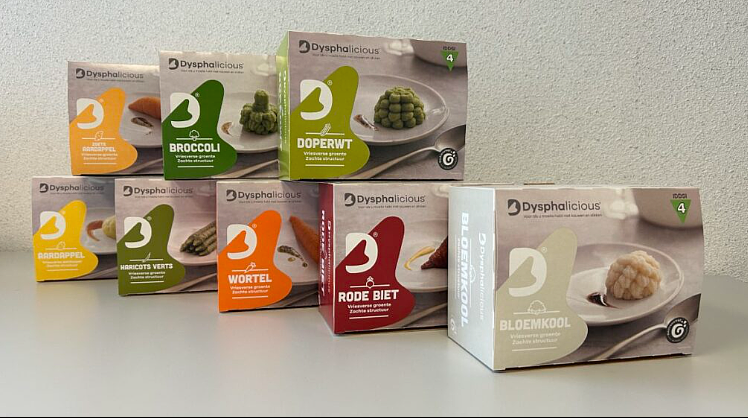
Dutch food 3D printing company Gastronology has partnered with Belgian distributor Revogan to bring its products into Belgian care homes and hospitals, with orders opening in August 2026.
Revogan brings more than distribution capacity to the partnership. The company has spent years building relationships with Belgian dietitians, speech therapists, and care institutions, giving Gastronology a faster path into the Belgian healthcare market. This kind of embedded access matters in healthcare procurement, where products rarely sell themselves on technical merit alone.
“We deliberately choose partners who, like us, work on the basis of scientific substantiation and professionalism,” says a spokesperson for Revogan. “Gastronology’s Dysphalicious products align seamlessly with our goal of providing healthcare professionals and their patients with nutritional solutions they can rely on.”
Scaling Consistency Into Care Settings
Gastronology’s pitch to care facilities rests heavily on the consistency that industrial manufacturing makes possible. The company has been producing Dysphalicious meals at scale since April 2024, working with contract manufacturer Budelfood B.V. in Poortvliet, Netherlands.
Products meet International Dysphagia Diet Standardisation Initiative (IDDSI) level 4, the international standard for pureed foods that require no chewing, and were developed with input from dietitians, speech therapists, and an SVH-certified master chef. For care staff, that means a ready-to-use product without the variability that comes with preparing texture-modified meals on-site.
Inconsistent results in texture-modified food preparation have been a persistent problem in institutional dysphagia care, where meals are typically produced by blending or pureeing standard dishes in facility kitchens with uneven outcomes in appearance, taste, and safety.
3D printing allows manufacturers to reconstruct food in forms that visually resemble the original dish while meeting precise texture requirements, which is the core proposition Gastronology is bringing to the Belgian market. The current range covers eight plant-based items, including cauliflower, carrot, sweet potato, and beetroot, with meat-based options in development. Each portion weighs 50 grams and is delivered frozen.
Beyond institutional supply, Gastronology has already extended its reach into home care in the Netherlands through online delivery platform QSTA, where portions are sold in boxes of 20 or 22. The Belgium deal follows a similar pattern of expanding access through existing distribution networks.
For Gastronology, signing a distribution partner in Belgium is a way to enter a new national market without building local sales infrastructure from scratch. The company has said it intends to grow daily production capacity from 700 kgs to 2,500 kgs over the coming years, suggesting the Belgium partnership is one piece of a wider scaling effort.
Whether Revogan’s network proves sufficient to move meaningful volume in a healthcare procurement environment defined by long approval cycles is the question the next few years will answer.
Institutional Adoption Remains a Key Constraint
How difficult consistent IDDSI compliance is to achieve is apparent from where much of the field still sits. In August 2025, researchers from Kyushu University and Cardiff University published findings on a frequency-based heating method for 3D printed food gels, showing that radiofrequency and microwave exposure at different frequencies could produce textures mapping to different dysphagia diet stages.
The research was conducted using a bioprinter assembled from LEGO Mindstorms components, suggesting the work remains some distance from commercial production. The contrast points to one of the harder parts of Gastronology’s value proposition, which is printing food that meets a texture standard not just in a lab but reliably at volume.
On the institutional side, adoption is also still at an early stage in many markets. A collaborative study announced in March 2026 involving Spellman Care, the University of Leeds, and PRINTFOODS UK is investigating whether 3D printed food technology could work for elderly residents on texture-modified diets in active care home settings, with the initial phase consisting of structured interviews with head chefs and nursing staff.
The fact that care institutions in the UK are still in the interview-and-evaluation phase while Gastronology is already seeking a second distribution market in Belgium does not mean demand is assured, but it does suggest the company is moving faster commercially than much of the surrounding ecosystem.
3D Printing Industry is inviting speakers for its 2026 Additive Manufacturing Applications (AMA) series, covering Energy, Healthcare, Automotive and Mobility, Aerospace, Space and Defense, and Software. Each online event focuses on real production deployments, qualification, and supply chain integration. Practitioners interested in contributing can complete the call for speakers form here.
To stay up to date with the latest 3D printing news, don’t forget to subscribe to the 3D Printing Industry newsletter or follow us on LinkedIn.
Explore the full Future of 3D Printing and Executive Survey series from 3D Printing Industry, featuring perspectives from CEOs, engineers, and industry leaders on the industrialization of additive manufacturing, 3D printing industry trends 2026, qualification, supply chains, and additive manufacturing industry analysis.
Featured image shows a range of Dysphalicious meals. Photo via Gastronology.
