


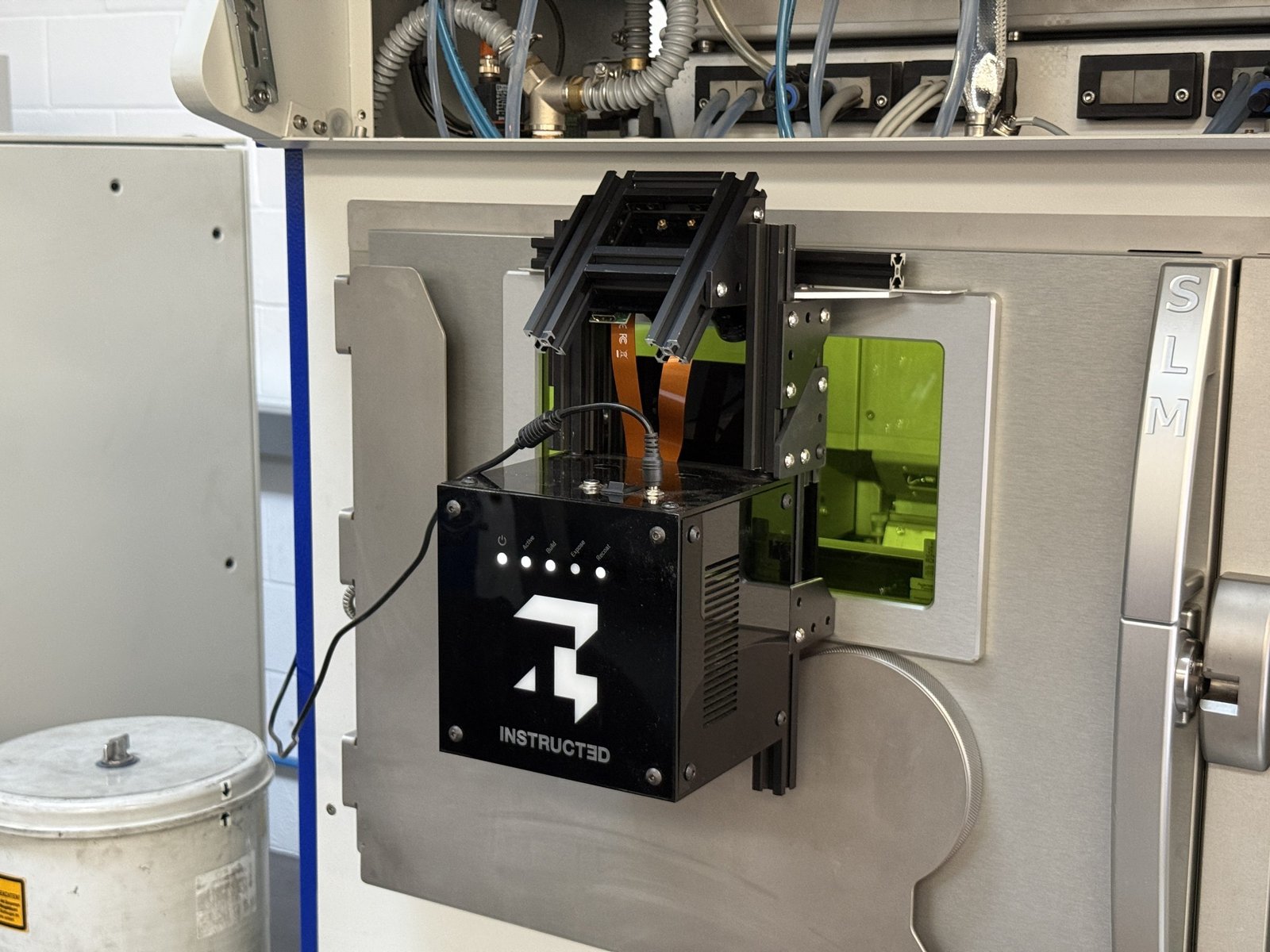
Sheffield-based Instruct3D has commercially launched Additive Build Intelligence, a combined software and sensor system for metal additive manufacturing (AM). The system is designed to help users predict where build issues may occur, review what happened during each print, and produce evidence that supports part verification. It draws on more than two decades of AM research at the University of Sheffield, pairing physics-based process optimization with low-cost sensor hardware and data analysis tools.
The launch targets a persistent gap in metal AM: manufacturers can print complex parts, but proving that those parts can be repeated and scaled consistently remains a barrier to production.
Instruct3D will formally define its Additive Build Intelligence category at ICAM 2026 in Orlando, Florida, which runs from September 28 to October 2. Co-Founder and CEO Ben Thomas is scheduled to speak from 10:30 to 10:50 in the In-Situ Monitoring and Process Control track, in Regency Ballroom P. His talk is titled “Cost-Effective, Multi-Modal Sensors for Cross-Platform AM Part Verification.”
Hardware and Software Components
The system has two parts. VertX is camera-based hardware that captures process data while a part is being printed. AdditiveOS, Instruct3D’s software platform, analyzes that data and turns it into information operators can act on. Although the setup relies on image capture, Instruct3D does not position itself as an in-situ monitoring company.
Instruct3D frames the workflow around four steps it calls Predict, Build, Prove, and Learn. The system helps users predict where build issues may occur, understand what happened during the process, generate evidence to support build verification, and feed the results of each build into the next.
“Cameras are part of the system, but they are not the story. The story is what we do with the data. By linking measured build behaviour with physics-based prediction and learning workflows, we can help users understand the material reality of the build, not just observe the process,” said Rob Snell, Co-Founder of Instruct3D.
Reducing Trial and Error in Metal AM
The launch comes as AM users in aerospace, defense, energy, and advanced manufacturing look for ways to reduce failed builds, shorten parameter development, gain a clearer understanding of the process, and produce quality evidence they can put to use.
“Metal AM does not need more disconnected data,” said Thomas. “It needs intelligence that helps manufacturers make better decisions before, during, and after the build. Additive Build Intelligence is about giving teams the confidence to build high-value parts more predictably, reduce trial-and-error, and move faster from development into production.”
According to Instruct3D, the system is already deployed on multiple machines worldwide, and its users have expanded from academic settings into contract manufacturing and prime contractor-led applications. The company says the technology was developed with commercial deployment in mind, using a scalable software model supported by hardware, low-cost sensors, and practical installation options.
“Our ambition is simple, to unlock for the first time the true potential of metal AM by making every build more predictable, more provable, and more valuable,” Thomas said.
Turning Build Data into Proof of Part Quality
Instruct3D is targeting the step between printing a metal part and being able to verify it. Its approach ties in-process camera data to physics-based predictions, so manufacturers get guidance before, during, and after the build, along with evidence to support verification, and each build informs the next.
In June, Swedish software company Interspectral AB and Austrian component maker Pankl Racing Systems AG expanded their collaboration around AM Explorer, Interspectral’s data fusion and analysis platform for metal AM. Pankl plans to roll the platform out more widely across its AM operations to support anomaly detection, qualification workflows, data integration, and real-time monitoring. The partners expect faster qualification, better repeatability, and stronger traceability from the work. Like Instruct3D, the effort treats production data as the route to proving parts are sound at scale. However, AM Explorer is a software platform being refined inside a production partner’s operations, with no stated physics-based prediction before a build or dedicated sensor hardware, both of which are part of Instruct3D’s system.
Instruct3D’s launch adds a prediction-led option to the tools aimed at documenting metal AM part quality for production.
Register now for AMA: Software 2026. Join 3D Printing Industry on 22 October for expert presentations, panel discussions and live audience Q&A exploring the software shaping additive manufacturing. Register here.
To stay up to date with the latest 3D printing news, don’t forget to subscribe to the 3D Printing Industry newsletter or follow us on LinkedIn.
Explore the full Future of 3D Printing and Executive Survey series from 3D Printing Industry, featuring perspectives from CEOs, engineers, and industry leaders on the industrialization of additive manufacturing, 3D printing industry trends 2026, qualification, supply chains, and additive manufacturing industry analysis.
Featured image shows Additive Build Intelligence Solution. Photo via Instruct3D.
