


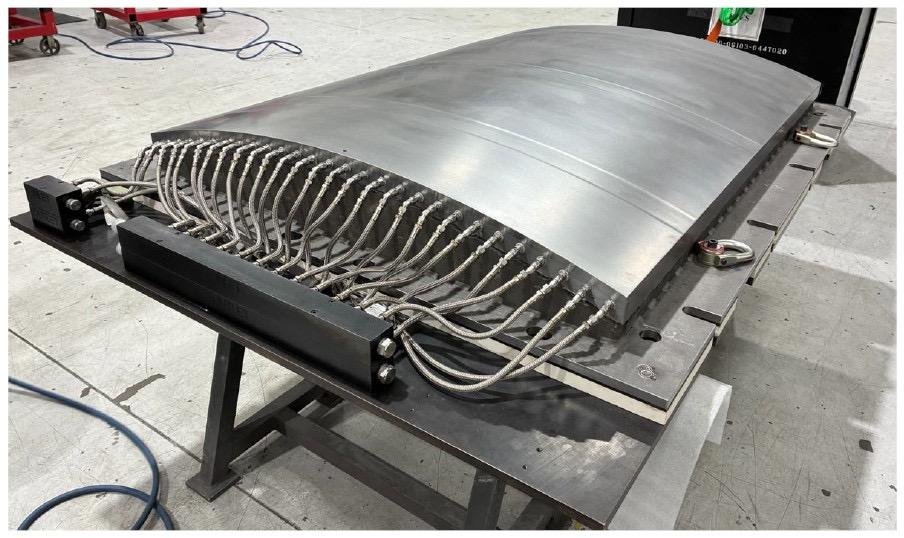
Oak Ridge National Laboratory (ORNL) and Boeing have produced a steel Stamp Form Die (SFD) mold using wire-arc additive manufacturing (WAAM). The tool stands 6 feet tall, measures 4 feet wide, weighs close to 2 tons, and took eight weeks to print. Boeing will use it in its work for NASA‘s Hi-Rate Composite Aircraft Manufacturing (HiCAM) project. The build also examines whether metal additive manufacturing (metal AM) can produce the large forming tools used in thermoplastic composite part production.
An SFD is a punch press that cuts or forms material. Molds of this kind are typically made through machining, casting, forging, and drilling. The project assessed whether printing a thermally controlled SFD mold at the Department of Energy‘s Manufacturing Demonstration Facility (MDF) at ORNL could lower cost, shorten lead time, and simplify fabrication. Boeing brought in a network of small and large US businesses to carry out the work.
“Boeing wanted to explore the possibility of using [WAAM],” said William Carter, ORNL robotics engineer at the MDF. “They worked with us to evaluate the issues in making the mold.”
“NASA and its industry partners are working to increase the production rate of composite aircraft to meet the growing demand for air travel and to reduce aircraft weight, which improves fuel efficiency, lowering costs for aircraft operators,” said Richard Young, NASA HiCAM project manager. “Doing so is essential to maintaining U.S. competitive advantage in the commercial aircraft industry.”
Printing a Two-Metal Tool on Arc-1
Thermoplastic aircraft doors are formed by pressing a heated sheet of plastic between two SFD metal molds.
ORNL supplied expertise in WAAM processing and residual stress simulation. It printed the part on its Arc-1 system, which uses a robotic arm and welding torch to melt wire and deposit metal in layers. According to ORNL, Arc-1 differs from most WAAM systems in that it can feed several wires simultaneously and print with more than one metal.
“Multi-material WAAM allows for the realization of completely new designs, combining fine-tuned mechanical performance with time and cost savings,” said Andrzej Nycz, ORNL senior robotics engineer.
The mold combines two alloys. Mild steel makes up the structural regions to provide strength and stiffness. Stainless steel forms the working surface for corrosion resistance, dimensional stability, and a durable working interface.
Conventional molds of this type carry heating and cooling fluids through long, straight drilled holes. Printing allowed the team to build curved internal channels that follow the contour of the mold, so the tool heats and cools more efficiently and performs better in use.
Controlling Distortion and Finishing the Mold
Warping was the main obstacle during printing. As deposited metal cooled, residual stresses twisted the structure and pulled it out of dimension. To counter this, the team attached temporary ribs to the back of the mold and used simulation to adjust the design so the print would compensate for the distortion. After 32 simulation iterations, the finished print landed within a few millimeters of its target shape.
The mold then went to Baker Industries, a Lincoln Electric subsidiary in Michigan, where it was annealed to relieve internal stress. The support ribs were removed, and Baker Industries carried out the remaining fabrication steps needed to meet Boeing’s requirements. ORNL and Lincoln Electric developed the WAAM technology behind the tool under a Cooperative Research and Development Agreement.
Applications Beyond Aircraft Tooling
Not every component of the final tool was printed, but ORNL says the methods developed during the project can be applied to similar tool types. The laboratory presents the result as evidence that large, complex tools can be printed faster and more efficiently than with conventional methods. The announcement does not include lead time or cost figures comparing the printed mold with a machined or cast equivalent.
“We used this as a test case,” said Ahmed Arabi Hassen, ORNL’s group leader for Composites Innovation. “Its success means the technology could be used to make large thermoplastic structures for other sectors of U.S. industry, such as energy and automotive.”
Wire-Arc Printing Moves Into Aerospace Composite Tooling
The ORNL and Boeing mold applies WAAM to a production tool for composite aircraft parts. It combines two alloys and built-in heating and cooling channels in one print, and aims to cut cost and lead time compared with conventional tooling routes.
In a co-funded pilot, Italian aerospace tooling specialist Eligio Re Fraschini and robotic AM company Caracol tested WAAM on a spar tool used in carbon fiber lamination. Caracol’s Vipra XP system deposited 316L stainless steel to build a 110 kg tool measuring 1,000 × 550 × 85 mm in 30 hours, followed by CNC finish machining. The partners reported a 50% weight reduction against a conventionally made equivalent. Like the ORNL mold, the pilot used wire-arc deposition to replace conventional production of composite tooling for aerospace. However, the tool was built from a single alloy at a much smaller scale, and no integrated thermal channels were reported.
Australian metal AM company AML3D has joined a three-year R&D project with an undisclosed aerospace prime to qualify its wire-arc process, which it calls WAM, for aerospace tooling production. The company says tooling lead times in the sector can reach 24 months. The project targets the lead time problem the ORNL mold was also meant to address. Its focus, though, is on qualifying the process, and no specific tool or composite forming application has been reported yet. Across the three efforts, the ORNL mold is the one that combines multi-alloy deposition with conformal thermal control in a nearly 2-ton production tool.
Register now for AMA: Software 2026. Join 3D Printing Industry on 22 October for expert presentations, panel discussions and live audience Q&A exploring the software shaping additive manufacturing. Register here.
To stay up to date with the latest 3D printing news, don’t forget to subscribe to the 3D Printing Industry newsletter or follow us on LinkedIn.
Explore the full Future of 3D Printing and Executive Survey series from 3D Printing Industry, featuring perspectives from CEOs, engineers, and industry leaders on the industrialization of additive manufacturing, 3D printing industry trends 2026, qualification, supply chains, and additive manufacturing industry analysis.
Featured image shows Stamp Form Die mold after final processing, with other elements added. Photo via Baker Industries.
