

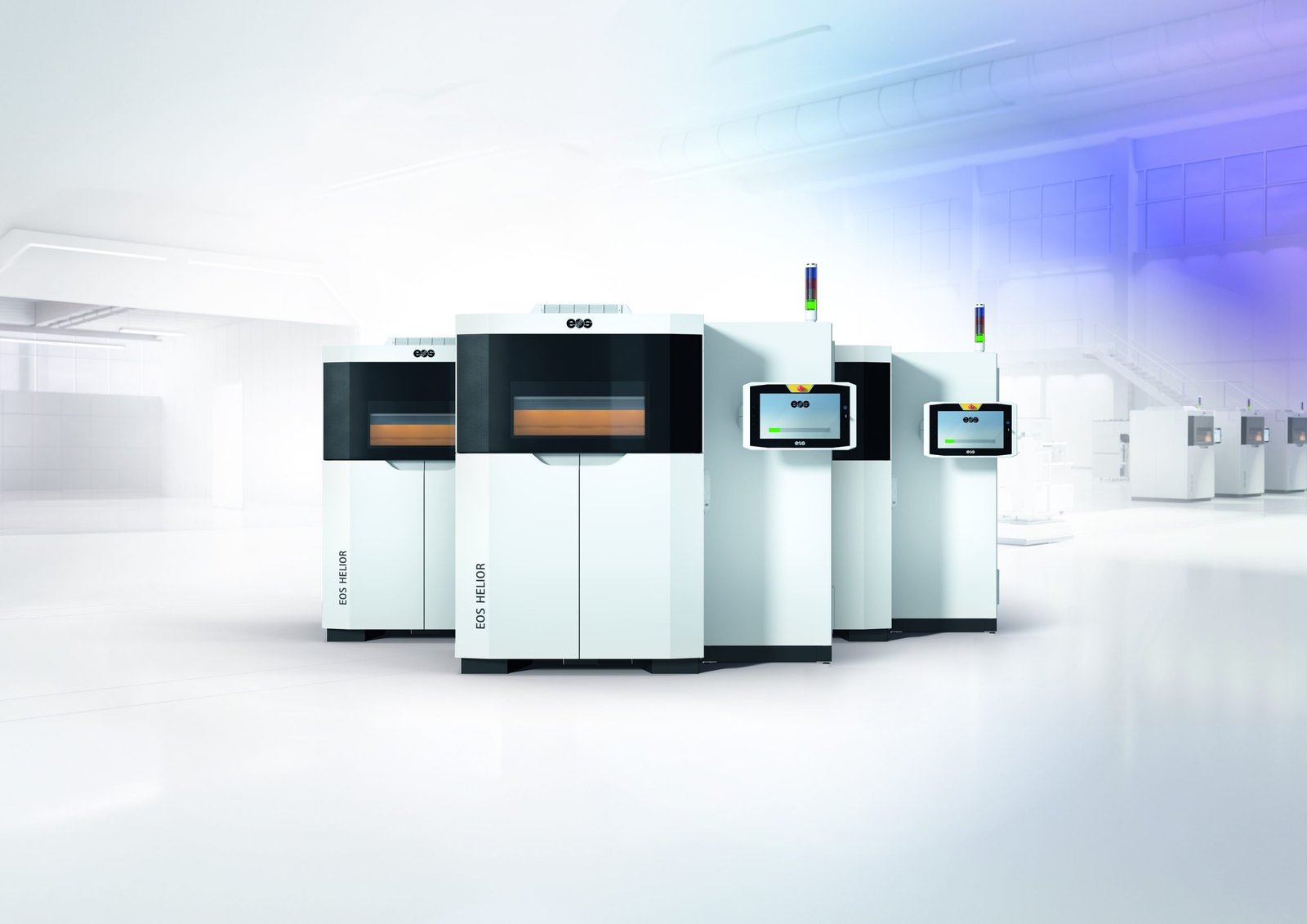
EOS has unveiled HELIOR, a large-format selective laser sintering (SLS) system designed to improve the economics of industrial polymer 3D printing. Introduced at Formnext 2026, the machine combines three 80 W lasers, dynamic load balancing, an adjustable roller recoater and new process-control software, with EOS claiming up to 80% higher throughput and substantially reduced depowdering requirements.
The EOS HELIOR has a build volume of 700 × 380 × 580 mm and is designed around 24-hour production cycles. Commercial availability begins in December 2026.
In an interview with 3D Printing Industry, Rüdiger Herfrid, EOS Polymer Portfolio Lead, explained the engineering behind HELIOR, the qualifications to its productivity claims and how production customers influenced development.
Building on the EOS P 770
Although HELIOR retains the P 770’s build volume and exchangeable build-frame architecture, EOS has redesigned substantial portions of the machine. “The platform is also the same,” Herfrid explained. The decision to retain established mechanical foundations reflects the importance of reliability in continuous industrial production.
However, the optical assembly, electrical cabinet and control systems are new. Existing P 770 machines cannot be retrofitted to HELIOR, Herfrid confirmed.
The redesigned optics include an enclosed laser beam path to reduce contamination and improved laser protection windows. Increased airflow around the windows is intended to enable six consecutive builds without cleaning, while removable assemblies simplify maintenance. These changes target machine availability as much as printing performance.
Triple lasers with dynamic load balancing
HELIOR replaces the P 770’s two 70 W lasers with three 80 W lasers. Rather than simply increasing installed laser power, EOS has introduced dynamic load balancing to distribute scanning work between them. The lasers do not individually cover the entire build area. Two operate across the left and right regions, while a third provides additional capacity in the centre.
Software adjusts laser workloads layer by layer, avoiding unnecessary overlap regions and shifting boundaries where multiple lasers must process larger components. Herfrid said the algorithms draw on experience gained from EOS’s multi-laser metal additive manufacturing systems.
The greatest productivity benefits are expected for larger components, where the system can optimise exposure workloads more effectively. Shifting scan-field boundaries between layers is also intended to improve mechanical consistency by preventing fixed overlap regions from extending vertically through a component.
Adjustable recoating reduces depowdering effort
HELIOR introduces a roller recoater whose rotational speed can be controlled independently of its movement across the powder bed. According to Herfrid, this allows EOS to control powder-cake consolidation, producing a softer surrounding powder bed without compromising the conditions needed for sintering.
The recoater operates alongside geometry-aware exposure software that distinguishes between bulky regions and thin walls, adjusting laser energy input to reduce unwanted powder adhesion. EOS claims the combination can reduce post-processing effort by up to 80%. Herfrid clarified that this figure specifically concerns depowdering and represents a maximum improvement for suitable geometries.
Components containing internal channels, slots and other difficult-to-clean features can benefit substantially. Solid geometries may experience little improvement. “If you don’t have any holes and slots inside, then you don’t have this effect,” he said. The figure is based partly on comparisons of blasting time and feedback from production operators, rather than a universal reduction in finishing labour or total post-processing costs.
Optimising production for 24-hour cycles
EOS designed HELIOR around the requirements of contract manufacturers operating equipment six or seven days per week. At a representative 10% packing density, the machine can complete a full-height build within 24 hours, allowing service providers to schedule production around daily cycles.
Herfrid said EOS selected this packing density to reflect realistic mixed production jobs rather than exceptionally dense nesting arrangements. Compared with the P 770, he described approximately 60% more build volume being processed within a 24-hour operating window under these conditions.
The advertised 80% throughput increase is a maximum rather than a representative average across all applications. The distinction between printing time and total production time is also important. Herfrid explained that full builds may require approximately three days of external cooling. Exchangeable build frames allow subsequent jobs to begin while previous builds cool.
HELIOR also supports shorter jobs, with Herfrid describing a build-frame turnaround of less than two hours.
“Whether manufacturing one part or one million, margins matter,” said Joachim Zettler, EOS Chief Technology Officer. Zettler said HELIOR supports more than 1,000 litres of production before maintenance operations, with improved utilisation and reduced manual intervention intended to lower costs per part.
Improving dimensional accuracy through software
HELIOR also introduces 3D EOSAME, extending EOS’s existing exposure homogenisation technology into the vertical dimension. The software compensates for temperature variations throughout the build chamber using a three-dimensional correction matrix.
Herfrid explained that the system does not perform real-time closed-loop adjustments. Instead, the correction is established through machine-specific measurements and subsequently applied during production. A separate feature, Smart Scaling, addresses dimensional deviations caused by shrinkage during cooling.
The software modifies component geometry during build preparation, anticipating changes that would otherwise affect Z-direction accuracy. Herfrid presented an example in which measured deviation was reduced from 740 micrometres to 120 micrometres, an improvement of approximately 84%. The result demonstrates the potential of software-based dimensional compensation, particularly for taller components.
Production customers influence development
Five established additive manufacturing service providers participated in HELIOR’s development programme: FKM Additive Manufacturing, Prototal Group, Materialise, Shapeways and Formrise. Customers selected representative production jobs for evaluation and provided feedback on part quality, productivity and machine operation.
Herfrid described several changes resulting directly from this process. Operators identified handling difficulties with removable laser protection windows, prompting EOS to redesign the assemblies with improved grips. Customer feedback also accelerated Smart Scaling development, which EOS had initially considered introducing after launch.
The programme identified a further requirement for automated process-monitoring alerts. Although HELIOR includes thermal imaging, customers argued that displaying images without automatic warnings would require continuous operator attention. EOS is developing alert functionality for subsequent availability. FKM is among the first customers receiving HELIOR.
“The higher productivity of the new system generation fits perfectly with our single-shift operation,” said Matthias Henkel, Managing Director of FKM Additive Manufacturing.
He said completing a full build each day simplifies production planning and improves machine utilisation. HELIOR launches with validated parameters for PA 2200 and PA 2220 HighReuse, with additional materials planned according to customer demand.
Targeting industrial production economics
HELIOR reflects EOS’s increasing emphasis on larger production systems, where equipment performance and reliability can justify premium pricing. Herfrid said EOS sees opportunities to move polymer SLS closer to applications traditionally served by injection moulding, particularly where production volumes are substantial but designs change frequently.
Drone manufacturing provides one example. Manufacturers may require hundreds of components before a design stabilises sufficiently to justify injection mould tooling. Rather than replacing injection moulding, Herfrid sees opportunities for the technologies to complement one another, allowing manufacturers to move between processes as production requirements change.
For contract manufacturers, the central question will be whether HELIOR’s increased output, improved dimensional accuracy and reduced depowdering requirements deliver measurable reductions in finished-part costs. The machine’s engineering changes and customer involvement provide a basis for those claims, although detailed comparative cost-per-part data remains outstanding.
EOS HELIOR is being exhibited at Formnext 2026, November 17–20, in Hall 12.0, Booth D71, ahead of commercial availability in December.
Vote now in the 2026 3D Printing Industry Awards.
To stay up to date with the latest 3D printing news, don’t forget to subscribe to the 3D Printing Industry newsletter or follow us on LinkedIn.
Explore the full Future of 3D Printing and Executive Survey series from 3D Printing Industry, featuring perspectives from CEOs, engineers, and industry leaders on the industrialization of additive manufacturing, 3D printing industry trends 2026, qualification, supply chains, and additive manufacturing industry analysis.
Featured image shows The EOS HELIOR. Photo via EOS.
