


What should you automate next? Get ideas at AMA: Software 2026.
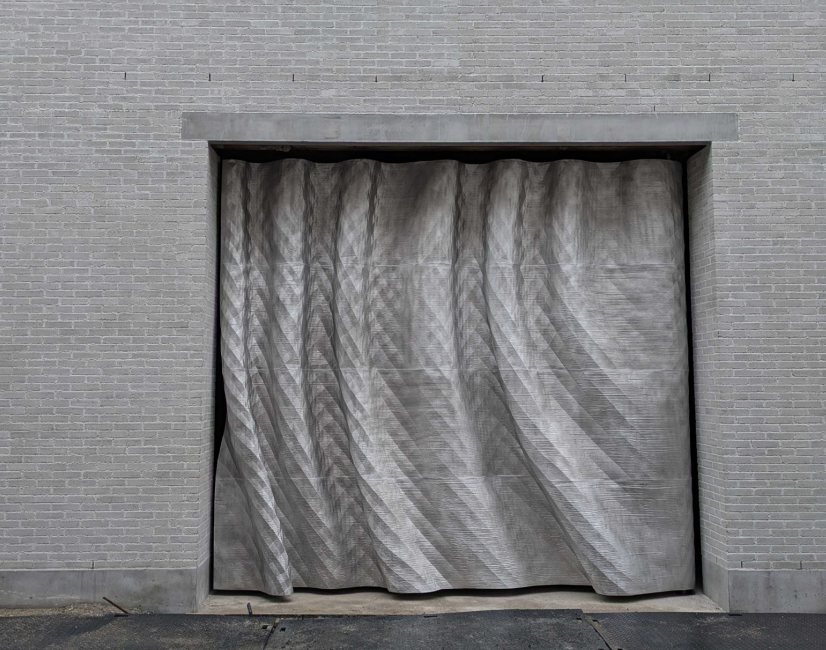
Design studio Unfold has completed Freeze Frame 82.2, a WAAM 3D printed aluminum sculpture shaped like a theatre curtain caught in motion, which now serves as the main entrance gate to DING, the new extension of Design Museum Gent in Belgium. Measuring more than 4x4m, the load-bearing gate was printed by Dutch metal additive manufacturing company MX3D using WAAM. The work was commissioned by sogent following an invitation from the museum and guest curator Siegrid Demyttenaere.
The printed aluminum section weighs 250 kg and was produced in twelve separate segments that were later assembled by hand. Mounted on a load-bearing aluminum support structure, the complete gate weighs 360 kg. Positioned at the threshold of the museum, it acts as a semi-permeable boundary, revealing the building by day and closing it off at night.
From Simulation to Weld Beads
Freeze Frame 82.2 originated as a computer simulation in which Unfold set a spring-based digital cloth in motion to study curtain behavior. The studio paused the animation at frame 82.2, where the curtain appears drawn slightly aside, suggesting a glimpse through it just before it opens. That frame defined the sculpture’s form and title.
To turn the image into metal, a robotic arm equipped with a welding gun followed a carefully coordinated choreography, building the frozen frame layer by layer in aluminum. In WAAM, a metal wire is melted by an electric welding arc and deposited by the robot, a technique that allows large components to be produced at high speed and with less material waste than traditional manufacturing methods.
The process converts what were weightless, ephemeral physics in the simulation into a tangible structure able to bear its own load. Unfold describes each welded bead as “preserving the energy and turbulence of the action that shaped it,” leaving the visible texture of the print as a record of the movement behind the form.
A Gate for a “More-Than-Museum”
DING was not conceived to provide “more museum,” but to be a “more-than-museum”: a space for debate, talks, workshops and small exhibitions that examine a world in transition. Rather than an archive of past design solutions, the museum intends it as a place where design happens live and as a platform for asking the right questions and proposing imaginative answers to pressing global needs.
That ambition shaped the brief. Unfold set out to answer how a single artwork could sit at the threshold of the extension, act as the main entrance to the entire museum, and also symbolise a period in which design is expected to keep questioning while helping to shape what comes next.
The studio drew on ethnographer Victor Turner’s 1967 essay “Betwixt and Between: The Liminal Period in Rites of Passage,” which builds on folklorist Arnold van Gennep’s work. Turner described the liminal phase, from the Latin limen, meaning threshold, as the interval when old positions have been given up but new ones not yet assumed, a suspension of certainty that makes transformation possible.
Unfold argues that society is now in such a phase. In the studio’s view, theatre lives in this ambiguous state more than any other art form, and the curtain is its clearest image: not a barrier but a permeable membrane that both hides and reveals.
By fixing the curtain at the charged instant before it opens, the gate offers neither a beginning nor an end, but a moment held open. Unfold intends it as an invitation for visitors to linger in that shared in-between and to see uncertainty as possibility rather than paralysis. As the museum opens its new wing, the studio says the work is a reminder that design’s future lies not in fixed answers but in a willingness to pause, look again and step over the threshold together into what has not yet been fully imagined.

From Display Cases to Front Doors: Museums Build with 3D Printing
Design Museum Gent installed Freeze Frame 82.2 as a load-bearing entrance gate for its DING extension, using simulation-driven design and WAAM fabrication. The piece integrates 3D printing into the building’s architecture, signaling the wing’s focus on live experimentation.
Munich’s Deutsches Museum took a similar approach when it planned a 3D printed façade for its new entrance, developed by 3F Studio, a spin-off of the Technical University of Munich. Based on the Fluid Morphology research project, the translucent, multifunctional envelope was designed to wrap the building like a soft, airy cloth. At full scale it would measure around 45 metres long and 15 metres high, weigh between 8,000 and 12,000 kg, and be printed in recyclable PETG, with the studio first targeting the museum’s interim entrance.
Gateways are also becoming showcases for large-scale printing in exhibitions. At the 2025 INTERNI “Cre-Action” exhibition in Milan, Zaha Hadid Architects and Dutch concrete printing specialist Vertico presented Aevum, a pair of offset 6 by 6 metre arches pairing traditional marble carving with robotic concrete printing. The printed arch, made of 21 unique elements, stands 5.6 metres tall, weighs 5.5 tons and was produced in six days using Vertico’s Accelerator printhead on a robot-on-track system.
From museum doors to exhibition arches, 3D printing is increasingly shaping the very thresholds visitors walk through.
Register now for AMA: Software 2026. Join 3D Printing Industry on 22 October for expert presentations, panel discussions and live audience Q&A exploring the software shaping additive manufacturing. Register here.
To stay up to date with the latest 3D printing news, don’t forget to subscribe to the 3D Printing Industry newsletter or follow us on LinkedIn.
Explore the full Future of 3D Printing and Executive Survey series from 3D Printing Industry, featuring perspectives from CEOs, engineers, and industry leaders on the industrialization of additive manufacturing, 3D printing industry trends 2026, qualification, supply chains, and additive manufacturing industry analysis.
Featured image shows 3D printed aluminum curtain. Photo via Stad Gent.
