


To a younger generation of watch lovers the name “Hublot” means just one thing: loud and proud. The Big Bang line that made the brand a household name grew into a smash hit after its creation by the industry’s famous marketing genius, Jean-Claude Biver, in 2005.
But many older horophiles will remember “Hublot” by the single model launched by Italian timepiece entrepreneur Carlo Crocco’s MDM brand in 1980—a watch every bit as disruptive as Biver’s Big Bang— but in a very different way.
Carlo Crocco and his original “Hublot” timepieces
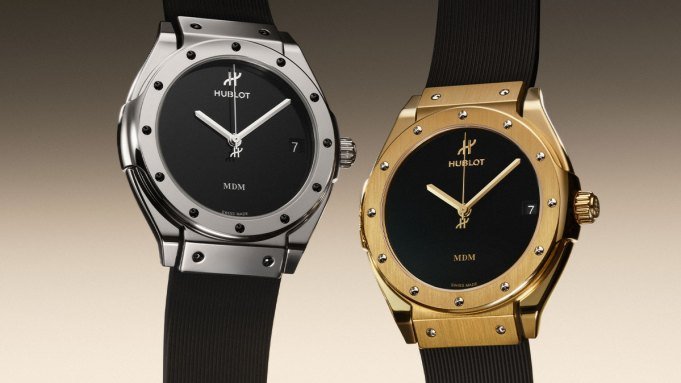
Named after its porthole shape, the original Hublot all but outraged the luxury watch world by combining a gold case with a rubber strap and a plain, jet-black dial which used 12 bezel screws as hour markers rather than conventional batons or numbers.
Slim, elegant, refined, and expensive, its success was nevertheless anything but assured. That is until yachting fan King Constantine of Greece spotted an advertisement in Time magazine that pictured a Hublot against the background of a raging sea with a glimpse of sailboat in the corner.
He immediately went out and bought two, one for himself and the other for his brother-in-law King Juan Carlos of Spain – inadvertently opening the VIP floodgates that put Hublots on the wrists of everyone from fashion mogul Giorgio Armani and Queen Noor of Jordan to F1 driver Jacques Lafitte, as well as Elton John, Andy Warhol, and Eddie Murphy. The list went on. And on.
Now the modern-day Hublot (it was adopted as the brand name after the first model’s success ) hopes to recapture some of that 1980s verve with an all-new version of Crocco’s original model called the Classic Fusion Tributo.
Although it’s a far more accurate evocation than the existing Classic Fusion Original (launched in early 2023), the ‘Tributo’ has been adapted to match modern expectations so features some notable differences. The most obvious is the 38mm, seven-part case which is two mm larger than that of the 1980 watch and noticeably thicker. That’s because it contains Hublot’s HUB 1711 in-house automatic movement, as opposed to the ultra-slim quartz mechanism used in the original.

Hublot Classic Fusion Tributo sideview
The distinctive slope of the case where it meets the strap at the top and bottom has also been made steeper to deflect from the larger size, while a combination of subtle polishing techniques are used for the same reason.
And as for the defining rubber strap: that’s no longer made from natural rubber (which was famously infused with a vanilla scent to mask its otherwise less pleasant odor). It now comes in high-spec FKM or fluorocarbon rubber, a high-performance synthetic version that looks the same but is stronger and more resilient.
And whereas buying an original Hublot required the customer to undergo an in-store ceremony of choosing a correct-size strap from a vanilla-smelling coffret containing five different options, the Tributo comes with a more practical deployant buckle made from titanium.
Placed side-by-side and seen from a couple of feet, the original and new versions are difficult to tell apart. The latter even maintains the MDM logo on the dial—although nowadays it stands for “Main dans le Main,” the humanitarian foundation set-up by Crocco in 1998.
Hublot has pledged to give the charity CHF 100,000 from the proceeds of sales of the Tributo watches, which will initially be made in 400 examples (200 in white gold with onyx dials and 200 in yellow gold with matte black dials), each model is priced at $30,900.
Hublot Classic Fusion Tributo; an up-close view of the titanium deployant buckle
Subsequent production numbers, says creative director Alessandro Camilli, will be governed by demand.
Speaking at the launch of the Tributo in Milan, Crocco, who is 82 this month, seemed taken with the “homage” to his original creation which, he claims, only lost momentum due to being widely imitated.
“Nobody knew about us when we went to the Basel watch show in 1980,” he recalls. “The price was high, the watch was unlike anything else, and we had done no market research, so it could have been a flop. But we wanted to appeal to the higher end [of buyers], and we did. The Hublot was chosen by many important people and production went, roughly, 50 percent to men and 50 percent to women—and we never once gave a watch away.”
He notes that growth was exponential in the first five years until other brands had time to catch up. “But then so many copies and fakes began to be made that soon everyone had a watch like ours,” he says. “But, in my time, I could still recognize a true Hublot from 10 metres…”
