


Spend less time fixing files. Discover smarter workflows at AMA: Software 2026.
Global 3D printer hardware revenues grew 31% year-on-year (YoY) in the second quarter of 2026, according to new figures from global market intelligence firm CONTEXT. The data points to a return to growth across the additive manufacturing (AM) market, led by a continued recovery in Industrial systems and strong volume gains for Entry-level printers. Unit shipments were higher than in Q2 2025 in three of the four price classes the firm tracks.
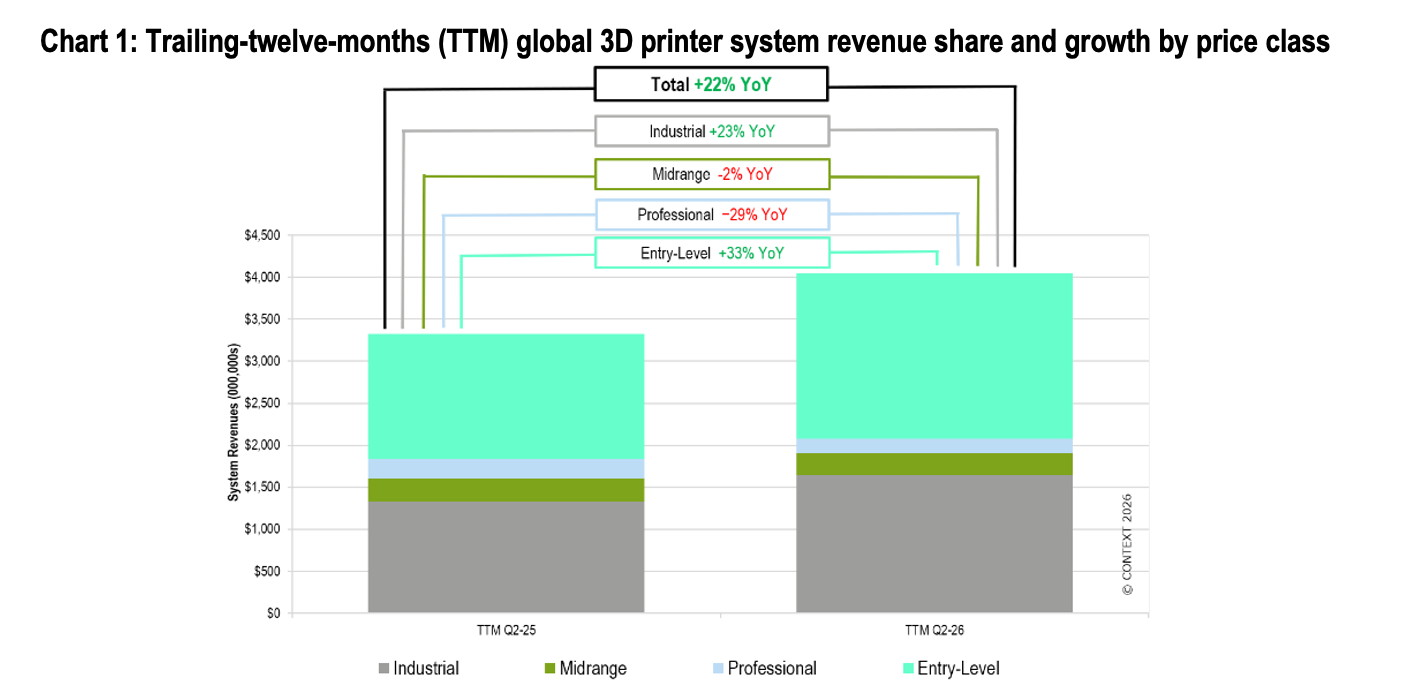
Over the trailing twelve months (TTM), Entry-level printers produced 49% of hardware revenue. That makes them the largest segment by value, ahead of Industrial systems at 41%. In Q2, Industrial revenue rose 40% and Entry-level revenue rose 36% YoY. On a TTM basis, revenue growth reached 23% for Industrial machines and 33% for Entry-level units.
Chris Connery, VP of Global Analysis at CONTEXT, said earlier growth drivers, from specialized athletic shoes to pandemic supply-chain disruptions, do not compare with current demand for the production of rockets, data center infrastructure, consumer electronics, and drones. “While Industrial 3D printing used to be defined by its use to produce hearing aids and clear dental aligners, in 2026, if you are manufacturing a drone, a rocket, or an advanced mobile phone, you are using 3D printing as an essential part of your manufacturing process,” he said.
Metal Systems Drive Industrial Shipments
Industrial printers are those priced above $100,000. Their unit shipments increased 25% YoY, the fourth straight quarter of growth for the class.
Over the TTM, China accounted for 37% of Industrial shipment volume, ahead of North America at 29% and Western Europe at 21%. In Q2 alone, shipments into North America and China were close to even after growing 44% and 42%, respectively. CONTEXT notes that supply in this class remains regional, with Chinese manufacturers serving domestic buyers and Western original equipment manufacturers (OEMs) supplying customers in the US and Europe.
Metal AM systems made up 53% of Industrial unit shipments and 75% of Industrial hardware revenue in the quarter. Metal printer shipments grew 36% and revenue grew 51%. Powder Bed Fusion (PBF) accounted for 77% of metal units and 83% of metal revenue.
Aerospace and defense (A&D) was the primary growth driver for metal AM, particularly among Western OEMs:
In China, Farsoon Technologies and Bright Laser Technologies (BLT) grew in the first half on orders from the 3C sector (computer, communication, and consumer electronics). In that sector, demand for titanium foldable phone hinges and smartphone frames increased sharply.
Polymer Systems and Fleet-Scale Orders
Industrial polymer shipments rose 16% globally. Vat photopolymerization shipments jumped 39%, mostly due to UnionTech in China. Demand for high-temperature material extrusion systems held steady.
Several polymer vendors reported large orders in the quarter:
- Stratasys secured orders for its F900 platform from domestic and APAC customers.
- 3D Systems reported strong Q2 system sales and a positive Q3 outlook, highlighting its largest single order to date for industrial polymer systems, destined for reusable rocket manufacturing.
- HP received an order for 81 5620 MJF printers from service bureau ADDMAN, bringing ADDMAN’s total fleet to 125 units.
Midrange and Professional Classes Move Toward New Technologies
In the middle price bands, low-cost Entry-level machines continue to pull demand away from traditional material extrusion (FDM/FFF) systems.
The Midrange class covers printers priced from $20,001 to $100,000. Its shipments recovered 8% and its revenue grew 3%. Polymer PBF (SLS) shipments in this class climbed 38%. CONTEXT expects further gains as Raise3D and other vendors continue their rollouts, and as Formlabs and HP launch the Fuse X1 and Jet Fusion 1200, respectively.
The Professional class covers printers priced from $2,501 to $20,000. Its shipments fell 13% and its revenue dropped 24%, mainly because of weaker sales of legacy FDM machines.
Several developments may change the Professional segment:
- Composite material extrusion shipments began after FibreSeek fulfilled its Kickstarter orders.
- Stratasys’ pending acquisition of Markforged is expected to further consolidate the composite sector.
- CONTEXT expects lower-priced full-color material jetting printers, such as the Flashforge CJ270 and the HeyGears G1X, to increase activity in coming quarters.
Entry-Level Growth and Early Signs of Oversupply
Entry-level printers are those priced up to $2,500. Their unit shipments grew 23% and their revenue grew 36%. China accounted for close to 95% of global Entry-level shipments over the TTM. It is also where much of the development of features such as AI integration, multi-color printing, and automated purge-tower management takes place.
CONTEXT refers to Bambu Lab, Creality, Elegoo, and Anycubic as the “Four Little Dragons of Shenzhen.” Together, the four companies accounted for 87% of Entry-level shipments in Q2.
- Bambu Lab grew and kept a wide lead in market share.
- Flashforge shipments rose more than 70%.
- Snapmaker shipments increased by nearly 3,000% after the company fulfilled its U1 Kickstarter campaign.

The firm also sees possible signs of saturation. Chinese exports of 3D printers grew 58% in Q2, bringing first-half exports to 3.9 million units. Part of this volume reflects stocking ahead of the Q4 holiday season, but CONTEXT points to a potential gap between units shipped and what end markets can absorb.
Creality issued a profit warning citing price competition, with essentially flat first-half revenue from 3D printer sales. Bambu Lab and other major vendors have expanded into laser engravers and UV printers, which CONTEXT suggests may indicate they expect printer shipment growth to slow.
Demand remains supported by hobbyists adding printers to their setups and by the spread of high-volume print farms, especially in China.
Defense and Electronics Buyers Turn to AM for Production
CONTEXT’s Q1 2026 analysis identified defense and consumer electronics as drivers of Industrial growth. In that quarter, EOS disclosed what it called the largest contract in its history, signed with a defense drone manufacturer. CONTEXT’s data also suggested metal PBF demand might outpace what Western OEMs can produce. Farsoon and BLT attributed their shipments to 3C titanium parts then as well. Growth rates in Q1 were lower for Industrial shipments, at 18%, and Industrial metal shipments, at 10%, than the 25% and 36% recorded in Q2. That makes the earlier report a baseline for the Q2 data, not an equivalent result.
A report on drone AM from Additive Manufacturing Research addresses the defense side of that demand directly. It estimates the market for 3D printed drone components at $140 million in 2025 and projects $900 million by 2034, driven by governments treating drone production as a national defense priority. It identifies metal PBF as the only metal process currently used in unmanned aerial systems production, with propulsion and large-drone structures flagged as areas for expansion. Most of the volume it describes, however, runs on polymers and low-cost printers, and its figures are market estimates and projections, not shipment data.
CONTEXT’s Q1 analysis raised whether Western OEM metal PBF capacity can keep pace with this demand. The Q2 orders keep that question open for the rest of 2026.
Register now for AMA: Software 2026. Join 3D Printing Industry on 22 October for expert presentations, panel discussions and live audience Q&A exploring the software shaping additive manufacturing. Register here.
To stay up to date with the latest 3D printing news, don’t forget to subscribe to the 3D Printing Industry newsletter or follow us on LinkedIn.
Explore the full Future of 3D Printing and Executive Survey series from 3D Printing Industry, featuring perspectives from CEOs, engineers, and industry leaders on the industrialization of additive manufacturing, 3D printing industry trends 2026, qualification, supply chains, and additive manufacturing industry analysis.
Featured image shows Chart Trailing Twelve Months (TTM) Global 3D Printer System Revenue Share and Growth by Price Class. Image via CONTEXT.
