


When the Antigravity A1 first launched, it carved out a totally distinct space in the consumer market as an 8K 360-degree camera drone. That setup was unlike anything else — and downright fantastic for pilots who wanted an immersive cockpit feel. But for some, there were drawbacks. Flying required either Vision goggles or a dedicated dual-stick grip controller. It wasn’t really built as an automated “follow-me” action drone, since wearing FPV goggles while riding a bicycle or snowboarding is a recipe for disaster.
The new Antigravity A1 Follow Me Bundle completely changes that equation.
By introducing two new wearable controllers—the Watch Remote and the Ring Remote—Antigravity allows users to ditch goggles and handheld joysticks entirely. Instead, you get hands-free, automated 360-degree tracking that keeps the camera focused on you while your eyes and hands stay on your activity.
Whether you’re road cycling, trail running, hiking, or managing a busy family outing, it transforms how the A1 fits into active adventures.

What’s included in the new Follow Me bundle (and pricing)
The Follow Me Bundle is available as a complete drone package ($799, including the drone itself) or as a standalone Accessory Kit ($339) for existing A1 owners.
| Product / Configuration | Price (USD) |
|---|---|
| Full-Coverage Propeller Guards | $39.99 standalone, otherwise including in Bundle ($339 for accessory kit without drone, or $799 for kit including drone) |
| Watch Remote (Wearable Control) | Included in Bundle ($339 for accessory kit without drone, or $799 for kit including drone) |
| Ring Remote (Drag-to-Fly) | Included in Bundle ($339 for accessory kit without drone, or $799 for kit including drone) |
The complete bundle, which retails for $799, includes:
- Antigravity A1 Drone
- Watch Remote
- Ring Remote
- Full-Coverage Propeller Guards
- High-Capacity Flight Battery (4345 mAh)
- Lens Guards & Spare Propellers
- USB-C Charging Cable & Crossbody Bag
Antigravity sent me an early demo of the products so I could test them out ahead of the launch, though opinions are my own.
The Watch Remote


Weighing just 44.7 grams (1.6 oz), the Watch Remote feels as light as a standard fitness tracker on your wrist. It features a bright 1.72-inch LCD screen (550 nits, 356×400 resolution) that remains easy to read even in direct sunlight while cycling.
The display provides live telemetry, battery levels, tracking status, and touchscreen sliders:
- Left Slider: Controls forward and backward repositioning.
- Right Slider: Manages vertical ascent and descent.
To arm tracking, you simply tap “Wave to Track” on the wrist interface and raise a hand above your head within a 1-to-5-meter distance. The drone locks its tracking box onto you instantly without needing a smartphone app.
The Watch Remote supports tracking speeds up to 10 m/s (22.4 mph), making it highly effective for road cycling, gravel riding, and running. Because the A1 records in full 8K 360 (7680×3840 @ 30fps) or 5.2K @ 60fps, you don’t have to worry about whether you’re perfectly centered in the frame while moving—you can reframe the shot on your phone or desktop during post-processing.
2. The Ring Remote


The Ring Remote weighs 8.2 grams (0.3 oz) and fits fingers sized 46–70 mm. It has no screen — just a single tactile button designed to be pressed blindly while moving.
The standout feature here is called Drag-to-Fly. Here’s how it works:
- While the drone follows you, press and hold the Ring button.
- Move your arm left, right, upward, or downward.
- The drone dynamically matches your hand movement in real time.
It is remarkably intuitive — even my kids picked it up with almost no instruction. By default, the drone locks its minimum height to 20 feet for safety. Rotating your wrist inward draws the drone closer, while rotating outward pushes it back into a wide scenic view.
Both the Watch Remote and Ring Remote feature IP67 water resistance and offer >5 hours of tracking battery life, easily outlasting multiple drone flight sessions.
Key hardware specifications
| Specification | Value / Rating |
|---|---|
| Image Sensor | 1/1.28-inch CMOS (f/2.2 aperture) |
| Max Video Resolution | 8K @ 30fps / 5.2K @ 60fps / 4K @ 100fps |
| Photo Resolution | 55 MP (10496×5248) / 14 MP |
| Takeoff Weight (with Guards) | 351 g (12.4 oz) |
| Max Flight Time (Tested) | 23 minutes (Tested at 5 m/s in no wind) |
| Max Tracking Speed | 10 m/s (22.4 mph) |
| Max Horizontal Speed | 11 m/s (24.6 mph) |
| Internal Storage | 20 GB built-in + microSD support up to 1TB |
| Transmission Distance (Clean line) | 150–200 meters (492–656 feet) |
| Transmission Latency | ~300 ms |
| Battery Capacity | 4345 mAh (7.16V Li-ion 2S) |
New safety features
Tracking closely at low elevations introduces flight risks, but the A1 incorporates forward and downward vision positioning Follow-me drones in general — particular those flying this close to ground level — present real flight risks. But Antigravity introduced mitigations such as Full-Coverage Propeller Guards, Omnidirectional Obstacle Avoidance, and an Ultra-Low Altitude Mode which is a flight locked at 1-meter follow elevation.
Tracking at waist height creates a grounded sensation of speed. The system handles these low elevations with steady stability. I tried to move the drone into a chainlink baseball backstop and a pine tree, both times the obstacle avoidance stopped the drone and it didn’t get near the obstacles. I was a little nervous flying a drone with what felt like so little control but overall it was an easy and intuitive system. Landing on a low battery was a little tricky and if you wait too long it will simply sit down wherever it is. I would recommend planning out a landing plan long before you need to, as the new controls will make it difficult to simply take control of the drone.
The propeller guards


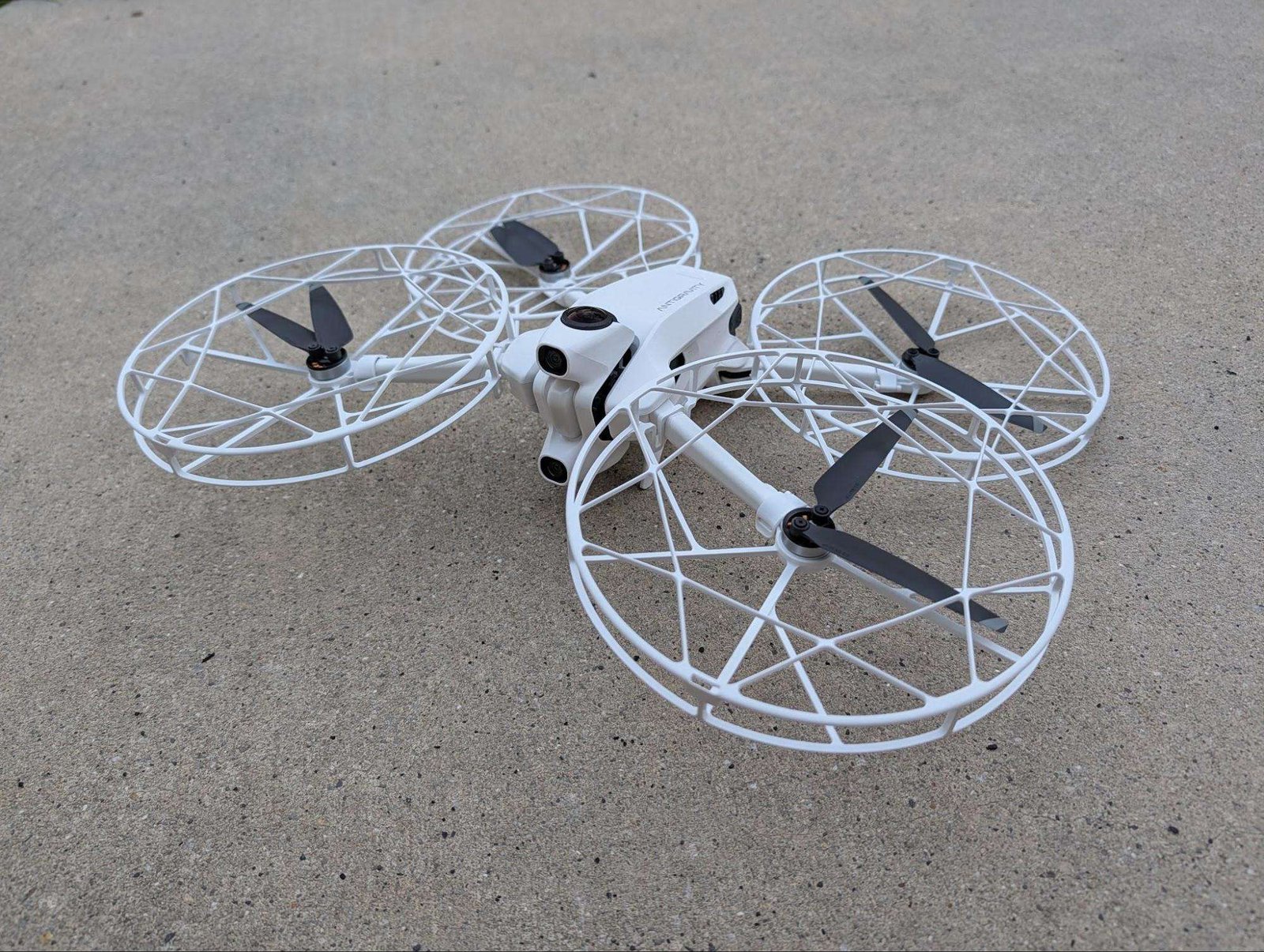
Another component of the bundle is Full-Coverage Propeller Guards, which really just serve as a safety feature. With them installed, the total takeoff weight becomes 351 grams, which places the craft above the 249-gram threshold. That means you’re past the standard FAA registration tier for outdoor operations in the United States (aka you will have to register the drone if you go this route).
When installed,I found flight times to be less than the normal 20 minutes that I was getting previously. It seems the full coverage propeller guards add enough weight and drag to make a difference.
My take? I do appreciate the safety feature, and if you’re fine sacrificing a few minutes of flight — and you don’t mind registering your drone — then I do love this option.
Antigravity vs Avata 360


Most people like to compare the Antigravity A1 vs the DJI Avata 360, and I’ve done that too. But with this new Follow Me Bundle, it’s becoming less of an apples to apples comparison since the approach to flying and utilizing each drone is fundamentally different.
Who is the new Antigravity Follow Me bundle for?
For those who are active on social media, looking to collect videos of themselves on active adventures and are looking to be able to collect excellent video with minimal flying experience, it’s worth going for this bundle. I would also recommend to those who are curious about experiencing the newest technology on the market, because this is certainly a new direction. If you love the process of flying the drones and framing the perspective to get that perfect shot, then I would look at other drones on the market that have covered that ground for years.
The key here is that this bundle keeps the attention on you, the user. For better or for worse, that means generally all your videos and photos will have you as the subject. Content creators or people who generally want to document their activities would find value in this — as well as people who want visuals of themselves with epic backdrops.
Related
Discover more from The Drone Girl
Subscribe to get the latest posts sent to your email.
