


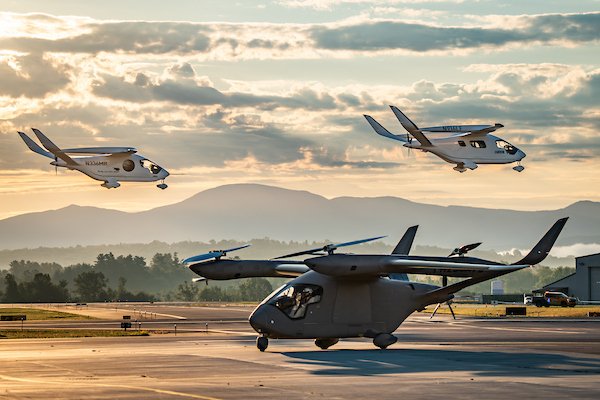
Permission allows developer to carry stakeholders on eVTOL demonstration sorties in USA.
Beta Technologies has become the first electric vertical take-off and landing (eVTOL) aircraft developer to be given permission to carry passengers on demonstration flights ahead of achieving type certification.
Announced on 21 October, the Special Airworthiness Market Survey Certificate granted by the Federal Aviation Administration (FAA) allows Beta to carry out flight operations with stakeholders – potential customers or other interested parties – on board.
“Before they could observe from the outside of the airplane, now they get to experience it from inside,” says Beta chief executive Kyle Clark.
Beta has wasted no time in putting its market survey approval to use, traveling 30nm (55km) between Plattsburgh and Burlington airports on 20 October with “an allowable stakeholder” on board.
But more important than providing a sales tool, or a means to convince regulators or politicians of the advanced air mobility industry’s worth, Clark believes the approval is a validation of Beta’s aircraft and its internal processes.
“It means we have been able to achieve a large number of flights with a stable configuration, painting the corners of the envelope, and doing so in a safe and consistent manner.
“And in parallel with that, to generate the maintenance manuals and all the processes to make sure we have a safe and reliable configuration.”
Clark sees the approval as a “validation” of the Beta team doing the “quiet work behind a super-reliable, rigorous aerospace programme”.
On top of which, it provides Beta with a “mile marker” from the FAA on the journey to certification.
It follows a similar authorisation granted last year for Beta’s conventional take-off and landing Alia CX300.
In the meantime, Beta continues to work towards certification for its electric propulsion unit (EPU), which equips both Alia variants.
Beta had hoped to gain FAA approval for the EPU in late 2026, but it hit a “pretty big blocker around mid-year” due to differing interpretations of the rules between it and the regulator, which set the process back, says Clark.
“It took probably an extra four or five months of negotiation and that programme is now back on track.
“You can never recover time – once it’s gone it’s gone – but we are now submitting and gaining approvals for the final test plans; we are now largely through the certification testing.”
However, he declines to speculate when the FAA might now award certification. “I’m not going to forecast a timeline because walking down this path has enough variability that it would be false precision for me to give you a timeline.”
Clark concedes there will be a knock-on impact on the timelines for the Alia CX300 and A250 due to the demands on its engineering resources but says it will not be a “day-for-day delay”.
Certification for the CX300 was targeted for 2027, with the eVTOL A250 following around 12 months later.
Beta has now flown more than 250,000 miles with its test fleet, a milestone reached on 19 October, says Clark.
Additional milestones targeted for the remainder of the year include surpassing more than $4 billion of deposit-backed orders, increasing the production rate to four and a half aircraft per month, installing more charging facilities across the USA and a “maniacal focus on certification”, says Clark.
The post Beta buoyed by FAA approval for Alia A250 passenger flights first appeared on FlightGlobal.
