


TotalEnergies EP Denmark has installed seven anti-surge valves fitted with additively manufactured nickel-based alloy disk stacks from IMI. The parts work in a sour-gas environment where hydrogen sulphide (H₂S) partial pressures reach up to 3.3 kPa. The 3D printed parts passed DNV-ST-B203 AMC Level 3 qualification, and tests showed they performed as well as conventionally manufactured nickel-alloy components. TotalEnergies then approved them for use.
The parts were produced by Laser Powder Bed Fusion (LPBF). IMI developed a proprietary heat treatment for sour-service conditions to go with them. The deployment is a practical example of additive manufacturing being used in a safety-critical application.
Fixing valve passing under H₂S exposure
The project began with an operating problem: valve passing in anti-surge systems working under demanding service conditions. The H₂S levels made a replacement hard to approve. Any new component had to show high corrosion resistance, reliability and mechanical performance before it could be cleared for use.
Nickel-based alloys are widely used across oil and gas. Industry experience with additively manufactured versions in sour service is limited, though, so the project depended on qualification.
Qualifying a printed part for sour service
IMI’s engineering team worked with TotalEnergies to develop and validate the printed disk stacks. The program combined extensive mechanical and corrosion testing with the new heat treatment process, which was designed to get the best material performance out of the alloy.
Tests showed the parts performed as well as conventionally manufactured nickel-alloy components while meeting the requirements of DNV-ST-B203 AMC Level 3 qualification. TotalEnergies then approved the installation of the seven valves.
Bertrand Maillon, Retrofit3D leader at IMI, said the aim was to prove reliability rather than just printability. “The challenge here was to avoid simply producing an additively manufactured component. Rather, we wanted to demonstrate that it could perform reliably in a demanding sour-gas environment where corrosion resistance and long-term integrity are critical,” he said.
Maillon described the first valves entering service as an important milestone for both companies. He said the result came from the qualification program and the heat treatment process the two teams developed together, and from close engineering collaboration.
Bertrand Levaché, Head of Additive Manufacturing at TotalEnergies, said: “What started as a collaborative effort to tackle valve reliability challenges in a demanding H₂S environment evolved into an actual demonstration of how innovation can flourish through partnership.”
How the Retrofit3D trims work
The disk stacks come from IMI’s Retrofit3D program, which designs custom 3D printed control valve trims that fit into existing valve bodies. The trims use IMI’s DRAG technology, which sends fluid through a multi-stage, multi-path trim to reduce differential pressure. IMI says the design eliminates erosion, vibration and noise. Depending on the problem, IMI replaces either the cage alone or the full trim set.
Only the internal trim changes in a Retrofit3D upgrade. The pressure boundary and the actuation are untouched, which IMI says lowers the risk for the operator. Because no pipework is cut or re-welded, the company says installation can be finished within hours.

Upgrading valve internals instead of replacing them
The TotalEnergies project is part of IMI’s Retrofit3D strategy: fixing control valves by replacing their internal parts, so welded valves don’t have to be cut out and swapped. IMI says it has upgraded hundreds of valves this way, including projects in China and for Griffith Energy. This qualification takes the approach into sour service.
Other operators are also turning to 3D printing to keep existing equipment running. ConocoPhillips identified the need to replace many of its choke cage valves, which control water flow in oilfield injection wells. Because the OEM had stopped making the parts, the company retrofitted its existing valves with 3D printed cages, which is said to have extended valve life, reduced costs and improved uptime. Shell has gone further into pressure-bearing hardware. It received CE certification from LRQA for a 3D printed pressure vessel at a time when no standards existed specifically for printed pressure-retaining parts.
Qualification has been the common thread. DNV GL organized two Joint Innovation Projects with 20 partners, including BP, Shell, Total (now TotalEnergies), Siemens and SLM Solutions, to develop guidelines for qualifying parts made by LPBF and WAAM. On the supplier side, Protolabs was reportedly the first powder bed fusion manufacturer certified by DNV for oil and gas, with the certification covering its DMLS process with Inconel 718.
IMI’s project adds a printed part qualified to DNV-ST-B203 AMC Level 3 and now running inside sour-gas valves.
To stay up to date with the latest 3D printing news, don’t forget to subscribe to the 3D Printing Industry newsletter or follow us on LinkedIn.
Explore the full Future of 3D Printing and Executive Survey series from 3D Printing Industry, featuring perspectives from CEOs, engineers, and industry leaders on the industrialization of additive manufacturing, 3D printing industry trends 2026, qualification, supply chains, and additive manufacturing industry analysis.
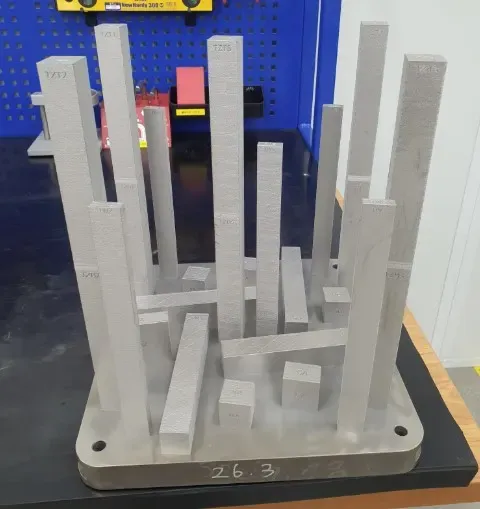
Featured image show Additively manufactured metallic test specimens on a build plate. Photo via IMI.
