


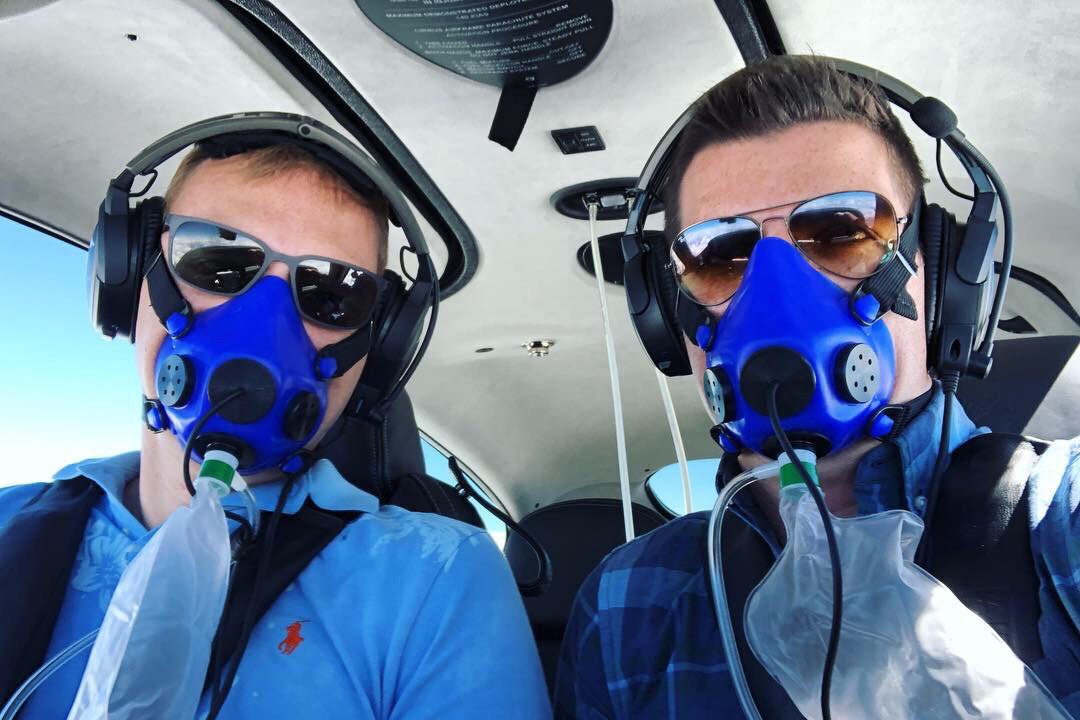
It’s time to test your high altitude operations…
1) You’re flying from Phoenix, AZ to Las Vegas, NV. You plan to fly at an altitude of 12,000′ MSL with an ETE of 1 hour. The altimeter setting at KPHX is 29.93, and at KLAS it’s 29.97. What oxygen requirements apply?
FAR 91.211 states that if your cabin pressure altitude is above 12,500′ MSL for more than 30 minutes, you as the pilot must wear supplemental oxygen. However, in this case, you’re below the cabin pressure altitude of 12,000′ MSL, so this rule doesn’t apply to you.
FAR 91.211 states that if your cabin pressure altitude is above 12,500′ MSL for more than 30 minutes, you as the pilot must wear supplemental oxygen. However, in this case, you’re below the cabin pressure altitude of 12,000′ MSL, so this rule doesn’t apply to you.
2) Individuals who are fatigued can start to experience hypoxia symptoms as low as _________ during the day and _________ at night.
Individuals who are fatigued can start to experience hypoxia symptoms as low as 10,000′ MSL during the day and 5,000′ MSL at night.
Individuals who are fatigued can start to experience hypoxia symptoms as low as 10,000′ MSL during the day and 5,000′ MSL at night.
3) You plan to reposition your Citation X today at 39,000′ MSL (cabin pressure altitude of 39,000′ MSL) with inoperative packs and outflow valve. No pressurization! Which two supplemental oxygen systems can you use, and what are their altitude restrictions?
You can use a diluter-demand oxygen system which is limited to 40,000′ or you can use a pressure-demand oxygen system that doesn’t have any cabin pressure altitude restrictions. That being said, extended flights at high altitude aren’t a great idea. Useful time of consciousness is very low, and you’re relying on your O2 system working for the entire flight.
You can use a diluter-demand oxygen system which is limited to 40,000′ or you can use a pressure-demand oxygen system that doesn’t have any cabin pressure altitude restrictions. That being said, extended flights at high altitude aren’t a great idea. Useful time of consciousness is very low, and you’re relying on your O2 system working for the entire flight.
4) If you wanted to cruise at an altitude of 16,500′ between Spokane, WA (KGEG) and Seattle, WA (KSEA) on a Part 91 flight, what restrictions apply?
FAR 91.211 requires crewmembers to use supplemental oxygen and to provide passengers with it at all times above a cabin pressure altitude of 15,000′ MSL.
FAR 91.211 requires crewmembers to use supplemental oxygen and to provide passengers with it at all times above a cabin pressure altitude of 15,000′ MSL.
5) What is hypoxic hypoxia?
