


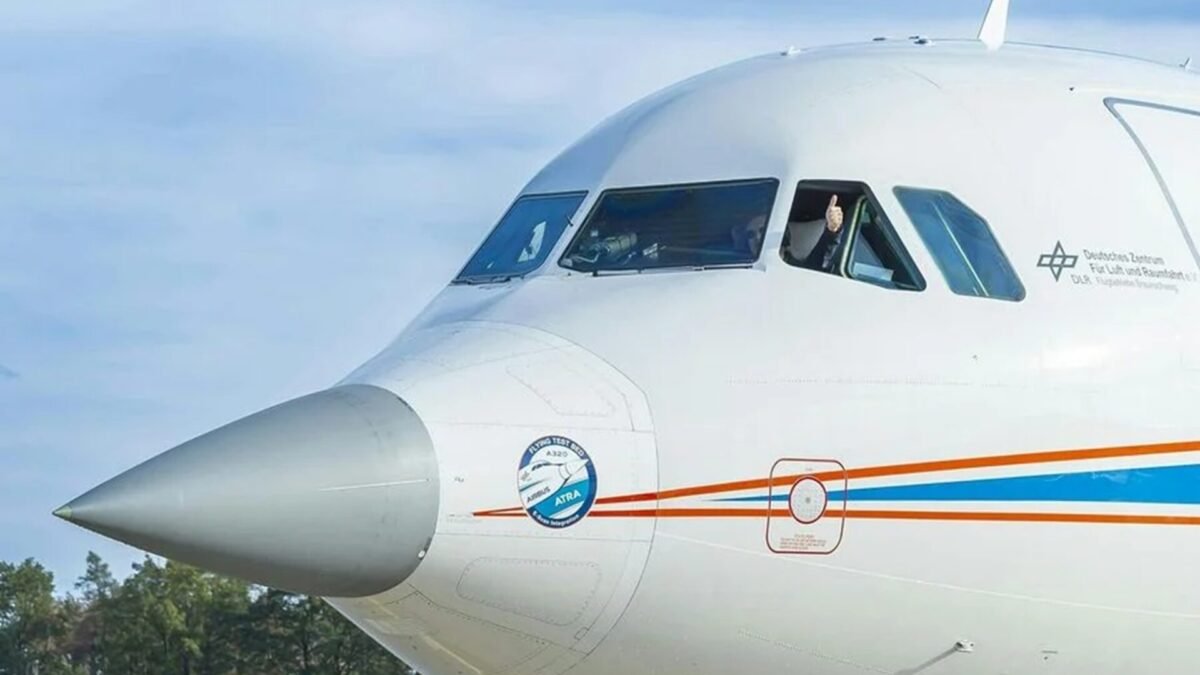
An Airbus A320 fitted with the pointed nose of a Eurofighter has completed commissioning flights with the fighter’s next-generation radar on board.
The unusual test aircraft is now operational at the company’s site in Manching, Germany, Airbus announced on November 6, 2026. Known as the A320 ATRA, the aircraft will serve as a flying laboratory for the Eurofighter Common Radar System Mark 1 (ECRS Mk1), which is being developed for German and Spanish Eurofighters.
According to Airbus, the latest flights confirmed that both the aircraft and the radar can perform as intended in the air.
Why Airbus fitted an A320 with a Eurofighter nose

ATRA (short for Advanced Technology Research Aircraft) belongs to the German Aerospace Center (DLR). It first flew with its new nose on January 21, 2025, from the DLR airfield in Braunschweig.
Airbus engineers in Manching designed and assembled the Eurofighter nose section. Teams from Airbus Defence and Space and Airbus Commercial Aircraft redesigned the front fuselage and reinforced the airframe to accommodate it.
The modifications go well beyond the aircraft’s unusual appearance. Airbus installed hundreds of meters of data cables, along with liquid and air-cooling systems to regulate the radar’s temperature. Workstations inside the cabin allow engineers to monitor radar performance in real time and evaluate new software versions and functions.
So, why not simply use a Eurofighter? Thomas Hirsch, Airbus E-Scan radar project manager, explained in January 2025 that the A320 ATRA “has a significantly shorter clearance process and can stay in the air longer than a Eurofighter”.
This gives engineers more time to test the radar under real flight conditions without tying up a combat aircraft.
Eurofighter ECRS Mk1 radar tests move forward ahead of 2027 deliveries
Hensoldt and Indra are developing the ECRS Mk1 under contract to Airbus Defence and Space. The active electronically scanned array (AESA) radar is intended to improve the Eurofighter’s air-to-air capabilities, with subsequent software upgrades adding more advanced air-to-ground and electronic warfare functions.
In February 2025, Hensoldt announced a contract extension worth approximately €350 million ($393 million), including test systems for the A320 D-ATRA and further development of the Mk1 Step 1 radar. At the time, the company was aiming to begin flight testing of the revised radar by the end of 2025.
In June 2025, Hensoldt confirmed that the first radars incorporating an upgraded processor and antenna power supply and control system had been produced. The company said that the Mk1 Step 1 standard would undergo flight testing aboard the A320 testbed.
By June 8, 2026, Hensoldt and Indra had begun testing the radar against live targets of opportunity and cooperative targets, ahead of the planned airborne trials.
With Airbus now confirming that the radar has successfully operated in-flight, the A320 ATRA is ready to support further development and validation work.
The ECRS Mk1 is destined for Germany’s 38 Quadriga Eurofighters and Spain’s Halcón I aircraft. Hensoldt confirmed in October 2025 that it would also equip the 20 Tranche 5 Eurofighters ordered by Germany that month.
The radar is scheduled to begin installation on Germany’s Quadriga aircraft in 2027, with deliveries to Germany and Spain also targeted for that year. Airbus claims that existing Eurofighters are expected to receive the radar through future retrofit programs.
