


Making an entrance
Even with those credentials the rough and rugged world of offshore support work did not spring immediately to mind when considering the H160.
I was aware that the type had entered service with PHI and had started offshore energy support (OES) work from its Houma, Louisiana, base following an exhaustive service entry programme. I had also seen the company’s first H160 being “Bubba-proofed” in Houma shortly after delivery.
I also knew that Bristow had the type in OES service in Nigeria, and of course that Omni was active in Brazil on offshore contracts.
Despite all of that, somehow it was still a surprise when I encountered NHV’s Chief Operating Officer, Jamie John, when we were both on the way to this year’s VERTICON and he told me that NHV would be taking delivery of two H160s this spring as an initial tranche.
The surprise wasn’t that they were acquiring H160s, but that they were going to be tasked to the company’s Den Helder base rather than, say, West Africa. The North Sea is, after all, the premier league when it comes to offshore energy support in both in terms of rugged weather and business competitiveness.
A few days later, during VERTICON, a chance encounter with NHV’s CEO Lars-Henrik Thorngreen resulted in an invitation to accompany him on the delivery of the first H160 from the Airbus factory in Marignane to Den Helder – and so fast forward to early April and grey day in Marignane.
While the NHV base at Ostend might have conceivably been in VFR range, just, and with favourable winds, the prospects looked unrealistic.
Instead, the broad plan was to fly first to Dijon for fuel then on to Ostend for a second fuel stop, and a chance for NHV’s headquarters team to meet their latest addition and finally on to Den Helder.
Working with the NHV crew, Marcus Lipp and Rogier Morssink, we determined over breakfast that some challenges awaited in the form of the weather, especially in the Lower Rhône Valley where the higher terrain, together with the airspace, made filing IFR look like a good idea.
IFR would rule out absolutely the idea of a two-leg trip. The threat of icing gave us further pause, to the extent that we were also considering alternate routes as far west as the Spanish border, before turning north to outflank the weather.
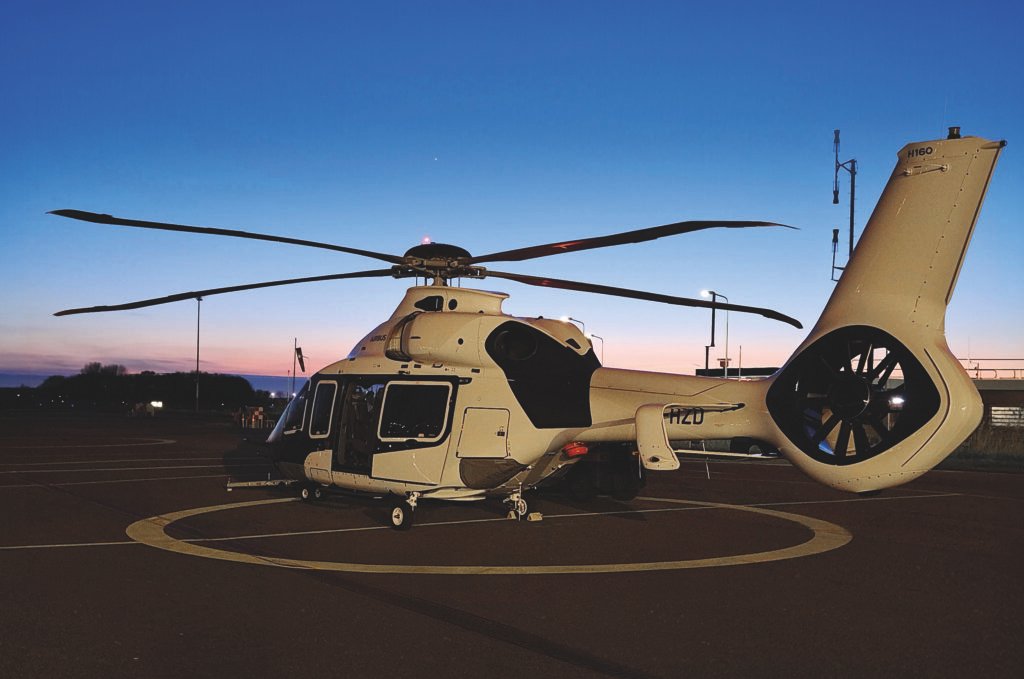
Pictured during a handy fuel stop at NHV’s base in Ostend, Belgium. Image: Gideon Ewers
Conversations at the delivery centre with the Airbus team revealed that in either event, VFR or IFR, our plan would be Marignane-Dijon-Ostend-Den Helder, with a night stop in Ostend.
Little did we know at that point that paperwork in the form of the Danish CAA accepting the serial number of the emergency locator transmitter (ELT) fitted to the life raft would scupper any chance of departure that day.
