


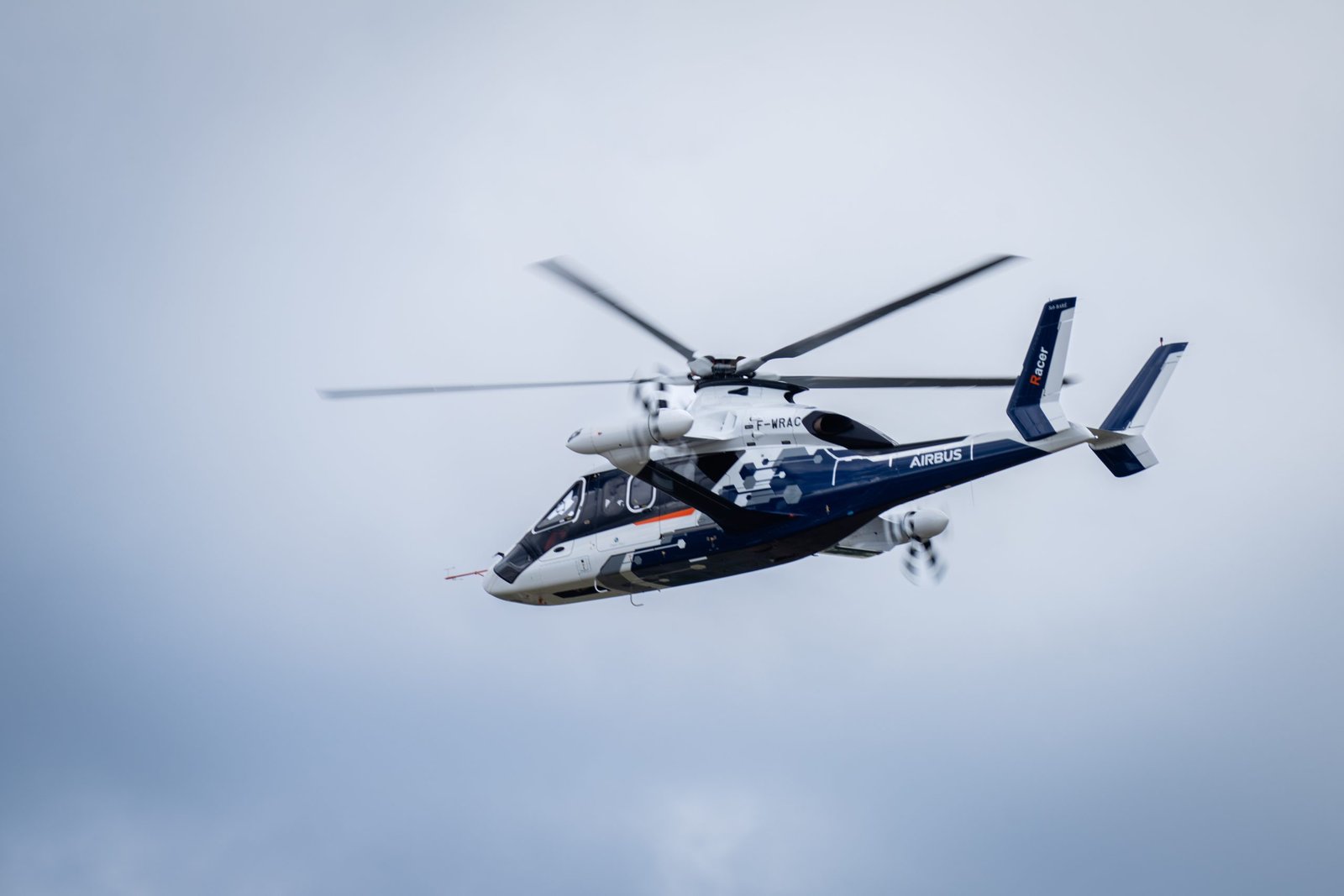
Airframer continues to validate its compound architecture through flight tests of the Racer demonstrator.
Airbus Helicopters is unlikely to launch a new civil rotorcraft using the compound architecture it is validating through the Racer demonstrator without first introducing the high-speed technology on a military platform, according to the airframer’s chief executive.
In flight testing since April 2024, development of the Racer has been funded by the EU’s Clean Sky 2 civil aviation programme.
In addition to a goal of proving the viability of a fast rotorcraft – it has reached speeds of up to 240kt (444km/h) – the Racer is also intended to demonstrate improvements in fuel burn and noise emissions.
Despite the civil focus of the Clean Sky 2 funding, Airbus Helicopters chief executive Matthieu Louvot believes the Racer architecture is “probably” destined to first appear on a military rotorcraft.
This is due to “the cost implied in the development” and the fact that “we think the value of speed, the additional speed, will be stronger for military customers”, he says.
“One day if you make a high-speed helicopter you could [eventually] have a civil version,” he adds.
While Clean Sky 2 bankrolled the development of the demonstrator itself, Airbus Helicopters has funded the Racer’s flight-test programme from its own research and technology budget.
Elsewhere, Airbus Helicopters is receiving EU-level support to mature the technologies required for a future military rotorcraft. Alongside Leonardo Helicopters, the manufacturer is leading a project backed by the European Defence Fund (EDF) to mature the technologies required for a future military rotorcraft.
Called the European Next Generation Rotorcraft Technology (ENGRT), the EDF has provided €100 million ($114 million) for its second phase, running until early 2029.
Louvot says it is “extremely important” that the initiative “moves forward” and coalesces into a future development programme.
But ENGRT remains at an early stage: at this point it is focused on the technological building blocks for a future helicopter and has yet to settle on one particular architecture.
Although many of those technologies – an open system architecture to allow rapid upgrades, autonomous flight-controls, teaming with uncrewed assets – will be required for any future rotorcraft whether conventional or otherwise, a decision will need to be taken at some stage.
“The architecture of the vehicle is an important choice to be made if we want to go to a demonstration,” says Louvot.
“A lot of technologies can be developed for various platforms [but] at some point the development should also go to the platform itself and then architecture must be determined.”
To a considerable extent, the overall configuration will be determined by desired performance, with high speed necessitating a more complex and costly architecture.
“If you want speed then it is a trade-off for a smaller payload,” he says. “You have to accept larger costs, so it is up to governments to see if there are enough benefits to speed to cover the costs entailed by such architectures.”
Should speed be selected as the predominant characteristic, then the debate will move on to the exact design: while Airbus Helicopters is clearly championing a Racer-derived compound rotorcraft, Leonardo Helicopters favours a tiltrotor.

Although the two airframers have successfully collaborated, alongside GKN/Fokker, on the current NH Industries NH90, the disparity between the two architectures proposed for high speed suggest that such a partnership would be difficult to reprise in the future.
However, Louvot insists there is a genuine desire to continue working with its European competitor.
“We strongly think the Racer architecture has many merits but there is a general willingness in any case to continue to co-operate efficiently with Leonardo… having a joint view of future military helicopters for Europe is a real strength and we want to keep it.
“I would tend to say that European co-operation in helicopters so far has worked pretty well, we just need to continue in that vein.”
Elsewhere, says Louvot, the immediate demand from military customers is for “connected platforms that can insert themselves in a collaborative combat environment” and for “more autonomous platforms that can perform dangerous missions in dangerous environments, exposing less the lives of the crew”.
At the recent ILA Berlin air show Airbus Helicopters unveiled the U145, an uncrewed cargo version of its strong-selling H145 light-twin.
Although the H145 is “well-suited” for such a conversion due to its compact footprint and 3.8t maximum take-off weight, Louvot sees potential for other platforms to follow suit.
“Potentially we have the software and the hardware to do other unmanned helicopters in our range, even bigger ones,” he says.
There are no other projects active at present and Airbus Helicopters will take things “one step at a time” but “if we get the request, we will,” he says.
Subscribe to gain access to all news
Already have a subscription? Log in.
Choose your subscription
Considering a corporate subscription? Contact us to find out more.
