


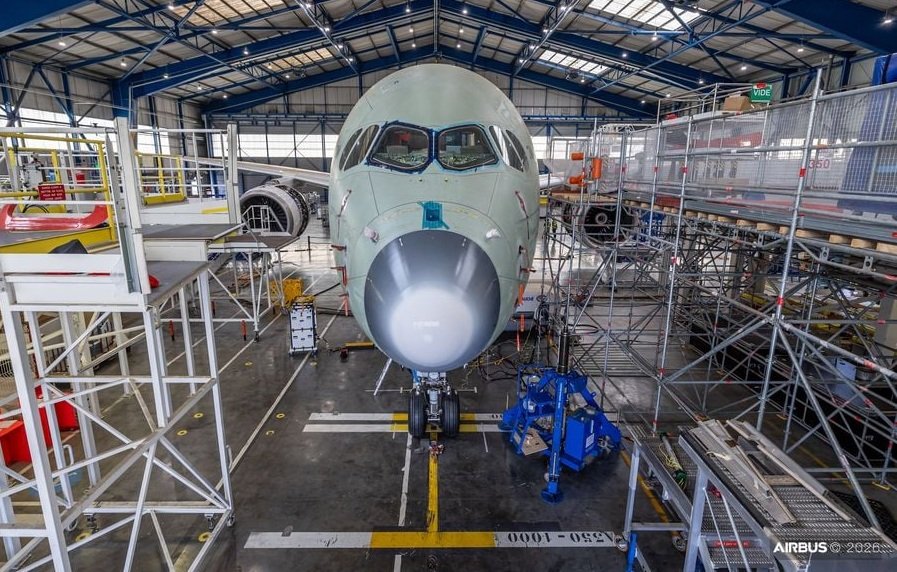
Airbus is preparing to carry out flight vibration tests, known as “flutter tests” on its A350 freighter prototype as it works towards clearing the newbuild model for flight tests and service entry.
These tests will be conducted during the first three months of the flight test campaign, said Airbus in a progress update on its website on 3 August.
“These tests will take the aircraft up to its maximum dive speed and Mach (VD/MD), marking the final steps before the A350F is cleared for service entry,” said the aircraft manufacturer.
The first A350F has already undergone a series of rigorous development and certification tests.
This has included included ground tests earlier this year on the first aircraft in the final assembly line (FAL) in Toulouse, and test-rig demonstrations running in parallel for the Main-Deck Cargo Door (MDCD) actuation and the Cargo Loading System (CLS) in Bremen, Germany.
Following these, another kind of test milestone was recently performed – the Ground Vibration Test (GVT) – which took place in Toulouse over three days in June.
The GVT is designed to accurately model the aircraft’s dynamic response. By measuring how the aircraft reacts to controlled vibrations, the team could fine-tune the ‘finite element’ models used for aeroelastics and dynamic loads computation.
Nicolas Lastere, loads and aeroelastics expert, explained: “This validation is a ‘key enabler’ for the first flight, providing the necessary evidence to complete the first step of aeroelastics model validation – which is essential for the opening of the aircraft’s flight envelope.”
Preparation activities began several days before the tests. These included installing the testing set-up (e.g. the sensors, the electrodynamic shaker exciter, and the data acquisition chain); configuring the aircraft; and weighing the aircraft.
“The aircraft is excited by two means: by external shakers and by moving the aircraft’s own control surfaces,” explained Airbus.
The dynamic response of the aircraft is then captured by accelerometers, allowing an accurate identification of its structural characteristics.
The company’s video recordings show these parts of the aircraft resonate in response to the sine-wave vibration inputs.
To optimise the test duration, Airbus developed an innovative way to perform such tests: A data fusion approach was used – i.e. a combination of the aircraft’s own FTI (Flight Test Instrumentation) is complemented by additional autonomous sensors installed for the test.
“When the test was underway, the aircraft was ‘excited’ by its own control surfaces through sine sweeps performed on different frequency bandwidths,” said Fabien Ayme, aeroelastic testing expert.
“In addition, some shakers were connected to the airframe at the wingtips, on the rear fuselage cone (‘section 19.1’) and on the engines to complement the varieties of excitations.”
He added: “The accelerations were all monitored by the testing team in real-time. After each run, post-processing was performed in order to validate the data and provide first results to the design office for analysis – so they could adapt the test matrix.”
When the tests were completed, the overall consensus was that the GVT results were of a high quality and provided an overall good matching comparison with the theoretical model predictions.
The GVT is the culmination of two years of meticulous preparation. It draws on a wide array of expertise across the company, involving stakeholders from the Final Assembly Line, Flight Control Systems, Vibration Testing, Flight Test Instrumentation, Tooling Development, Aeroelastics, and Mass Properties & Quality.
“By validating the aircraft’s structural dynamics on the ground, the GVT team has ensured that when the A350F finally takes to the skies, it does so with the confidence of a design – particularly its aeroelastic model – that has been rigorously tested, measured and quantified,” concluded Ayme.
Two aircraft are now at Airbus’ final assembly line in Toulouse.
In May, Airbus explained it had been testing its A350F’s Main-Deck Cargo Door (MDCD) actuation system and Cargo Loading System (CLS) on large physical test rigs.
