


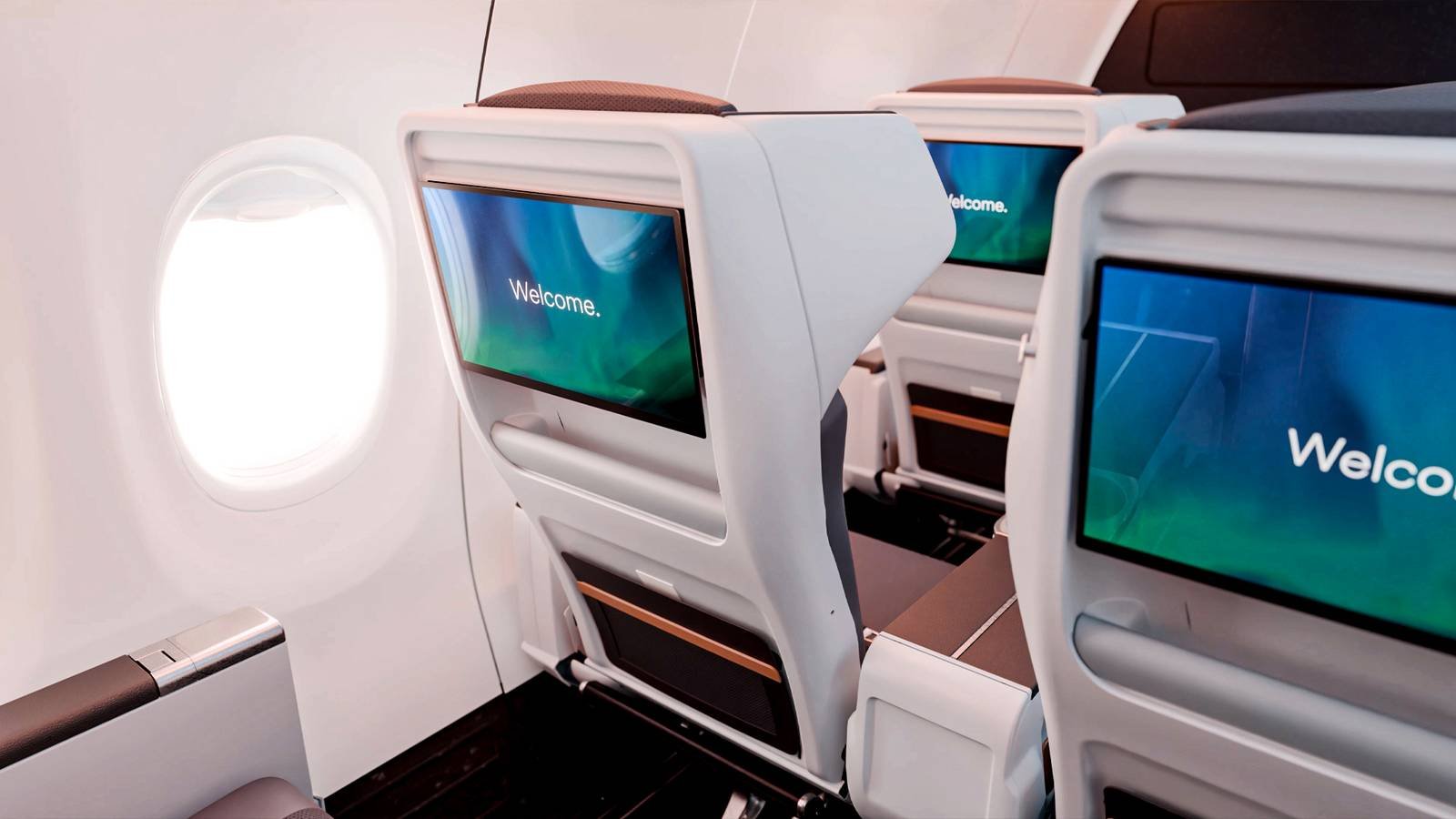
Anticipating the debut of its first Boeing 737 MAX 10, Alaska Airlines has announced its new in-flight entertainment (IFE) design, which will starkly divide the experience in the front of the cabin from the back of the jet. Only the two most expensive cabins get screens, which works out to roughly 15% of about 159 seats. Passengers in every other row will be on a bring-your-own-device plan (BYOD).
Splitting a cabin this way is rare. PaxEx commented that Copa Airlines may be the only other carrier doing something similar, which makes the choice stand out. Alaska announced the layout on September 29, at its Investor Day in Seattle. The new jet will be equipped with lie-flat Aurora Suites to fly on select transcontinental routes from 2028.
 Alaska has historically been opposed to seatback IFE for its single-aisle fleet to cut down on airplane weight. The Boeing 737 MAX 10 has already faced years of severe certification delays. Alaska also noted that keeping screens out of the main cabin helps them avoid further complex hardware certification delays so they can get the planes in the air faster. The airline is counting on free Starlink WiFi being enough to satisfy customers and make seatback screens unnecessary.
Breaking Down What Alaska Announced

The Alaska plan for the MAX 10 includes four cabins. Aurora Suites will be at the front, followed by its new, and first true premium economy class: Premium Reserve. Behind that will come Premium Class, which is actually just extra-legroom economy. Finally, there will be a Main Cabin with standard economy seating. According to Live And Let’s Fly, only the first two cabins get seatback screens on Panasonic’s Astrova system. Premium Class and Main Cabin passengers will use their own devices.
The table below breaks down the key differences between the different cabin classes on the upcoming MAX 10. The appearance of the Aurora Suites on the 737 airframe will also be a first for the airline. Notably, not every plane in the upcoming delivery of the 105 MAX 10s will be equipped with the same layout. Alaska has said that at least 25 will be configured using this arrangement.
Alaska executives framed the premium experience as being about the suites and Premium Reserve, while Main Cabin would resemble the rest of the fleet, according to APEX. Alaska’s Boeing narrowbodies have never offered built-in entertainment, and the Airbus jets inherited from Virgin America lost theirs after the merger. The airline expects its first MAX 10 delivery in the second quarter of 2027, but the lie-flat seats will not be installed until 2028.
The Front Row Certification Problem

The Federal Aviation Administration officially certified the Boeing 737 MAX 10, clearing the final hurdle after years of delays on October 20. Now, Alaska expects to take delivery of 22 MAX 10 aircraft throughout 2027. To get these planes into service as quickly as possible and avoid any further delays, this initial batch will feature Alaska’s standard, high-density domestic cabin layout with 188 seats.
Like the rest of Alaska’s current fleet, these 2027 planes will be strictly BYOD across all rows. The 25 aircraft equipped with the Aurora Suite will be a special premium heavy subfleet. This is the specific 2028 fleet that will introduce the 19-inch (48.26 cm) and 16-inch (40.64 cm) 4K screens to the front of the plane while keeping the back of the aircraft bare. The delay was unplanned, as Alaska did not know that the seats were still pending FAA approval when it unveiled the design to the public.
The primary reason for the delay is that the FAA subjects lie-flat premium seats to intense 16G dynamic crash testing. Traditional seats face straight forward, which makes managing crash impact forces relatively predictable. Lie-flat suites on single-aisle jets are typically installed at an angle. The FAA requires extensive sled-testing to prove that a human body positioned at an angle can survive a 16-G-force impact without hitting the suite walls or suffering severe neck and spinal trauma.
To pass the FAA’s strict head-injury criteria during a crash, angled lie-flat suites will require highly complex, inflatable airbag seatbelts. The FAA must also certify the entire cabin installation as a single system. Then the FAA must inspect to confirm the structures do not block emergency egress paths for the rest of the plane. Designing, testing, and adjusting the shell materials to pass these specific impact regulations routinely takes seat manufacturers 18 to 24 months.
What Hawaiian’s A330 Data Showed

The successful rollout of Starlink on the Hawaiian Airlines Airbus A330 fleet served as the proof-of-concept for Alaska. The pilot program launched on Honolulu’s widebodies directly informed the corporate leaders and gave Alaska Air Group the confidence to cut seatback screens from the main cabin of the upcoming 737 MAX 10.
However, Beat of Hawaii questioned how much that data proves. Hawaiian’s older screens were dated, which makes declining use harder to read as a verdict on seatback entertainment itself. A passenger who ignores an aging display has not necessarily rejected screens. The data may simply be related to a problem with Hawaiian’s hardware rather than seatback IFE overall.
These widebodies fly some of the most isolated routes in the world across the Pacific Ocean, entirely dependent on satellite coverage. Operational data proved that Starlink delivered gate-to-gate, low-latency broadband. The successful introduction of a route that passes over a vast span of remote Oceanic airspace also shows that the same coverage should be reliable over the continental US.
Hawaii essentially acted as the guinea pig. When given access to free, ground-speed internet, a massive percentage of travelers actively bypass the airline’s built-in entertainment system. The A330 data also highlighted where built-in screens still matter: the premium market. Passengers paying top-tier fares expect an all-inclusive, luxury environment where they do not have to prop up a phone.
What Alaska Could Still Change

Alaska heavily values an identical narrowbody cabin in their fleet so they can swap aircraft seamlessly if a flight is delayed or canceled. Because their current 737-800s, 737-900ERs, and MAX 9s are completely screenless, introducing screens to the back of only the MAX 10 would create a highly inconsistent passenger experience if an aircraft swap occurred. Still, there are some caveats to this overarching strategy.
Alaska’s real long-haul strategy reveals that the back of the bus will get seatback screens on select aircraft, and their anti-screen stance is highly dependent on the type of route the plane is flying. Alaska has left the door open to potentially changing its hardware in the back of some jets. Specifically, their upcoming widebody Boeing 787 Dreamliner fleet defies the norm established by the airline’s mainline 737 workhorses.
Unlike the narrowbody 737 MAX 10, the 787 Dreamliners are being built for long-haul international flights where BYOD is a much tougher sell to passengers. For the 787s, Alaska has committed to installing seatback screens with Bluetooth across all four cabins, meaning passengers in standard Premium Class and the Main Cabin will have built-in seatback TVs.
Alaska Ventures Into A New Era

The rollout of the MAX 10 is one part of a new campaign of aggressive overseas long-haul expansion as well as the progression of the post-merger fleet reorganization. For decades, Alaska proudly branded itself as a domestic, single-aisle carrier. By absorbing Hawaiian’s widebodies and placing its largest aircraft order in history, Alaska is using the MAX 10 as a pilot program to see how much premium domestic flying can feed a brand-new global network.
The 2028 MAX 10 launch will be a live test campaign for its Starlink WiFi partnership. Alaska will be closely monitoring passenger feedback data. If customer satisfaction scores tank significantly compared to Delta or United Airlines, changes may still be made. Similarly, if passengers aggressively complain about dead phone batteries and neck strain on 6-hour transcontinental routes, there may be a retrofit to the new MAX 10s.
When Alaska acquired Hawaiian, it instantly became a widebody operator, inheriting a mixed long-haul fleet of A330-200s and 787-9 Dreamliners. Alaska immediately launched an aggressive international expansion plan. The airline is executing a massive strategic realignment out of its tightly constrained Seattle-Tacoma (SEA) hub to facilitate its steady fleet and network growth.
Relying On Its Roots: Proudly Boeing

To sustain its aggressive pace, Alaska signed a massive deal with Boeing for 105 firm MAX 10s and expanded its firm 787 widebody order book to 17 aircraft, including a conversion to the larger 787-10 variant. The MAX 10 is the linchpin that connects the domestic network to this new international widebody operation. The standard 188-seat MAX 10s arriving in early 2027 allow Alaska to fly more people per flight from major domestic cities into Seattle without using up valuable airport slots.
Alaska’s chief financial officer has also stated that the high-density 188-seat domestic MAX 10s are incredibly cheap to operate, which allows them to offer highly aggressive economy pricing. By leaving the main cabin un-screened initially, they save millions in fuel weight and hardware costs. But because they are aggressively competing for premium international travelers who demand a top-tier tech experience, corporate leadership has purposely left the door open to retrofitting the fleet.
They believe that if passengers have free, blazing-fast WiFi, they will happily stream onto their own devices and ignore the lack of a seatback TV. On the other hand, the airline will be watching to see if premium economy passengers or corporate travelers begin changing over to United or Delta because they are tired of BYOD inconvenience. In which case, Alaska can easily expand the IFE hardware during regularly scheduled overnight maintenance intervals.
NEAR YOU NOW
What’s that plane overhead?
See every flight within 20 miles of you right now and where they’re
all going.
