



A combustion chamber with undetected flaws, or a nozzle with clogged internal channels observed during a hot fire test, can set a rocket programme back months. At NASA‘s Marshall Space Flight Center, that risk has pushed engineers to treat additive manufacturing in aerospace as an integrated chain of design, build and post processing steps, where weak links anywhere along that chain can mean scrapped parts and lost months.
Dr. Paul Gradl, principal engineer at NASA Marshall Space Flight Center, laid out that view of metal additive manufacturing (AM) in a session titled “Pushing the Envelope: NASA’s Frontline Applications of Metal Additive Manufacturing” at our online event Additive Manufacturing Advantage: Aerospace, Space and Defense 2025.
Dr. Gradl returns for AMAA 2026 this week, register here for AMAA 2026, taking place online on July 9th.
Post processing decides whether a part survives qualification
AM for aerospace, in Gradl’s framing, runs through a sequence of interlinked stages: design for additive manufacturing (DFAM), model and analysis checks, build layout and support generation, followed by process parameters and metal feedstock selection, and finally post processing (really just “the process”), covering powder removal, heat treatment, support and build plate removal, and inspection. Each stage feeds into the next, and a decision made early in design can determine the final geometry and material properties of a part.
The consequence of overlooking the later stages is blunt, in his telling. Gradl said success in metal AM depends on understanding post processing, adding that his organization has several scrapped parts because something was missed in that phase. The whole sequence is iterative, often cycling through design, build and post processing several times before a process is locked down, a pattern he compared to the trial and error his own children encounter when 3D printing toys at home.
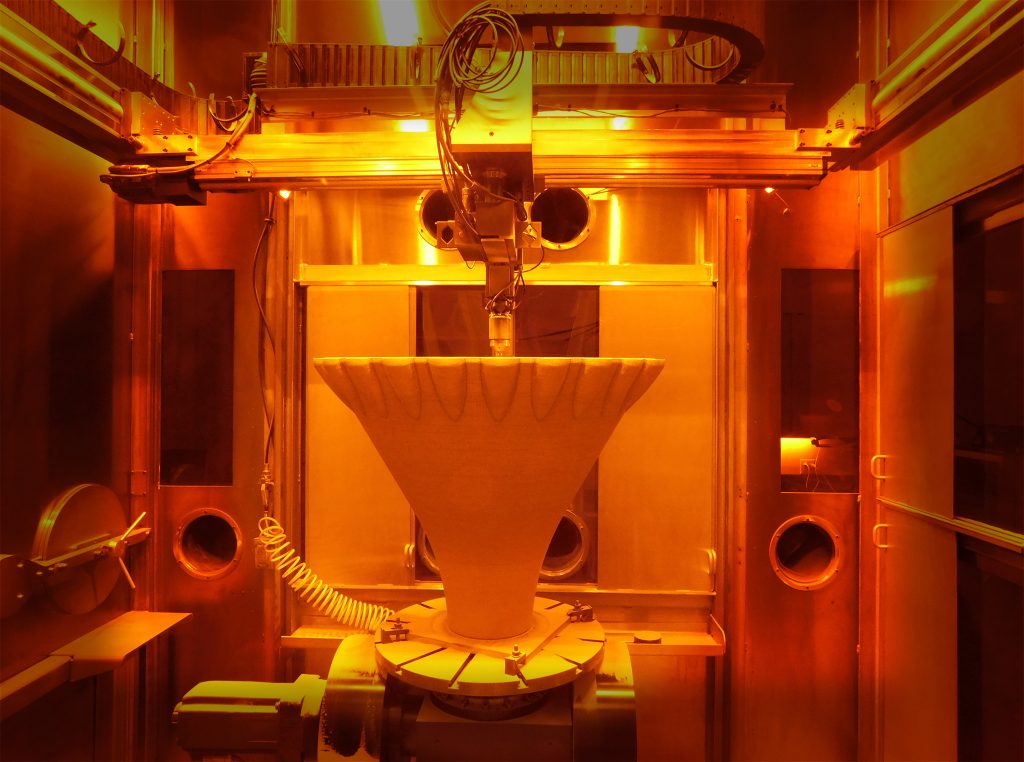
NASA does not favour one AM process over another, an approach Gradl described as process agnostic. Laser and electron beam powder bed fusion, directed energy deposition (DED), additive friction stir deposition, cold spray, and ultrasonic AM each suit different applications: powder bed fusion for fine, complex internal geometry, and additive friction stir deposition or cold spray where a part replaces a casting or forging. NASA’s current parts span both ends of that range, from internally channelled powder bed fusion components to large scale DED parts reaching two to three metres in diameter and height, a scale that, according to Gradl, was not achievable with this level of internal complexity five years ago.

New alloys depend on AM
Some materials NASA now uses, in Gradl’s account, could not have been produced, or formed into useful shapes, without AM. GRCop-42, a high conductivity, high temperature, oxidation resistant copper alloy, was previously made through powder metallurgy or rolled from extruded plate. AM, he said, allows engineers to form it directly into combustion chamber geometries, and the material has flown with commercial space partners.
Two further examples followed the same logic. NASA HR-1, a hydrogen resistant alloy, became practical for high temperature, high pressure hydrogen applications because of AM. GRX-810, an oxide dispersion strengthened alloy developed at NASA Glenn Research Center, offers what Gradl described as a thousand times better creep life than traditional nickel based superalloys, with continuous operation approaching 1,200 to 1,300°C.
Tools such as integrated computational materials engineering have accelerated this work, he said, citing a new burn resistant material for pure oxygen environments that went from concept to test specimens in roughly three months, down from a process that previously took years. Multi-material and multi-process AM extends the same approach further: combustion chambers combining GRCop-42 with NASA HR-1, built using both powder bed fusion and DED, allow high conductivity and high strength properties to sit in different zones of the same part rather than being limited to a single alloy.
Underpinning all of this is data. NASA is characterizing roughly 50 AM materials across an estimated eight thousand plus samples, tracking processing, thermal history, heat treatment and detailed microstructure and fracture mechanisms.

NASA’s data and standards work echoes a wider push for shared AM material baselines
NASA’s stated rationale for releasing its material characterization data, that the industry currently lacks open databases comparable to those for traditional raw materials, points to a gap other organisations in the additive sector have also worked to close. NASA’s own role, as Gradl described it, centres on leading development of AM standards and qualification approaches for human spaceflight, giving NASA and commercial partners a common technical basis for new alloys rather than each requalifying from scratch.
That same data sharing instinct underpins NASA’s collaboration with commercial space companies on materials it has developed in house. NASA’s RAMPT project, for instance, transferred its GRCop-42 copper alloy into Relativity Space’s Terran 1 vehicle, with NASA providing the technical expertise to move the material from an internal development programme into a flight ready product. Gradl described this kind of transfer as a deliberate model for the agency’s work, saying NASA takes on the development risk and matures a process through qualification so the resulting alloys can advance industry capabilities more broadly (as well as NASA missions).
NASA’s aluminum nozzle work follows a similar pattern of taking an industry constrained material and making it usable for additional additive processes. Through its Reactive Additive Manufacturing for the Fourth Industrial Revolution (RAMFIRE) project, developed with material supplier Elementum 3D, the team produced a weldable aluminum alloy with the heat resistant properties needed for rocket engines at large scale, a material industry has since made available beyond just NASA programmes.
NASA is positioning lunar and Martian AM as the next frontier
Gradl closed his presentation by extending the discussion beyond rocket engines to NASA’s longer term goals of establishing a presence on the Moon and exploring Mars. AM using in-situ resources, including lunar regolith, being explored as a means of building roads, landing and launch pads, habitats and power plants on site, reducing the need to transport materials from Earth.
Early demonstrations include directed energy deposition of simulated regolith to produce test bricks and shapes, alongside exploratory work in vacuum extrusion and sintering based processes. These efforts remain at an early process development stage, Gradl said, and space manufacturing carries its own set of challenges distinct from those NASA has already addressed in terrestrial rocket engine production.
Asked what he wanted the audience to take from the session, Gradl pointed to the rigour required across the entire process, from early decisions to final qualification, rather than the build step alone. “It’s not just the process, it’s every step from the early design decisions that we make all the way through qualification and certification of parts bringing them to space,” he said.
Register for AMAA 2026, taking place online on July 9th.
To stay up to date with the latest 3D printing news, don’t forget to subscribe to the 3D Printing Industry newsletter or follow us on Twitter, or like our page on Facebook.
While you’re here, why not subscribe to our Youtube channel? Featuring discussion, debriefs, video shorts, and webinar replays.
Featured image shows Additive Manufacturing Advantage: Aerospace, Space and Defense. Image via 3D Printing Industry.
