


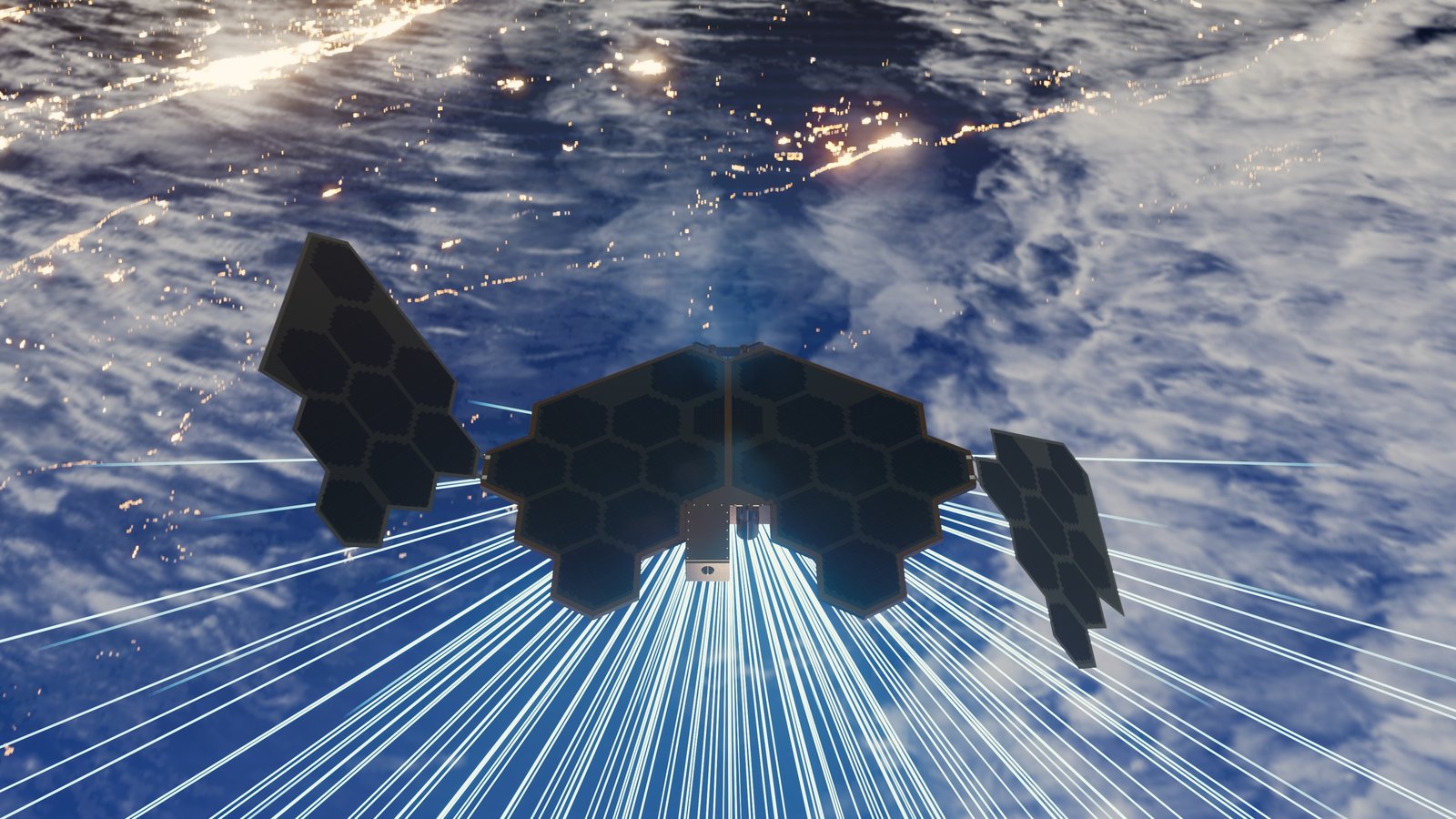
SpinLaunch CEO Massimiliano “Massi” Ladovaz paints an ambitious picture of a rapidly shifting space industry driven as much by geopolitics and sovereignty as by engineering innovation.
Ladovaz argued that SpinLaunch’s Meridian system, meant to employ smaller, highly-efficient satellites, could make sovereign constellations financially attainable for countries and regional operators that previously lacked the resources to compete.
He spoke with SpaceNews about the company’s nascent launch technology, which uses kinetic acceleration rather than traditional rockets, and the broader strategy aimed at radically lowering the cost of deploying satellite constellations.
The following conversation has been edited for clarity and length.
David Ariosto: Your company became famous just by virtue of the nature of the technology, essentially using centrifuge acceleration that uses a mechanical arm inside a large vacuum chamber to fling payloads into orbit, rather than using rockets.
Massi Ladovaz: Absolutely. Who doesn’t know SpinLaunch, right? It’s fascinating what the team put together. And it talks a lot about the nature of the company. It’s really disrupting innovation. Try having a problem and try to look at it in a different way.
Yes, and you yourself have been around the block a few times, having worked across the space industry. With your own evolution in terms of leadership, what convinced you to go to SpinLaunch?
’ve been in the industry for the last 25 years. I’ve built quite a few satellites, including, obviously, I was the CTO of OneWeb. [That meant] hundreds of satellite launches. But when I was contacted for the job [at SpinLaunch], my first reaction was ‘forget it, I’m not interested.’ I said no to it. And then after extensive due diligence, I realized that these guys had put together something really, really disruptive. And that’s why I got very excited about it, and I said, ‘I want to be part of it.’
What guidance and what lessons did you bring?
First of all, I bring all the scars of building a constellation. I know how hard it is to bring a constellation, but I really try to build on what the team has put together. As I said, the main differentiator of Meridian is looking at the LEO problem in a different way. Meridian is substantially cheaper to build and to deploy than other systems. We need hundreds of millions to build and deploy a constellation, versus billions. When I saw that, I said, ‘guys, we also need to change the go-to-market.’ Today, there is another challenge that the industry has, or another need. [That’s] about control. Sovereignty is becoming more and more important as an element.The paradigm can be completely changed, because if a constellation costs 6, 7, 8 billion dollars, even a government is struggling to pay that amount of money. [But] if you go to a government and you say, no, actually, it’s going to cost hundreds of millions, immediately, the door is open … And that’s where we did change the go-to-market. That was my contribution.
Some customers are really just trying to minimize the cost of the infrastructure. That’s for Kuiper, and that’s for Amazon. Good for them. A lot of other customers are concerned about the fact that one day, they could be turned off. One way, one day, somebody would decide, ‘Oh, this country cannot access the system anymore.’ And this is resonating very, very much. I mean, you can see the push in Europe, you can see the push in the Middle East, you can see the push in Asia. We are still a relatively small startup, but the intensity and the demand from customers is incredible. They really want control. They want sovereignty.
Does that diversity happen if it’s not done in tandem with launch? Because I don’t know that the launch question has been solved in terms of the broader global market.
The fact is that our technology is such that we could launch an entire constellation on only one launcher. And that changes the story. Now, obviously, you have to find one rocket, but it’s very different to find one rocket and having to find 20, 30, 40.
From an outsider’s perspective, it would seem like you’re competing with something that’s got far more redundancy and therefore far less risk … but explain that to me a little bit more.
The technology allows you to get to the number of satellites that Starlink has launched. It very much depends how much redundancy or how many satellites that a customer would want. Our system is so cheap that we could keep launching at a fraction of the cost. Other systems are very sophisticated, very expensive and you don’t want to even try to compete on that. [But] that’s a differentiator. We could launch thousands of satellites if we wish. We don’t need them. We are operating at a higher altitude as well. We could launch at lower altitudes if people want. That’s the type of flexibility that we give to the customers.
How much does the geopolitical situation play into the calculus for customers?
Everyone now is talking about sovereignty, and people understand sovereignty in a different way. What we offer is a turnkey system to customers. People can buy and own their own constellation. All those elements about control and the geopolitical situation are really, really very important with a lot of customers.
