


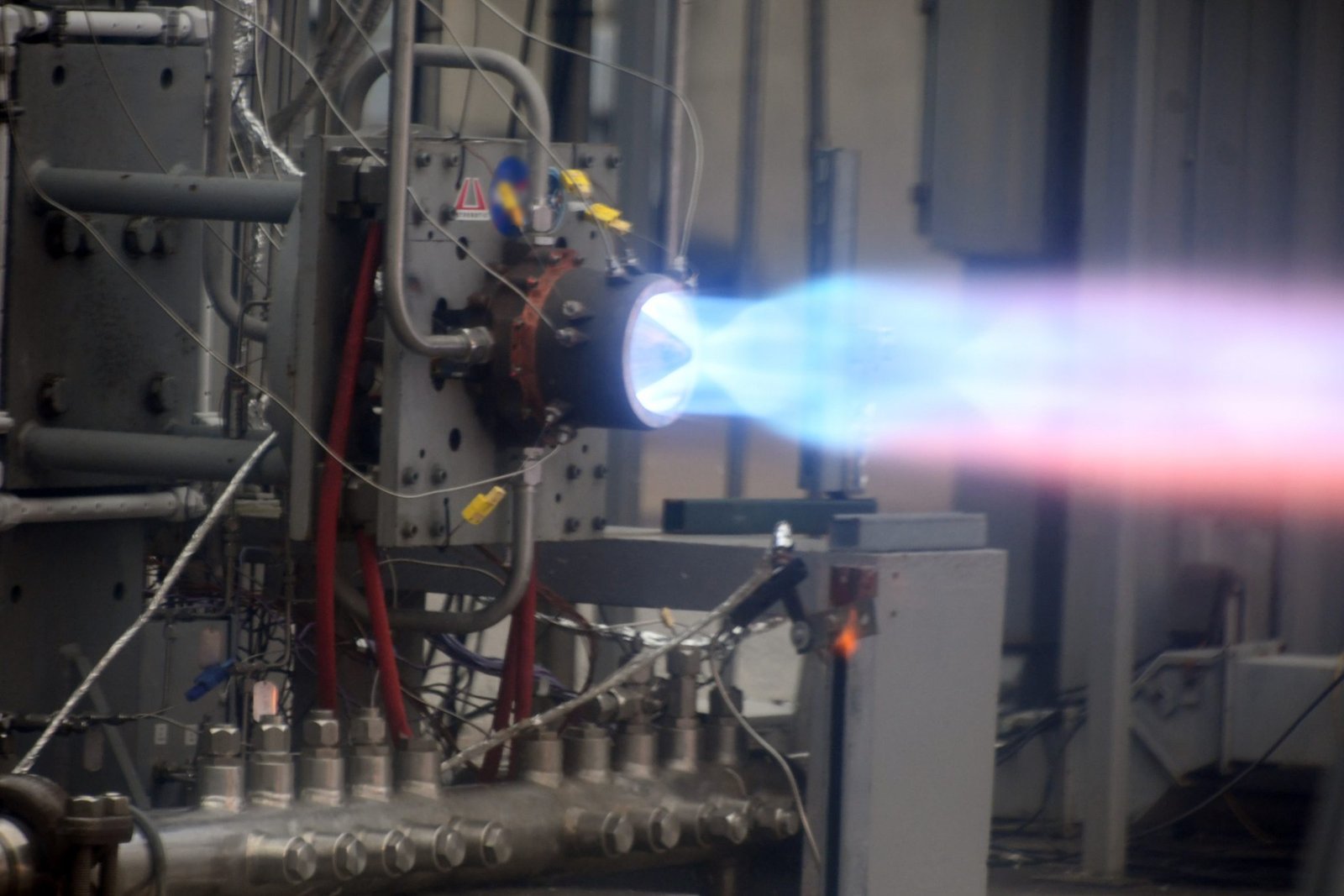
Pittsburgh-based space robotics and lunar logistics company Astrobotic has completed a hot fire campaign for its Chakram rotating detonation rocket engine, with additive manufacturing playing a central role in enabling the milestone. Two prototypes completed eight successful tests at NASA’s Marshall Space Flight Center in Huntsville, Alabama, accumulating more than 470 seconds of total run time, including a single 300-second continuous burn believed to be the longest ever recorded for an RDRE.
PermiAM: The Additive Manufacturing Technology Behind Chakram
At the center of the Chakram programme is PermiAM, a patented metal additive manufacturing technique co-developed by Astrobotic and Elementum3D that enables tunable porosity within printed metal components. The ability to precisely control how porous a material is has direct consequences for thermal management, combustion stability, and propulsion efficiency, three of the most demanding engineering challenges in RDRE design.
The NASA SBIR contracts supporting the programme focused specifically on novel injector design and the application of PermiAM to RDRE components, making additive manufacturing not a peripheral contribution but a foundational one.
The results speak to that foundation. Each prototype produced over 4,000 pounds of thrust, placing Chakram among the most powerful RDREs ever demonstrated, with nearly all hot fires reaching thermal steady state, the marker of stable, sustained engine operation.
What RDREs Do Differently
Unlike conventional rocket engines, which combust propellant through continuous, steady-state burning, RDREs use supersonic detonation waves rotating around a ring-shaped chamber. That process extracts more usable energy from the same amount of fuel, offering up to 15% improvement in specific impulse, a better thrust-to-weight ratio, and a smaller, lighter engine overall. The challenge has always been controlling those detonation waves with enough stability to make the technology practical, which is precisely what Chakram’s test campaign demonstrated.
“Chakram more than exceeded our expectations. With any cutting-edge technology like an RDRE, moving from design into testing, you’re always worried about unknown factors that could be critical to performance. But the engine performed even better than expected,” said Bryant Avalos, Astrobotic’s Principal Investigator for the Chakram program. “The 300-second burn was the cherry on top. Demonstrations like this show how RDRE technology could support a wide range of Astrobotic missions, from propulsion on future lunar landers to in-space orbital transfer vehicles, and other capabilities that will help expand operations throughout cislunar space.”

Next Steps and Future Applications
Astrobotic plans to incorporate Chakram into several upcoming vehicles, including Griffin-class lunar landers, Xodiac- and Xogdor-class reusable rockets, and an orbital transfer vehicle in development. The next phase of the programme will concentrate on regenerative cooling, throttling, and mass reduction, with PermiAM’s thermal management capabilities expected to remain central to that work.
“This test campaign was a tremendous success, and we met every objective we set out to achieve,” said Monica Traupmann, Co-Investigator on the Chakram program. “The data from these tests gives us a powerful foundation for the next phase of RDRE development and will help guide future engine designs. I’m excited about where we can take this technology next.”
Additive Manufacturing and the RDRE Frontier
For decades, rotating detonation rocket engines existed mostly on paper. The combustion environment, supersonic detonation waves, extreme heat flux, rapidly cycling pressure, made the hardware requirements difficult to meet through conventional machining. Additive manufacturing changed that. By enabling complex integrated structures such as coolant channels, flow paths, and injector orifices that cannot be produced any other way, and pairing them with advanced alloys capable of surviving the conditions inside an RDRE, the technology has unlocked efficiency gains over traditional chemical rocket engines.
Astrobotic is not the only company building on that foundation. NASA’s RDRE programme at Marshall Space Flight Center has relied on laser powder bed fusion alongside GRCop-42 and GRX-810 alloys to produce thrust chambers with wall geometries and cooling architectures that conventional machining simply cannot replicate, hardware that liquid propulsion engineer Thomas Teasley described as the direct enabler of the RDRE becoming a practical reality.
In April 2025, Venus Aerospace incorporated a NASA SBIR-developed laser powder bed fusion nozzle into its RDRE platform, a component its CTO described as ready for flight integration across future landers, orbital transfer vehicles, and hypersonic drones.
Astrobotic’s Chakram campaign, built around its proprietary PermiAM porosity control process, now adds what is said to be the longest sustained RDRE burn on record to that growing body of evidence.
3D Printing Industry is inviting speakers for its 2026 Additive Manufacturing Applications (AMA) series, covering Energy, Healthcare, Automotive and Mobility, Aerospace, Space and Defense, and Software. Each online event focuses on real production deployments, qualification, and supply chain integration. Practitioners interested in contributing can complete the call for speakers form here.
To stay up to date with the latest 3D printing news, don’t forget to subscribe to the 3D Printing Industry newsletter or follow us on LinkedIn.
Explore the full Future of 3D Printing and Executive Survey series from 3D Printing Industry, featuring perspectives from CEOs, engineers, and industry leaders on the industrialization of additive manufacturing, 3D printing industry trends 2026, qualification, supply chains, and additive manufacturing industry analysis.
Featured image shows successful hot fire test of the Chakram rotating detonation rocket engine (RDRE) at NASA’s Marshall Space Flight Center (MSFC) in Huntsville, Alabama. Photo via Astrobotic.
