


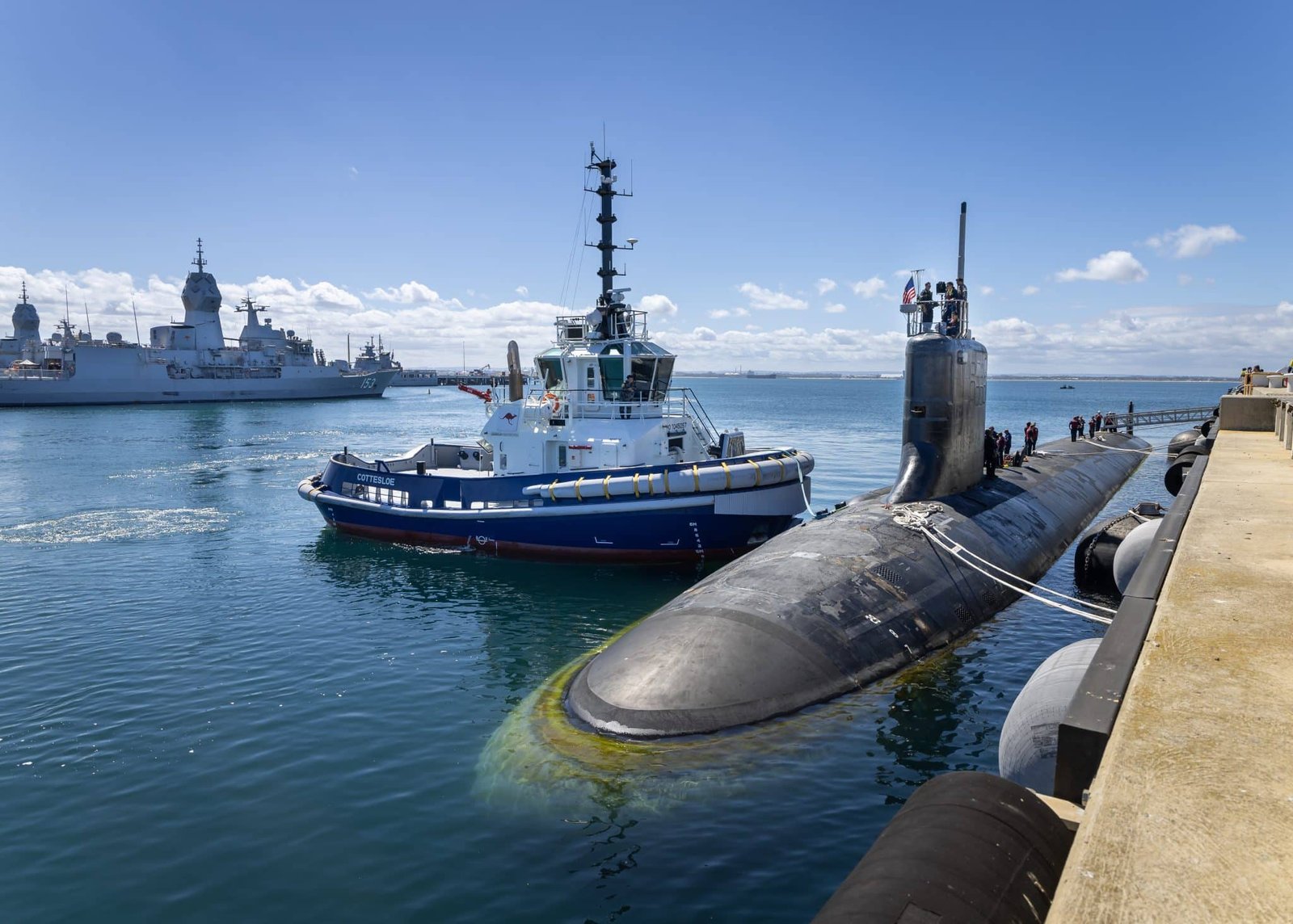
The three AUKUS partners Australia, the United Kingdom and the United States have published a new statement on the side of the Shangi La-Dialogue in Singapore. The declaration notably changes the acquisition of Virginia-class nuclear powered submarines by Australia under the AUKUS Pillar I “Optimal Pathway”. Also part of this agreement is the intention to collaborate on developing payloads for uncrewed underwater vehicles (UUV) under AUKUS Pillar II.
Joint Statement, AUKUS Defence Ministers’ Meeting
30 May 2026
Today the Honourable Richard Marles MP, Australian Deputy Prime Minister and Minister for Defence, the Honorable Pete Hegseth, U.S. Secretary of War, and the Right Honourable John Healey MP, UK Secretary of State for Defence, met at the U.S. Embassy in Singapore and re-affirmed their commitment to delivering the AUKUS partnership.
Pillar I – Conventionally-Armed, Nuclear-Powered Submarines
Through discussions today, the Deputy Prime Minister and Secretaries confirmed that AUKUS Pillar I remains on track to support Australia’s acquisition of a conventionally-armed, nuclear-powered submarine capability.
The Deputy Prime Minister and Secretaries confirmed key milestones continue to be met for Submarine Rotational Force-West (SRF-West) and announced the finalization of necessary arrangements for the establishment of SRF-West in 2027. SRF-West will directly support submarine deployments by expanding maintenance options and sustainment infrastructure in the region and will accelerate Australia’s readiness to own, operate, maintain, and regulate a sovereign conventionally-armed, nuclear-powered submarine capability. Just this month, the United States authorized establishment of the U.S. Navy support elements for SRF-West and will begin rotating the first U.S. Navy personnel to HMAS Stirling later this year. Likewise, the United Kingdom reaffirmed its commitment to have a rotational presence as part of SRF-West and noted the successful Submarine Maintenance Period conducted earlier this year by HMS ANSON.
The Deputy Prime Minister and Secretaries acknowledged Australia’s planned investments of up to AUD 8 billion at SRF-West for infrastructure and logistics support at HMAS Stirling, along with Australia’s initial down payments of AUD 3.9 billion to deliver the new Submarine Construction Yard in South Australia and AUD 12 billion for the Henderson Defence Precinct—including to support the delivery of contingency docking and depot level maintenance capabilities.
The Deputy Prime Minister and Secretaries welcomed the proposed approach to streamline Australia’s acquisition of Virginia-class submarines (VCS), simplifying supply chain management, operational and maintenance requirements, and maximising cost efficiencies. This approach would enable Australia to acquire three in-service VCS in lieu of a mixture of new and in-service VCS variants.
The Deputy Prime Minister and Secretaries acknowledged significant progress in the design and delivery of SSN-AUKUS, which will provide the UK and Australia with an advanced warfighting capability. This progress has been underpinned by investments from both the UK and Australia, including GBP 6 billion that the UK committed in 2025.
Pillar II – Advanced Capabilities
The Deputy Prime Minister and Secretaries reaffirmed the critical importance of accelerating the delivery of advanced capabilities under AUKUS Pillar II. They announced the first AUKUS Pillar II Signature Project: developing cutting-edge payloads and enabling systems for AUKUS partners’ Uncrewed Undersea Vehicles (UUVs), with delivery starting in 2027. This project is intended to significantly enhance AUKUS partners’ ability to protect critical national seabed infrastructure; deploy cutting edge surveillance, reconnaissance, and strike capabilities; conduct logistics operations; and bolster superiority in anti-submarine and anti-surface warfare, mine countermeasures, electronic warfare, and contested littoral manoeuvre.
Defence Trade and Industrial Base Collaboration
The Deputy Prime Minister and Secretaries confirmed their support for expanding the breadth of the AUKUS licence-free environment between AUKUS partners by taking expeditious and practical steps to narrow the list of excluded technologies. The Deputy Prime Minister and Secretaries also reaffirmed the value of the Advanced Capabilities Industry Forum and deepening collaboration across the trilateral defence industrial base.
-Ends-
Naval News comments:
The original AUKUS agreement in March 2023 through the “Optimal Pathway” intended the transfer of three Virginia-class submarines to Australia. Two of these would be in-service boats of the Blk IV-standard, which is presently entering service with the United States. The third boat would have been a newly produced hull for delivery to RAN in 2037. According to earlier statements in reporting this third boat would be of the Blk VII-standard.

The United States are presently transitioning Virginia-class production to nine boats of the Blk V standard. A similar figure of Blk VI-boats would follow suit. These variants feature an extended hull incorporating multiple Virginia Payload Modules behind the sail. The VPMs providing increased missile capacity aim to replace four converted Ohio-class SSGN, which will retire over the next years. Additionally, at least one boat will provide a seabed warfare capability replacing the the Seawolf-class submarine USS Jimmy Carter (SSN-23).
Construction for Blk V and VI will finish in the mid- to late 2030s. After that the United States intends to resume production of “standard length” Virginia-class boats in a new Block VII-configuration. This decision has its origin in the deferral of SSN(X)-development and production from the 2030s into the 2040s.
Uncertainty over Virginia variant and timeframe-changes
The statement does not clarify what variant the United States is now earmarking for transfer. The difference would have implications for the expected service time remaining for RAN. Virginia-class SSN have a designed for service life of approximately 33 years. The HEU reactor design does not provide for refuelling for the life of the boat. The original plan intended to deliver used boats with an estimated 20 years of service life left. Of ten Virginia Blk IV eight have joined active service with USN between 2020 and 2026.
The AUKUS-statement does not mention the previously outlined option for an additional two Virginia-class submarines. This contingency was in place, should British-Australian development for SSN AUKUS experience any delays. Finally, the modified agreement does not specify any changes for the delivery timeline of the three submarines in question.
Deepening collaboration on underwater drones
Beyond the AUKUS submarines the other significant material aspect of the agreement is an intended cooperative development and fielding of payloads and undefined “enabling systems” for uncrewed underwater vehicles. The three partners already work together regarding the development of naval drone command and control. A notable example is exercise “Autonomous Warrior” under the so-called “Maritime Big Play Initiative” of AUKUS Pillar II. Further collaboration formalising common drone control and deployment infrastructure would be a logical consequence of such activities.

The United States is also drawing on existing capability through Anduril’s Dive XL UUV. The American company originally developed this large underwater drone for the Royal Australian Navy through the Ghost Shark-program. The United Kingdom so far is not participating in this effort. London instead pursues a very similar capability under Project Cetus, which resulted in the Excalibur UUV. A common operational infrastructure including compatibe payloads for any of these UUVs could notionally be an aspect of the present declaration. However, further technical details on the effort have to await clarification in future official communication.
