


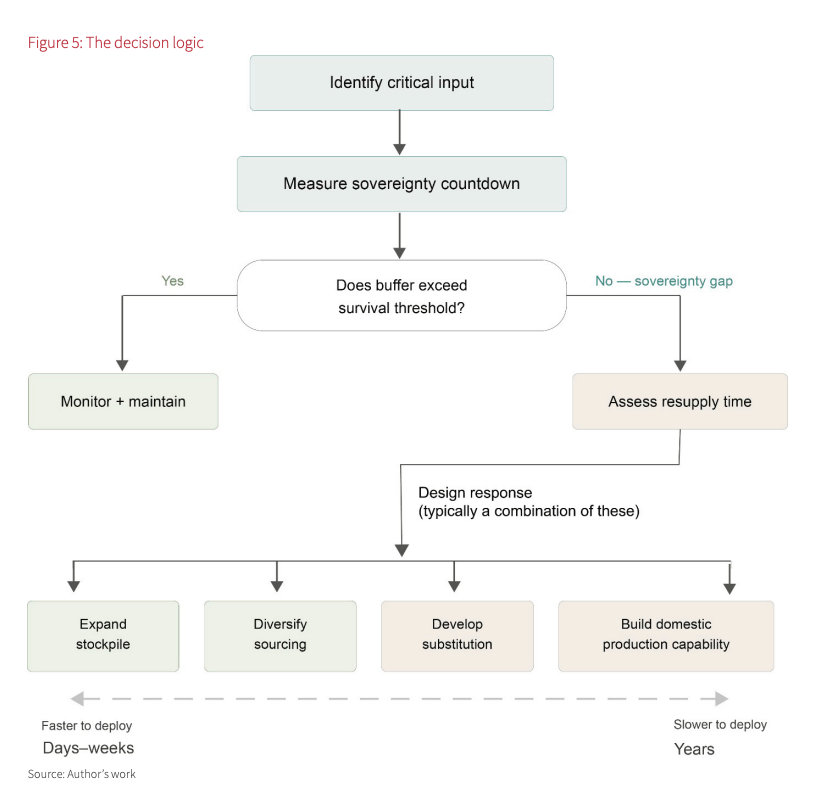
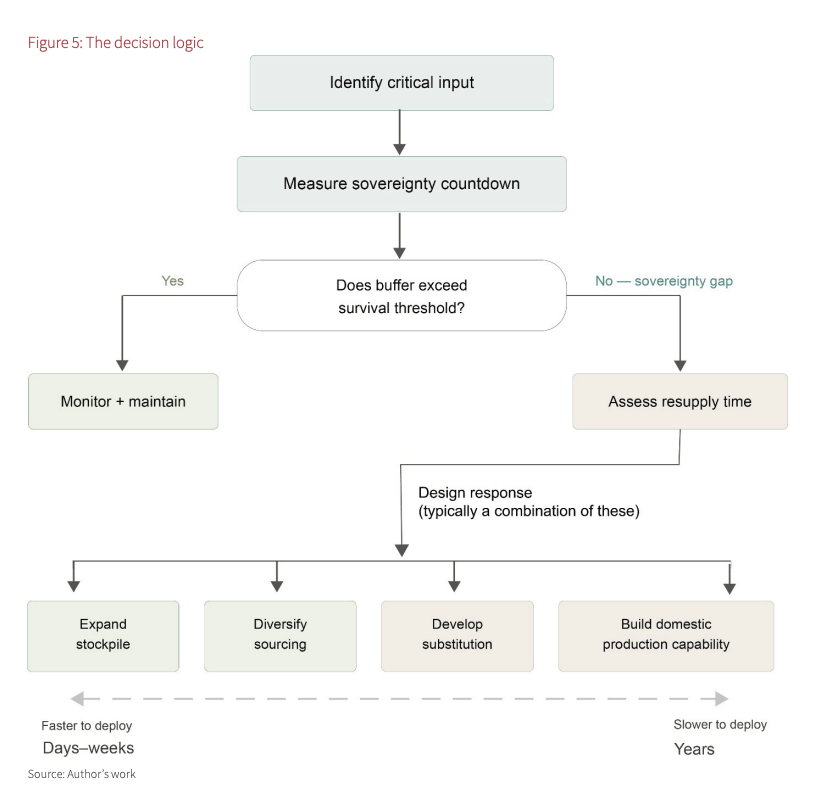
A new policy report from the Australian Strategic Policy Institute (ASPI), authored by Steven Camilleri, co-founder and CTO of metal 3D printing company SPEE3D, argues that national resilience is not a political ambition but an engineering problem. Titled Make Stuff Here… Or Else, the report introduces the concept of the “Sovereignty Countdown”: the measured window of time a critical system can keep running once external supply is cut off. For the 3D printing sector, the implications are direct and worth attention.
From Efficiency to Endurance: The Strategic Shift
For decades, the dominant logic of global manufacturing was cost optimization. If a component was cheaper offshore, sourcing it offshore was rational. That logic held as long as supply chains were stable, maritime routes were open, and geopolitics was predictable. None of those conditions can be assumed today.
The report argues that Australia, like many advanced economies, has traded its industrial immune system for the comfort of a distribution warehouse. Workshops closed, foundries shuttered, and technical knowledge migrated offshore. What remained was storage and logistics: systems that can move and hold what others produce, but cannot regenerate supply once reserves run out. A warehouse can delay failure; it cannot prevent it.
At the center of the framework sits a measurable question every critical infrastructure operator should be able to answer: if external supply stopped tomorrow, how long could this system keep running? Water treatment chemicals in some Australian utilities sit at 14 to 21 days of buffer. Diesel reserves are measured in weeks. Agricultural inputs like urea carry longer countdowns but fail silently, a missed planting window shows up months later as a harvest shortfall. The countdown differs by sector. The vulnerability is the same.
Where 3D Printing Fits: The Production Layer
The report identifies three layers that keep a nation functioning: essentials (water, energy, food), systems (the infrastructure delivering them), and production (the capability to repair, replenish, and sustain those systems). Weakness in the production layer cascades upward. This is precisely where additive manufacturing enters the equation.
3D printing is uniquely suited to restoring that production layer, not by recreating 20th-century factory infrastructure, but by enabling distributed, on-demand fabrication closer to the point of need. The report explicitly names advanced manufacturing, including additive methods, as part of a “leapfrog opportunity”: rather than rebuilding legacy smokestack industries, nations can restore sovereign capability using more flexible, digitally driven production tools better suited to large geographies, dispersed infrastructure, and limited industrial workforces.
The report also extends this logic to the digital layer embedded in modern infrastructure. Critical systems now depend not only on pumps, valves, and chemicals, but on firmware, sensors, operational technology, and trusted hardware. A water treatment plant might hold weeks of chemical inventory while its control systems have no domestic replacement pathway at all. Sovereign capability in additive manufacturing therefore means more than machines, it means the domestic capacity to design, prototype, certify, and maintain the trusted components that critical systems depend on.
Challenges and Limits: What 3D Printing Cannot Do Alone
The report is careful to avoid the trap of industrial overreach, and the 3D printing sector should read it with the same discipline. The framework does not call for domestic production of everything, it asks which inputs are so critical that a nation must retain the capability to sustain them locally. Water treatment chemicals, fuel refining, and agricultural inputs sit at the top of that list, and their continuity depends on industrial foundations well beyond what any single technology can address alone.
Even within its domain, real constraints apply. Workforce capability is a binding limit, the report stresses that machines without skilled operators do not constitute sovereignty. Rebuilding industrial trades, apprenticeship pipelines, and technical knowledge is as necessary as installing the equipment itself.
The report also flags a trap that industrial policy often falls into: rebuilding domestic capability around a single, sheltered producer solves nothing. A protected monopoly operating without competitive pressure is just a different kind of dependency. What genuine sovereignty requires is breadth, more than one capable supplier, shared standards, and readiness that gets tested rather than assumed.
Additive Manufacturing and the Sovereignty Agenda
SPEE3D’s Camilleri is not writing from the sidelines. His company has been at the center of Australia’s effort to rebuild sovereign manufacturing capability in defense-critical materials, giving the report both policy weight and operational credibility. The argument it makes, that additive manufacturing is infrastructure for national continuity, not just a faster way to make parts, is one the sector is already acting on globally.
Australia’s own trajectory illustrates the strategy. The country’s vast geography, remote northern operating bases, and deepening exposure to Indo-Pacific maritime competition have made dependence on fragile global supply chains a strategic liability that no ally can reliably fill on short notice. That urgency has translated into real institutional commitment: the AUD$58 million Additive Manufacturing Cooperative Research Centre and SPEE3D’s ongoing cold spray work targeting critical naval alloys are not pilot programs, they are sovereign infrastructure in the making.
The same logic is playing out elsewhere. In the UK, Oxford-based Argive developed 3D printed microturbines explicitly positioned to reinforce British sovereignty in critical propulsion technology, with the capacity to produce hundreds to thousands of units per month through a near-shore supply chain.
At the alliance level, America Makes’ transatlantic defense collaboration has formalized AM as shared infrastructure for interoperability and sovereign resilience, where standards, data security, and repeatability matter as much as production capability.
The question is no longer whether 3D printing belongs in sovereign industrial strategy. The budgets, the programs, and the alliances have already answered it.
3D Printing Industry is inviting speakers for its 2026 Additive Manufacturing Applications (AMA) series, covering Energy, Healthcare, Automotive and Mobility, Aerospace, Space and Defense, and Software. Each online event focuses on real production deployments, qualification, and supply chain integration. Practitioners interested in contributing can complete the call for speakers form here.
To stay up to date with the latest 3D printing news, don’t forget to subscribe to the 3D Printing Industry newsletter or follow us on LinkedIn.
Explore the full Future of 3D Printing and Executive Survey series from 3D Printing Industry, featuring perspectives from CEOs, engineers, and industry leaders on the industrialization of additive manufacturing, 3D printing industry trends 2026, qualification, supply chains, and additive manufacturing industry analysis.
Featured image shows domestic production alleviates vulnerability. Image via Australian Strategic Policy Institute.
