


Picture a product designer preparing a four-color prototype for a client review. On a single-nozzle machine, every color change means unloading one filament, loading the next, and pushing plastic through the nozzle until the old color clears.
The wasted material and extra steps add up, and each one needs to go right for the job to finish as planned. Many people who have done multicolor work on a desktop printer will recognize this routine.
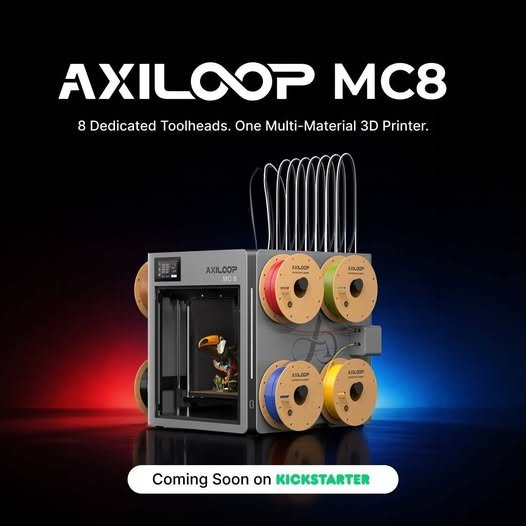
Toolchangers are one answer. Each tool holds its own filament and nozzle, and the printer swaps heads instead of feeding material through one. Introduced ahead of Formnext, consumer 3D printer manufacturer AXILOOP’s MC8 desktop 3D printer takes the idea to eight independent toolheads. Up to eight materials, colors, or nozzle configurations can be prepared for a single print, which is meant to reduce repeated loading, unloading, and purging.
Tool change speed matters because a multicolor print can call for many changes, depending on the model. AXILOOP specifies about four seconds per tool change with the head preheated.
For context, Snapmaker publishes five seconds for a direct toolhead swap on its U1, and Prusa lists roughly 12 seconds per change on its INDX system, measured from the last extrusion of one material to the first of the next. Stretch those numbers across 100 changes and the MC8 comes to 6 minutes and 40 seconds, against 8 minutes and 20 seconds for the U1 and 20 minutes for the INDX.
Worth knowing before anyone repeats those figures is that they are simple arithmetic on each manufacturer’s published nominal times. They are not head-to-head test results, the companies define their timings differently, and the totals leave out travel moves, heating, calibration, and purging. A 13-minute difference over 100 changes gives a sense of scale, not a guarantee for any particular job.
Workflow efficiency and engineering material support
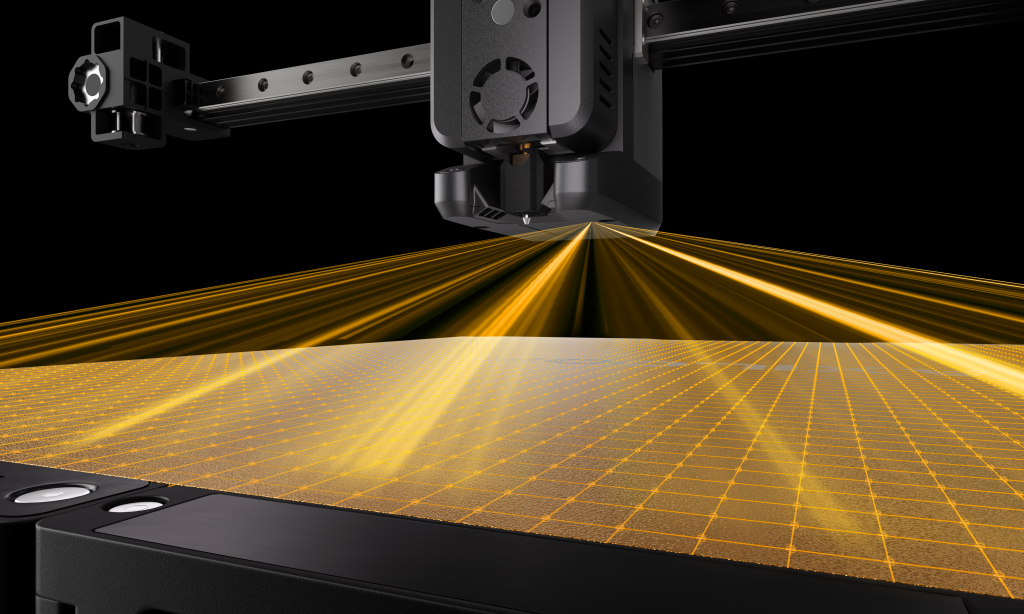
Other parts of the workflow aim to save time too. Automatic mesh bed leveling takes approximately one minute, and the purge design is optimized to reduce filament waste. The standard MC8 weighs 36 kg, so desk space and sturdiness are worth planning for.
At 40 kg, the MC8 Pro adds an enclosed body with a glass door, built-in chamber heating up to 65°C, and internal air circulation. This is intended to reduce warping with engineering filaments such as ABS, ASA, PA, and PC, along with carbon fiber and glass fiber reinforced polymers.
Building a system like this is demanding. Each of eight heads has to be picked up, positioned, and operated reliably, while temperature control, and software coordination all have to work together in a compact frame.
It is the kind of problem that Caroline and Murphy, who founded AXILOOP, had spent more than a decade working around while doing contract development for several 3D printer brands. In their experience, eight-toolhead machines were mostly either hobby-grade modifications or large, costly industrial units that small studios could not afford.
They built an in-house engineering team to change that, and brought on Martin Handshaw as senior advisor to assemble a testing and community network around the project. The MC in MC8 comes from the founders’ names, and the 8 stands for the toolheads.
The company is backed by Shenzhen Zesum Technology, a publicly listed company in China, and its subsidiary XiKe Industrial Co., Limited. The MC8 and MC8 Pro are its first eight-toolhead multicolor FDM printers, aimed at makers, product designers, and small production teams.
After a first public showing at Formnext Asia Shenzhen, the machine makes its global debut at Formnext 2026 in Frankfurt, Hall 12, Booth G61, November 17 to 20.
Technical specifications and pricing
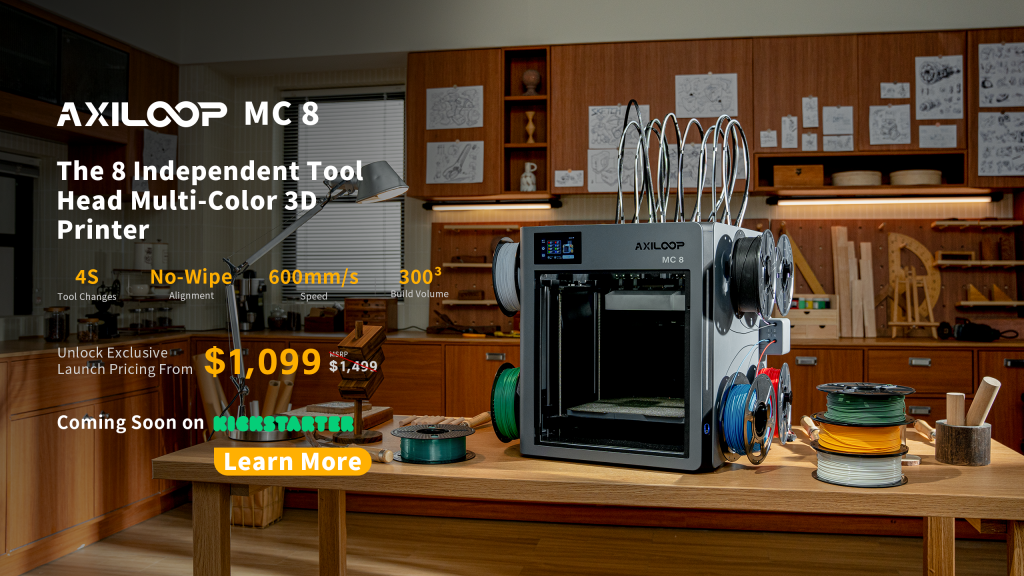
For those who do not want to wait for the show, the Kickstarter campaign launches soon at $1,099, with shipping expected to begin in the first quarter of 2027. Details and pre-order information can be found here.
| Product name | AXILOOP MC8 / MC8 Pro |
| Printer type | Desktop toolchanger FDM 3D printer |
| Independent toolheads | 8 |
| Build volume | 300 × 300 × 300 mm |
| Maximum print speed | 300 mm/s |
| Maximum travel speed | 600 mm/s |
| Maximum acceleration | 25,000 mm/s² |
| Maximum nozzle temperature | 320°C |
| Tool swap | 4 seconds (preheated) |
| Bed leveling | Automatic mesh bed leveling; approx. 1 minute |
| Slicer compatibility | OrcaSlicer |
| Weight | Standard: 36 kg; Pro: 40 kg |
| One-click Load / Unload | √ |
| Power Rating | 2200W high-power power supply, stable power output for constant chamber heating |
To stay up to date with the latest 3D printing news, don’t forget to subscribe to the 3D Printing Industry newsletter or follow us on LinkedIn.
Explore the full Future of 3D Printing and Executive Survey series from 3D Printing Industry, featuring perspectives from CEOs, engineers, and industry leaders on the industrialization of additive manufacturing, 3D printing industry trends 2026, qualification, supply chains, and additive manufacturing industry analysis.
Featured image shows the AXILOOP MC8 with eight filament spools loaded and a multicolor print on the build plate. Image via AXILOOP.
