


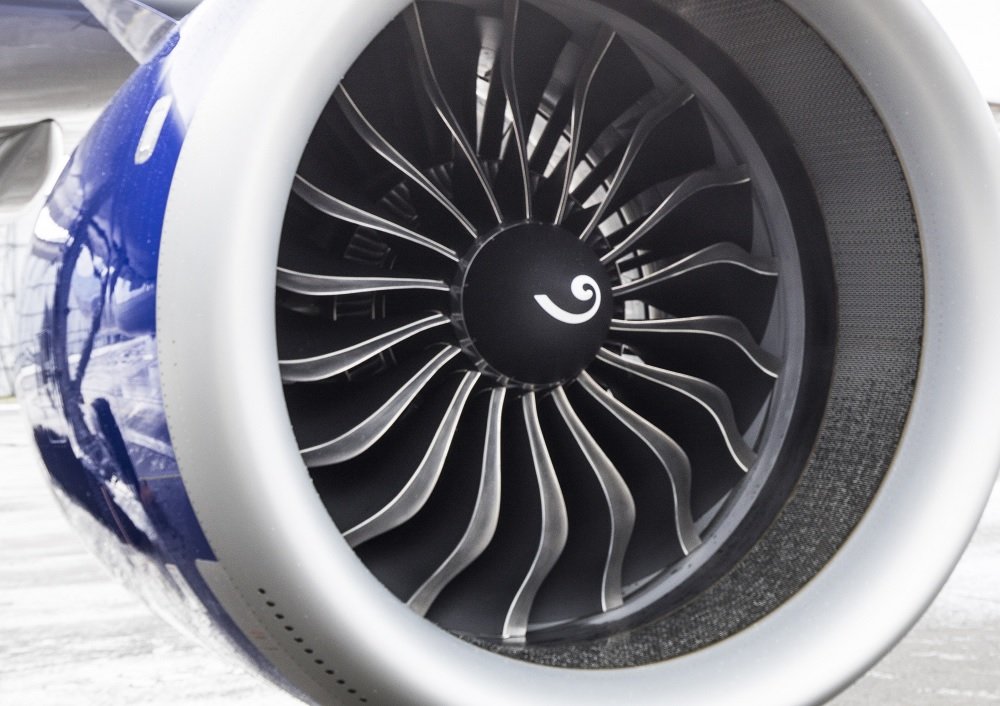
The US engine maker will gain control over the complex parts that have most bedeviled turbofan manufacturers.
GE Aerospace’s planned acquisition of airfoil producer Consolidated Precision Products (CPP) is not just a tactical move to address supply chain constraints.
Analysts also view the deal, revealed by GE on 8 September, as a long-term strategic step that will make the engine manufacturer less dependent on suppliers, and better able to control complex components that are perennially in short supply.
Such control can benefit GE’s existing engines and next-generation turbofans, and help break an airfoil duopoly, though it may not benefit the aerospace industry more broadly, observers say.
“I think it’s something beyond a supply chain play,” says Kevin Michaels, founder and managing director of aerospace consultancy AeroDynamic Advisory. “This is not some faulty vertical integration move that is ultimately going to backfire. It positions GE and CFM to be in control of their density.”
GE, which owns CFM International in partnership with Safran Aircraft Engines, will pay $11.75 billion to acquire Cleveland-based CPP, it says, adding that the deal will close in the second half of 2027.
“It’s really good for GE,” says Alex Krutz, managing director at Patriot Industrial Partners, noting GE can bring its “well-proven lean programme” – known as Flight Deck – to bear on CPP. “GE’s operating system will improve that business.”
“This doesn’t solve the significant constraints in the castings and forgings segment of the supply chain,” he adds.
Blades and vanes
CPP produces cast metallic components, most notably turbofan blades and vanes – exacting and difficult-to-manufacture airfoils. It makes a host of other aerospace components (flaps, ducts, housings, hubs, fittings and valves, for instance) from titanium, steel, aluminium, magnesium and nickel- and cobalt-based superalloys, according to its website.
CPP’s parts are found in turbofans made by essentially all major engine makers. GE engines with the parts include the CFM International Leaps that power Airbus and Boeing narrowbody jets, the GEnx that power 787s, T700 helicopter turboshafts, and F110 and F404 fighter-jet engines.
“Investing in mission-critical casting capacity is needed to support the strong simultaneous demand across commercial engines, aftermarket and defence,” says GE chief executive Lawrence Culp. “We expect to expand capacity, improve performance and accelerate new engine technologies for the current fleet and next-generation platforms.”
Owned by investment firms Warburg Pincus and Berkshire Partners, CPP employs some 6,600 people and has some 20 sites globally. It will generate $2 billion in 2027 revenue: 60% from commercial aerospace, 20% from defence, and 20% from the power-generation industry and other segments, GE estimates.
Acquiring CPP will help GE develop “new proprietary airfoil technology [that] enables cooler engine temperature… supporting durability and efficiency”, GE adds.
The engine maker expects the acquisition will help ensure it has enough airfoils in the coming years, noting its own demand will increase 30% by 2030. GE expects to generate economic synergies to the tune of $200 million by 2030.
“GE Aerospace has expressed strong enthusiasm for supporting our continued growth and expanded vision. Together, we look forward to delivering meaningful value and advancing the success of both organisations,” says CPP CEO James Stewart.
‘Black art’
Analysts view the acquisition favourably.
“We believe CPP could deepen GE’s vertical integration across the company’s position in proprietary, hard-to-replicate manufacturing assets,” says a report from RBC Capital Markets. “It addresses mission-critical castings capacity, a well-understood supply chain bottleneck.”
Blades and vanes, not other components, are likely why GE wants CPP, says Michaels, calling the airfoils “extremely hard” to manufacture. “It is the ultimate black art.”
While engine makers like GE design airfoils themselves, they typically source the components from a few specialised providers in the US and UK.
Howmet Aerospace and Precision Castparts are the top providers, collectively controlling 75-80% of a market that is essentially a duopoly, says Michaels, noting that CPP, the third-largest player, has 8-10% share.
Rolls-Royce also produces some airfoils in-house, and Pratt & Whitney (P&W) is working to boost its internal airfoil production, including with investments at its Asheville, North Carolina site.
Airfoil demand has surged recently. The parts are needed not only for commercial aircraft engines but also military turbofans (including those powering a new class of small autonomous military drones) and industrial turbines required to power new AI data centres, Michaels says. Industrial turbines represent 30% of demand, with aerospace engines accounting for 70%.
Suppliers, meanwhile, have struggled to keep up, hamstrung by their own supply chain and labour problems.
While GE, after acquiring CPP, plans to expand production of castings, it will likely do so only incrementally, Krutz says. “The industry as a whole will not benefit, as any growth will be consumed by GE. Other engine or aircraft manufacturers may not have the same benefit, unless GE creates significant new capacity.”
Analysts cite other factors as pushing GE to bid for CPP.
Today’s new narrowbody aircraft engines – P&W’s PW1100G geared turbofan and CFM’s Leap – have proven far less durable than anticipated, the result of burning hotter and at higher-pressures than earlier designs.
GE has needed to redesign some Leap components, rolling out high-pressure turbine durability kits, for instance. P&W has been working on its own improvements.
But Michaels says coordinating design changes with airfoil manufacturers has proven expensive and complicated, revealing the degree to which GE and its competitors depend on just a few providers.
“Going to ever-higher temperatures and pressures… it starts becoming more important to control your destiny,” he says. “It’s harder to have an arm’s length relationship with a supplier if you’re hitting them with constant design changes.”
Michaels also views GE’s move as a step toward cracking the Howmet-Precision Castparts duopoly.
“Engine OEMs forever have been frustrated by the power of the… duopoly,” he says. “They have been frustrated and looking for ways to break it”.
Krutz views GE’s move as another example of aerospace companies reverting to vertical integration following decades of de-centralising their supply chain and putting their “risks and costs on someone else”.
“Broadly, the pendulum is swinging back to vertical integration,” he says. “I’d say they went too far.”
The trend will likely benefit companies involved, but could “create more strain” in the broader supply chain, he adds.
The post ‘Black art’: Why buying airfoil maker Consolidated Precision makes sense for GE first appeared on FlightGlobal.
