


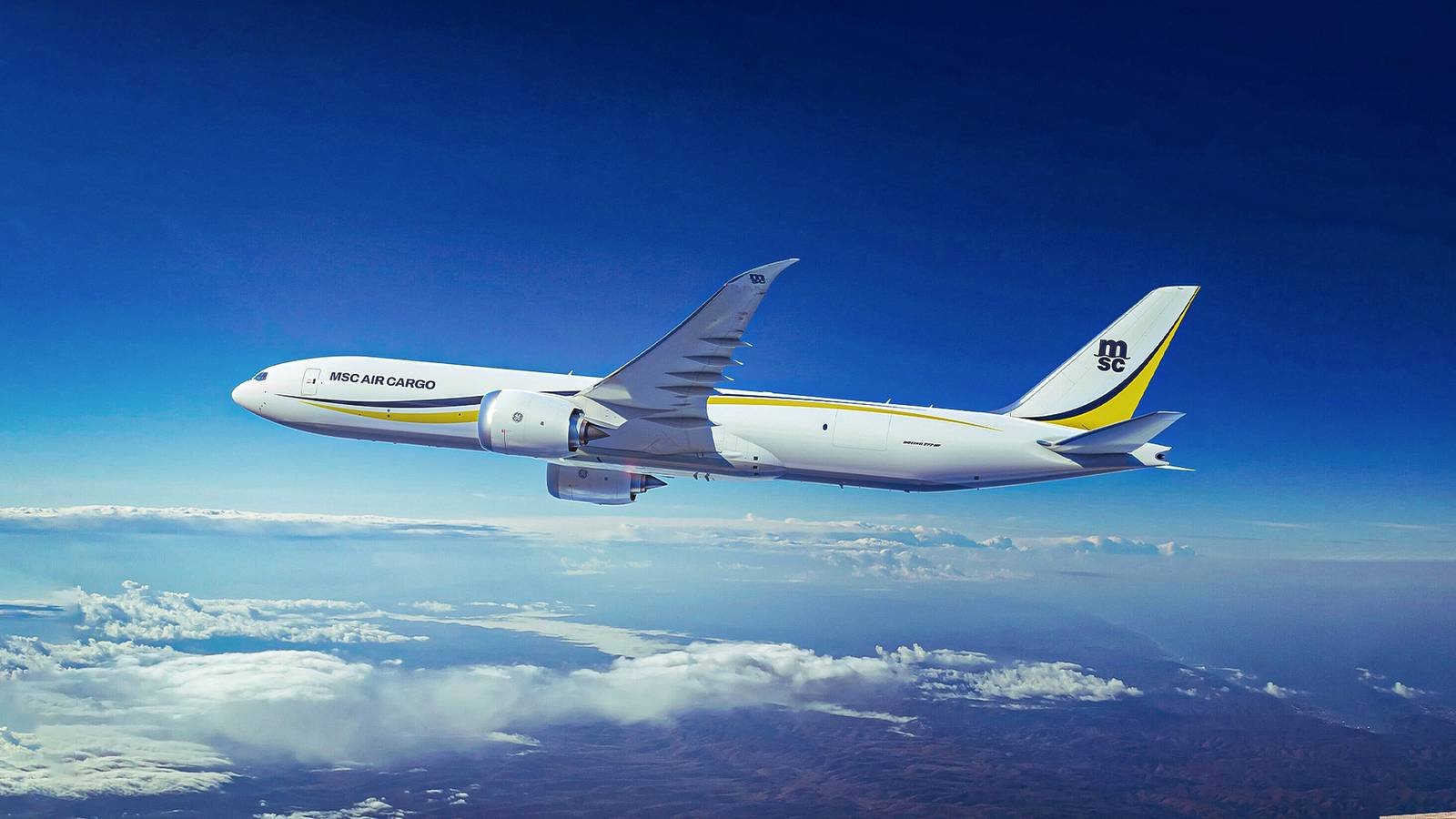
MSC Air Cargo ordered five Boeing 777-8F Freighters at the 2026 Farnborough International Airshow 2026, becoming the previously unidentified customer in Boeing’s order book and making its first commitment to the Boeing 777X family. The order makes MSC the third European operator of the type and increases Boeing’s firm 777-8F backlog to more than 80 aircraft, despite the aircraft not yet entering service. The 777-8F is positioned as a replacement for aging Boeing 747-400Fs and current 777Fs, whose production will end ahead of 2028 international emissions standards.
The decision is notable because MSC is best known as one of the world’s largest container shipping companies, yet it has committed to a next-generation freighter that has not even flown. Rather than simply expanding its air cargo fleet, the investment reflects a broader long-term strategy to strengthen its logistics network and prepare for future changes in the global freight market. This article explores the key factors behind MSC Air Cargo’s decision to order the Boeing 777-8 Freighter.
MSC Air Cargo Finally Reveals Itself As Boeing’s Mystery Customer

The Boeing 777-8 Freighter is the cargo variant of the 777X family, developed to succeed the highly successful 777 Freighter and eventually replace aging Boeing 747-400F and MD-11F fleets. Boeing launched the program in 2022 after confirming that production of the current 777F will end after 2027, as new international aircraft emissions standards will prevent further certification of the existing model. The 777-8F has therefore become Boeing’s long-term solution for the large widebody freighter market.
MSC Air Cargo announced an order for five Boeing 777-8 Freighters at the 2026 Farnborough International Airshow, marking its first commitment to the 777X family. The order also revealed MSC as the previously unidentified customer already listed in Boeing’s order book. The five aircraft will eventually complement the carrier’s existing fleet of seven Boeing 777 Freighters, supporting its continued expansion as the air cargo arm of the MSC Group. The latest commitment increases Boeing’s firm 777-8F backlog to more than 80 aircraft.
MSC also becomes only the third Europe-based operator to order the type, following Lufthansa Cargo and Cargolux. Other customers include Qatar Airways Cargo, Silk Way West Airlines, China Airlines, China Southern Airlines and Korean Air. While the 777-8F has yet to make its first flight, MSC’s decision to commit now demonstrates confidence in both Boeing’s next-generation freighter and the long-term outlook for global air cargo demand.
Why MSC Is Betting On An Aircraft That Has Yet To Fly

Although the Boeing 777-8 Freighter has yet to make its first flight, MSC Air Cargo has already committed to the program. The order first appeared in Boeing’s backlog in December under an unidentified customer before being officially revealed at the 2026 Farnborough International Airshow. Describing the purchase as “an investment in the long-term future of MSC Air Cargo and in the customers we serve,” CEO Jannie Davel made it clear that the company is looking well beyond today’s cargo market. By ordering early, MSC also secures valuable production slots for an aircraft that is expected to be in high demand once it enters service.
The decision is driven by more than simply acquiring a capable freighter. The 777-8F has been designed to meet future regulatory and operational requirements, delivering up to 30% better fuel efficiency and lower carbon emissions per payload tonne than legacy aircraft such as the Boeing 747-400 Freighter. From 2028, stricter ICAO emissions standards will prevent the certification of additional examples of today’s 777 Freighter, making next-generation aircraft essential for future fleet renewal. Although Boeing is seeking a temporary exemption for the current 777F while the 777-8F program progresses (set to enter service early 2029), airlines will inevitably need a long-term replacement.
The investment also aligns with MSC’s wider sustainability strategy. As one of the world’s largest container shipping companies (see below), reducing emissions has become a key priority. In 2023, MSC signed a five-year agreement with the Global Centre for Maritime Decarbonization (GCMD), while later that year it joined Maersk, CMA CGM, Hapag-Lloyd and Wallenius Wilhelmsen in calling on the International Maritime Organization to accelerate the transition to greener fuels. Investing early in the more efficient 777-8F therefore supports both MSC’s long-term fleet strategy and its broader commitment to lowering emissions across its global transport network.

MSC Wants More Than A Cargo Airline

To understand the significance of this order, it is important to look at MSC’s broader strategy. MSC, headquartered in Geneva, Switzerland, is one of the world’s largest container shipping companies. Founded in 1970, the privately owned logistics giant operates more than 900 vessels serving over 500 ports across 260 trade routes, supported by an extensive network of road, rail, and inland logistics services. While ocean freight remains the company’s core business, MSC has spent the past few years transforming itself into a fully integrated logistics provider capable of moving cargo across every major mode of transport.
That strategy accelerated during the COVID-19 pandemic, when soaring container shipping profits gave MSC an opportunity to expand aggressively. Between 2020 and 2024, the company acquired more than 260 vessels (primarily second-hand) while many competitors chose to preserve cash or return profits to shareholders. Rather than slowing its investment, MSC reinvested its record earnings into expanding its physical assets, including launching MSC Air Cargo in 2022. Today, the airline operates seven Boeing 777 Freighters connecting major cargo gateways across Europe, Asia, and the Americas, with five new Boeing 777-8 Freighters set to further strengthen its long-haul network. Air cargo complements MSC’s maritime business by transporting high-value, time-sensitive shipments that cannot wait for ocean transit, allowing customers to move freight through a single integrated supply chain.
MSC is not alone in pursuing this strategy. France’s CMA CGM launched CMA CGM Air Cargo in 2021, while Denmark’s Maersk expanded its dedicated air freight operations in 2022. As volatility in ocean freight markets has increased, shipping companies have increasingly diversified into aviation to reduce risk and offer customers end-to-end logistics solutions. MSC’s investment in Boeing’s next-generation freighter is not simply a fleet expansion but a well-thought-out strategic decision.
How MSC Air Cargo Actually Operates

Unlike traditional cargo airlines, MSC Air Cargo has adopted a hybrid operating model that combines leased aircraft with its own airline. When the company launched in 2022, it chose not to build a large fleet from scratch. Instead, operations began in 2023 with Boeing 777-200 Freighters operated under an ACMI (Aircraft, Crew, Maintenance and Insurance) agreement with Atlas Air, allowing MSC to enter the market quickly while minimizing operational and financial risk. At the same time, MSC strengthened its long-term position by acquiring Italian cargo carrier AlisCargo, giving it its own European Air Operator Certificate (AOC).
By late 2024, MSC Air Cargo had grown to more than 70 employees and operated five Boeing 777 Freighters. Four aircraft were flown by Atlas Air under the U.S. AOC, while a fifth operated under MSC’s own Italian AOC from Milan. The dual-AOC structure gives the airline significant operational flexibility. The U.S. AOC supports transpacific services linking North America and Asia, while the European AOC allows MSC to expand across Europe and Asia. Together, the two certificates enable the airline to optimize capacity, improve route planning, and offer seamless cargo services across some of the world’s busiest trade corridors.
The strategy has allowed MSC Air Cargo to grow gradually while limiting risk. Leasing aircraft through Atlas Air reduced the capital required to launch a new airline and enabled the company to build operational experience before investing heavily in its own fleet. Now, just a few years after launching operations, MSC has reached the stage where expanding with five Boeing 777-8 Freighters is a logical next step.
Why The 777-8F Is The Ideal Aircraft For MSC

While compliance with future environmental regulations was an important factor, the Boeing 777-8 Freighter also aligns closely with MSC Air Cargo’s long-term operating requirements. Designed as the successor to today’s 777 Freighter, the aircraft offers a combination of greater payload, improved fuel efficiency and lower operating costs, making it well suited to a global logistics company focused on moving large volumes of cargo as efficiently as possible. According to Boeing, the 777-8F will deliver the highest payload and the lowest fuel consumption, emissions and operating costs per tonne of any large freighter currently in development.
Powered by two GE9X engines, the 777-8F is capable of carrying a maximum structural payload of 118 tonnes, with a usable revenue payload of around 110-112 tonnes. It can fly between 4,410 and 5,000 nautical miles (8,167-9,260 km), depending on payload, while accommodating 31 standard cargo pallets on its main deck. The aircraft’s slightly shorter range compared with some existing freighters is a deliberate trade-off, allowing it to carry almost 16 tonnes more cargo than today’s 777 Freighter. For cargo airlines, transporting additional freight on every flight often delivers greater commercial value than maximizing range.
Aircraft | Range | Maximum Structural Payload | Cargo Volume Capacity |
|---|---|---|---|
777 (Current fleet) | 4,970 nmi (9,200 km) | 102 tonnes | 23,051 ft³ (653 m³) |
777-8F (Future fleet) | 4,410-5,000 nmi (8,167-9,260 km) | 118 tonnes | 27,051 ft³ (766 m³) |
Those capabilities fit naturally with MSC Air Cargo’s expanding global network, which currently serves 74 import destinations across Europe, six across Asia and 10 outbound European routes. As additional aircraft enter the fleet, the airline will be able to increase frequencies, open new long-haul routes and strengthen connectivity between its maritime, road and air logistics networks. Combined with compliance with future ICAO emissions standards, the 777-8F provides MSC with an aircraft capable of supporting both near-term expansion and long-term growth.
Buying Insurance Against Ocean Freight Volatility

MSC’s investment in the Boeing 777-8 Freighter reflects a much broader shift across the global logistics industry. In recent years, major container shipping companies, including MSC, Maersk and CMA CGM, have expanded into air cargo. They recognized that relying solely on ocean freight leaves them exposed to volatile market conditions. The COVID-19 pandemic proved that point. Container freight rates reached record highs before collapsing as supply chains normalized. Rather than returning those profits to shareholders, MSC reinvested them into expanding its logistics network.
Air cargo gives MSC a second source of revenue and strengthens its end-to-end logistics offering. It complements the company’s shipping business by carrying high-value and time-sensitive cargo that cannot wait for ocean transport. It also gives MSC greater control over its customers’ supply chains. By operating across both sea and air, the company is less dependent on fluctuations in container shipping demand.
Viewed in that context, the order for five Boeing 777-8 Freighters is about much more than adding aircraft. It is a long-term investment in resilience and flexibility. The new freighters will allow MSC to grow its air cargo network while supporting its broader logistics business. Most importantly, they provide insurance against future volatility in the ocean freight market. Rather than relying on a single mode of transport, MSC is building a business that can adapt regardless of how global trade conditions change.
