


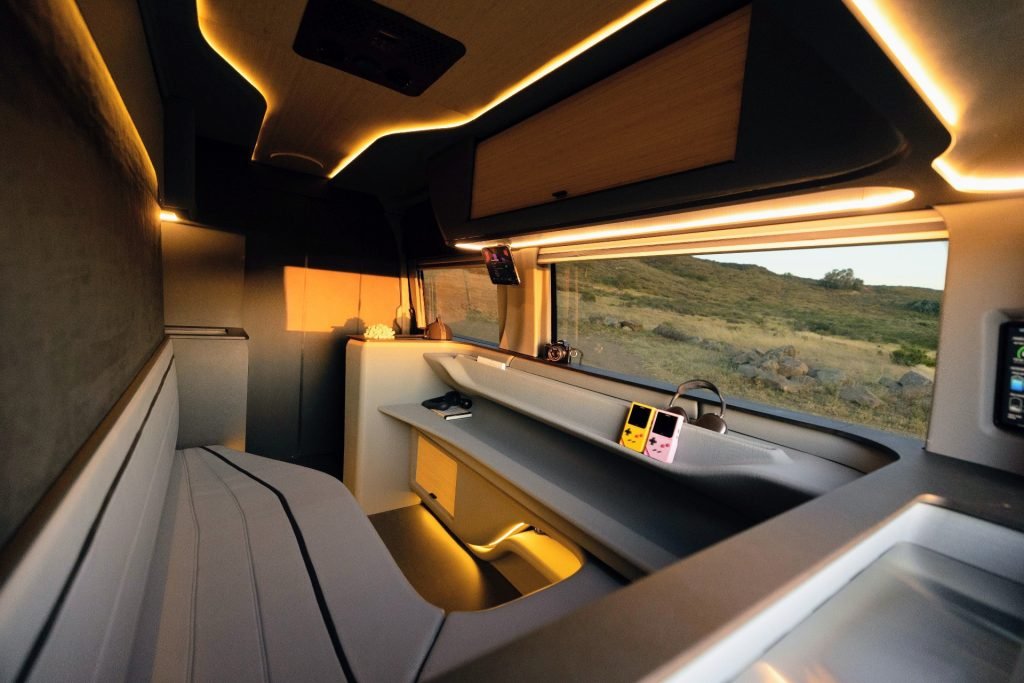
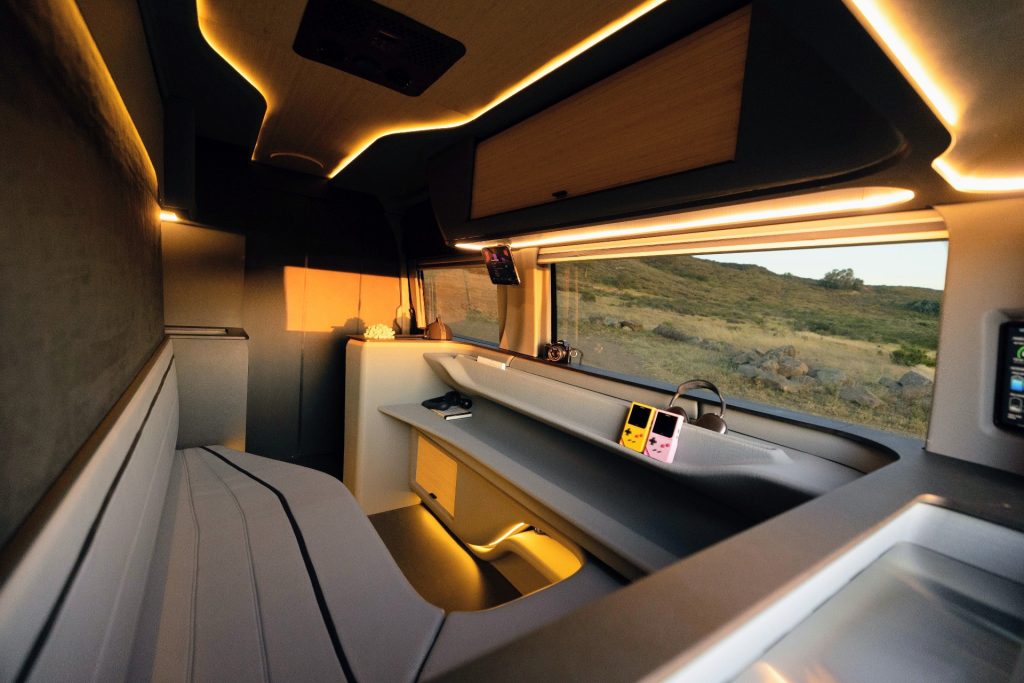
A camper van interior built almost entirely by large-format 3D printing has come in roughly 1,500 pounds (680 kg) lighter than the plywood-and-aluminum fit-out it replaces. Buckley Conversions built the prototype on a 144-inch-wheelbase Mercedes-Benz eSprinter, with founder Brandon Buckley calling it “the world’s first ever 3D printed luxury van.”
The saving comes from moving additive manufacturing off accessories and onto the primary interior structure, the load-bearing furniture and panels that conversion shops have cut from sheet goods for decades. Wood survives in only two places, and Buckley says the next van will remove it altogether.
Scanning first, printing second
The team began by capturing the van’s interior in three dimensions. That scan became the geometric reference for components modeled in CAD directly against the body structure, wheel arches and mounting positions, so the parts were designed to the vehicle rather than trimmed to fit it on the shop floor.
Printing was handled by a KUKA industrial robot carrying an extruder at its end effector. The couch, cabinetry and wall panels were printed in polypropylene. Buckley said the project drew on aerospace engineering experience, including staff with SpaceX backgrounds, with the twin aims of removing mass and standardizing assembly.
Wood survives only in the tambour faces of the overhead cabinets and a ceiling insert. Flat surfaces such as countertops use Richlite composite panels. Buckley has said the next build will replace both the wood and the Richlite with composite panels, pushing the printed-and-composite share of the interior higher again.
What the weight buys on an electric platform
Mass matters more on the eSprinter than it would on a diesel chassis. Buckley expects the reduction to improve range, acceleration, handling and braking distance, though the company has not yet released measured data supporting any of those claims.
The published specification puts eSprinter range at 150 miles on the 144-inch platform and 206 miles on the 170-inch, drawing on 81 kWh and 113 kWh traction packs respectively. Conventional camper conversions typically add 1,500 to 2,000 pounds to a van, so removing roughly that figure is not a marginal saving on a vehicle whose usable range is already the binding constraint.
Precedent, and the unanswered questions
Printed recreational vehicles are not new territory. Wave of the Future 3D printed The Wave camper trailer as a single seamless PETG piece on a custom ErectorBot back in 2018, pitching water ingress and rot as the problems additive manufacturing solved. More recently, a Ukrainian startup built a camper van from recycled bottle feedstock, and Buckley’s earlier customization work has been documented previously.
What distinguishes this build is the target market and the structural ambition: not a printed shell for a trailer, but a printed interior architecture inside an OEM commercial van sold at luxury prices, on a platform whose gross vehicle weight may qualify buyers for Section 179 depreciation.
The open items are the familiar ones for LFAM moving from prototype to product. Surface quality on printed polypropylene, interior fire-safety compliance, long-term dimensional stability under thermal cycling and road vibration, and reproducible print times all have to hold up before a one-off becomes a production line. Buckley’s stated plan to move remaining wood and Richlite to composites suggests the company knows the mixed-material compromise is a transitional state rather than the finished design.
3D Printing Industry is inviting speakers for its 2026 Additive Manufacturing Applications (AMA) series, covering Energy, Healthcare, Automotive and Mobility, Aerospace, Space and Defense, and Software. Each online event focuses on real production deployments, qualification, and supply chain integration. Practitioners interested in contributing can complete the call for speakers form here.
To stay up to date with the latest 3D printing news, don’t forget to subscribe to the 3D Printing Industry newsletter or follow us on LinkedIn.
Explore the full Future of 3D Printing and Executive Survey series from 3D Printing Industry, featuring perspectives from CEOs, engineers, and industry leaders on the industrialization of additive manufacturing, 3D printing industry trends 2026, qualification, supply chains, and additive manufacturing industry analysis.
Featured image shows Buckley Conversions prints a camper van interior. Photo via Buckley Conversions .
