


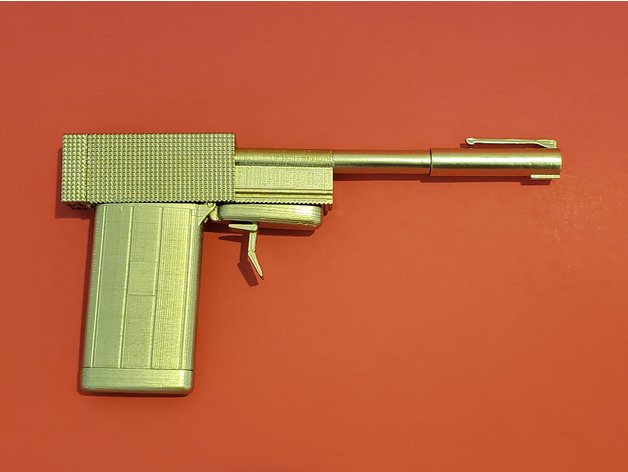
California lawmakers have passed Assembly Bill 2047 out of the Assembly, advancing the amended proposal to the Senate for further consideration.
Introduced by Assembly Member Rebecca Bauer-Kahan, AB 2047 would add the California Firearm Printing Prevention Act as Title 21.1 to the state’s Civil Code. The bill was amended in the Assembly on May 18, 2026, and ordered to third reading on May 19, according to California Legislative Information.
The proposal would require the California Department of Justice, or another relevant state agency, to investigate known firearm blueprint files and existing detection algorithms. By January 1, 2028, the agency would publish performance standards for firearm blueprint detection algorithms and software control processes intended for use by 3D printer manufacturers.
AB 2047 defines “firearm blocking technology” as hardware, firmware, or other integrated technical measures that prevent a 3D printer from starting a print job unless the underlying file has been evaluated by a firearm blueprint detection algorithm. The algorithm would need to assess STL files, CAD files, or geometric code, which could include machine instructions used to control a print job, and flag files that could be used to produce a firearm or illegal firearm parts.
The bill advances an earlier California 3D printer gun control proposal focused on requiring printers sold in the state to screen files before printing. The amended text gives that framework more detail, including deadlines for performance standards, manufacturer attestations, state model lists, and enforcement from March 2029.
Under the current text, manufacturers producing 3D printers for sale or transfer in California would need to submit an attestation form for each make and model by July 1, 2028. These attestations would confirm that the printer model includes a firearm blueprint detection algorithm, a software controls process, and testing of that system against state-issued performance standards. Submitting a false attestation could lead to perjury prosecution.
By September 1, 2028, the Department of Justice would publish a list identifying printer makes and models with complete attestations, as well as models with incomplete attestations on file. From March 1, 2029, the bill would prohibit the sale or transfer of 3D printers in California unless they are equipped with firearm blocking technology and listed by the state as having a complete attestation on file.
Printer architecture and open-source concerns
The bill could have implications beyond firearm regulation because it addresses how 3D printers receive and process files. AB 2047 lists firmware-based designs, integrated pre-print software designs, and other approaches such as handshake authentication as possible routes for implementing a software control process.
For integrated pre-print software, the bill describes a system where a 3D printer accepts geometric code only from a single slicer or pre-print software, which may be the manufacturer’s proprietary software. That software would evaluate STL or CAD files before producing printable code and would refuse to generate code for files identified as firearms or illegal firearm parts.
These provisions could affect open-source and third-party 3D printing workflows because the bill allows compliance through firmware-based controls, integrated pre-print software, or other systems designed to prevent users from bypassing file screening.
The bill builds on existing California law that already criminalizes knowingly aiding or facilitating the unlawful manufacture of firearms, including firearms made using a 3D printer.
Screening requirements raise technical questions
File-screening systems face the challenge of distinguishing firearm components from legitimate mechanical parts. Similar firearm screening requirements for 3D printers have already raised feasibility questions, particularly because mechanical parts can resemble one another across different applications. A component used in a firearm may share geometric features with a hinge, tool housing, or other benign part, making intent difficult to infer from shape alone.

File-matching systems also face limits. Small changes to a model can alter its digital signature without changing the function of the 3D printed part, while more advanced file analysis may require computational resources beyond those available on many consumer 3D printers. Moving those checks to remote servers could introduce privacy, connectivity, and database-maintenance questions for users and manufacturers.
Those concerns overlap with wider open-source 3D printing concerns around firearm screening bills. Adafruit has warned that compliance tied to proprietary software, cloud verification, or centralized authentication could affect education, offline 3D printing, small manufacturers, and open-source firmware projects.
Enforcement and penalties
Violations could trigger civil actions. A person who sells or transfers a non-compliant printer, or knowingly files a false attestation, could face a civil penalty of up to $25,000 per violation, plus injunctive relief and attorney’s fees for prevailing plaintiffs.
The bill also creates a new crime. Knowingly disabling, deactivating, uninstalling, or otherwise circumventing firearm blocking technology with intent to manufacture firearms would be a misdemeanor. The same would apply to knowingly distributing modified printers to facilitate unlawful firearm manufacturing.
AB 2047 states that performance standards should account for false-positive and false-negative rates, and does not require a perfect detection rate. It also calls for regular updates as new firearm blueprint files emerge.
Several categories of printers would be exempt, including systems manufactured and sold exclusively to licensed firearms manufacturers, the State of California, law enforcement agencies, certain engineering companies and government contractors, and entertainment industry stagecraft or propmaking studios. The listed exemptions do not appear to cover general consumer-grade printers used in settings such as schools, libraries, or makerspaces.
From file moderation to printer controls
Other parts of the 3D printed firearms chain have also faced scrutiny. After a New York investigation found downloadable weapon design files on Thingiverse, the platform ramped up efforts to restrict access to firearm blueprints and later deployed automated tools to detect and remove such content.
Other technical responses focus on enforcement after production. Research into how to trace 3D printed ghost guns has explored chemical profiling of 3D printing polymers, reflecting the difficulty of applying conventional firearms analysis to printed weapons.
3D Printing Industry is inviting speakers for its 2026 Additive Manufacturing Applications (AMA) series, covering Energy, Healthcare, Automotive and Mobility, Aerospace, Space and Defense, and Software. Each online event focuses on real production deployments, qualification, and supply chain integration. Practitioners interested in contributing can complete the call for speakers form here.
To stay up to date with the latest 3D printing news, don’t forget to subscribe to the 3D Printing Industry newsletter or follow us on LinkedIn.
Explore the full Future of 3D Printing and Executive Survey series from 3D Printing Industry, featuring perspectives from CEOs, engineers, and industry leaders on the industrialization of additive manufacturing, 3D printing industry trends 2026, qualification, supply chains, and additive manufacturing industry analysis.
Feature image shows 3D printed golden gun design by Brian Moman, aka VariablePenguin. Photo via Thingiverse
