


California policymakers are targeting the intersection of consumer 3D printing and firearm production with a bill requiring 3D printers sold in the state to screen what they are asked to produce.
Assembly Bill 2047, introduced by Assembly Member Bauer-Kahan, sets out a system built around software rather than hardware alone. At its core is the idea that 3D printers should be able to recognize and reject files linked to firearms or illegal firearm parts before a print ever begins.
To get there, the bill directs the California Department of Justice (DOJ), or another designated agency, to study existing firearm blueprint files and detection tools, and to establish performance standards for what it calls firearm blueprint detection algorithms by July 1, 2027. Certification of those systems is expected to begin at the start of 2028.
Those algorithms would be responsible for scanning common 3D printing file formats such as STL and other CAD based inputs, identifying designs that could produce a firearm or restricted components, and blocking them.
The standards outlined in the bill call for a high degree of accuracy, including the ability to catch modified versions of known designs and to update detection capabilities as new files circulate. Lawmakers stop short of demanding perfect detection, acknowledging the pace at which such files evolve.
Controls Extend Beyond File Detection
Detection alone is not treated as sufficient. The proposal also requires what it describes as software control processes, designed to ensure that printers cannot be used unless a file has been checked and cleared.
In practice, that could mean building checks directly into a printer’s firmware, limiting which software can send print jobs, or using other methods that are equally difficult to bypass. The state is expected to issue guidance on how these systems should be implemented, along with testing requirements, by March 1, 2028.
Manufacturers would face a set of deadlines tied to bringing products to market. By July 1, 2028, any company intending to sell or transfer a 3D printer in California would need to submit a self attestation for each model, confirming that certified detection and control systems are in place and have been tested.
The California DOJ would be able to review those submissions, request sample units, and, if manufacturers opt in, carry out a separate verification process that results in a formal notice of compliance. A public list of printer models would follow by September 1, 2028, identifying which devices meet the requirements, which are under review, and which have incomplete filings.
From March 1, 2029, the rules would begin to bite. Selling or transferring a 3D printer in California would be unlawful unless the device is equipped with the required blocking technology and appears on the state’s compliance list.
The bill carves out exceptions for printers made exclusively for licensed firearms manufacturers, for law enforcement or military use, and for certain industrial settings where the machines are not sold on the consumer market. It also lays out enforcement on two fronts.
Civil actions could target companies that sell non compliant printers or file false attestations, with penalties that include damages, injunctions, and fines of up to $25,000 per violation. On the criminal side, knowingly disabling or working around the blocking systems with the intent to produce firearms, or distributing modified printers for that purpose, would be treated as a misdemeanor.

States Target Different Points of Control
California’s approach sits within a broader set of state efforts targeting different stages of the same process.
In Colorado, proposed legislation focuses on the act itself, making it a criminal offense to manufacture firearms using 3D printers or CNC machines without a federal license, while also restricting possession and distribution of digital design files where intent can be established. New York’s proposal combines multiple layers, including 3D printer-level safeguards, limits on access to design files, and reporting requirements for law enforcement.
Measures in Washington and now California instead place the constraint at the point of production. That reflects a practical limitation: digital design files can be copied, modified, and redistributed with little friction, while enforcement after a weapon is produced comes too late. Requiring 3D printers to evaluate files before printing shifts control to a stage that is harder to bypass, even if the files remain widely available.
That model also introduces technical limits. Detection systems rely on identifying known blueprint files and commonly shared or modified variants, rather than determining in general whether an object is a firearm component. Mechanical parts often share similar geometry across uses, making classification based on shape alone difficult without blocking legitimate designs.
Small modifications can alter a file’s digital signature without changing its function, allowing designs to bypass matching systems. At the same time, many consumer 3D printers run modifiable firmware and offline workflows, complicating consistent enforcement.
In effect, the bill moves the point of control without fully resolving the limits of how that control can be applied.
3D Printing Industry is inviting speakers for its 2026 Additive Manufacturing Applications (AMA) series, covering Energy, Healthcare, Automotive and Mobility, Aerospace, Space and Defense, and Software. Each online event focuses on real production deployments, qualification, and supply chain integration. Practitioners interested in contributing can complete the call for speakers form here.
To stay up to date with the latest 3D printing news, don’t forget to subscribe to the 3D Printing Industry newsletter or follow us on LinkedIn.
Explore the full Future of 3D Printing and Executive Survey series from 3D Printing Industry, featuring perspectives from CEOs, engineers, and industry leaders on the industrialization of additive manufacturing, 3D printing industry trends 2026, qualification, supply chains, and additive manufacturing industry analysis.
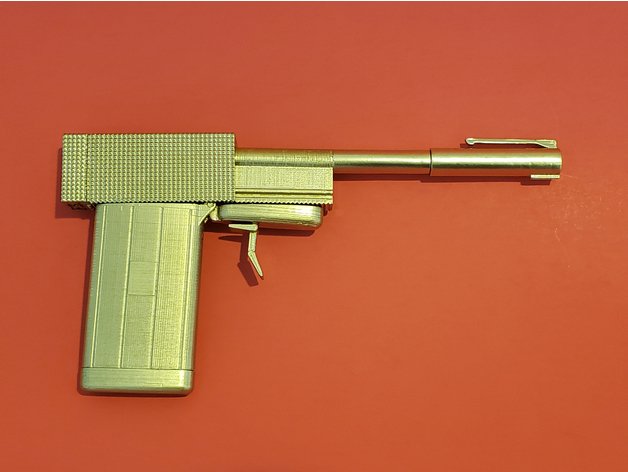
Featured image shows 3D printed golden gun design by Brian Moman, aka VariablePenguin. Photo via Thingiverse
