


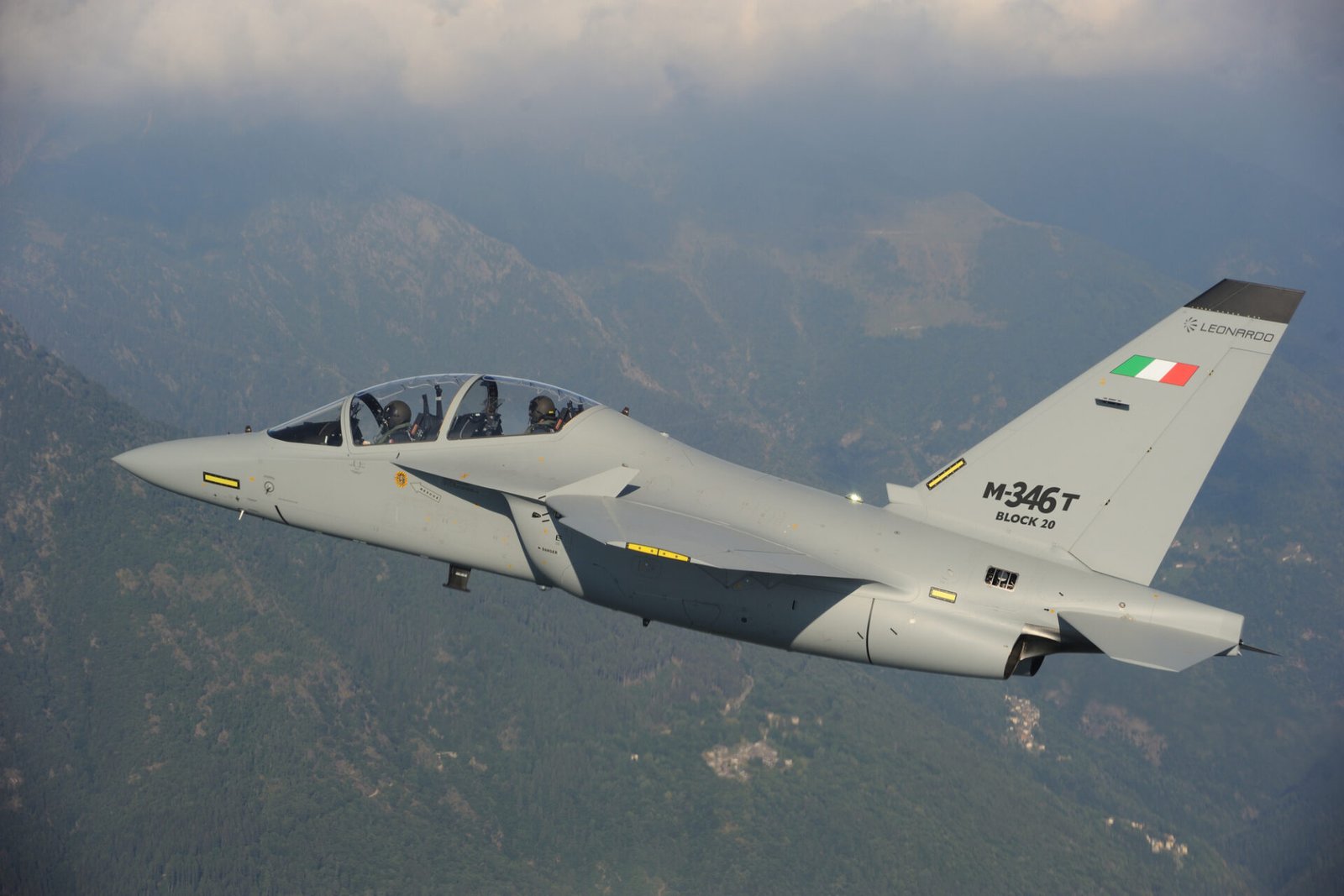
Canada has opened negotiations to acquire Leonardo’s M-346 Master advanced jet trainer for the Royal Canadian Air Force, the office of Prime Minister Mark Carney confirmed on June 16, 2026.
The decision came out of a meeting between Carney and Italian Prime Minister Giorgia Meloni on the margins of the G7 leaders’ summit in Évian, France, where the two governments agreed to open formal talks on a purchase.
Carney’s office did not say how many aircraft Canada intends to buy, at what price, or on what timeline. It framed the prospective deal as a way to let the Royal Canadian Air Force train on modern equipment and build what it called “sovereign training capability,” and placed it within Canada’s Defence Industrial Strategy and its build, partner, buy approach to procurement. Leonardo said it welcomed the statement.
Closing a domestic training gap
The negotiations fall under Canada’s Future Fighter Lead-In Training (FFLIT) program, launched in 2021 to replace the Royal Canadian Air Force’s CT-155 Hawk and prepare pilots for the country’s incoming F-35A fleet.
Canada retired the Hawk in 2024 after 24 years of service and has had no domestic advanced jet training capability since, sending candidates and instructors abroad instead. Canadian pilots currently train at Sheppard Air Force Base in Texas and at the Italian Air Force’s International Flight Training School at Decimomannu Air Base in Sardinia, where they already fly the M-346.
That existing familiarity gave Leonardo a clear advantage. The program had also weighed the Boeing and Saab T-7A Red Hawk and the Korea Aerospace Industries and Lockheed Martin T-50. Canadian officials have previously pointed to the early 2030s as a rough target for a new trainer to enter service, most likely in Leonardo’s latest Block 20 configuration. In Canadian service, the M-346 would be solely a trainer, not a light combat aircraft.
Part of a wider European turn
The talks follow a separate order in May 2026 by the privately run International Test Pilots School Canada for six M-346 Block 20s, with options for six more, which will support allied tactical training in North Bay, Ontario.
The decision also fits Carney’s broader effort to shift defense procurement toward European suppliers amid strained relations with Washington. Ottawa has already selected Saab’s GlobalEye for airborne early warning and continues to weigh a mixed fighter fleet of F-35s and Gripens.
