


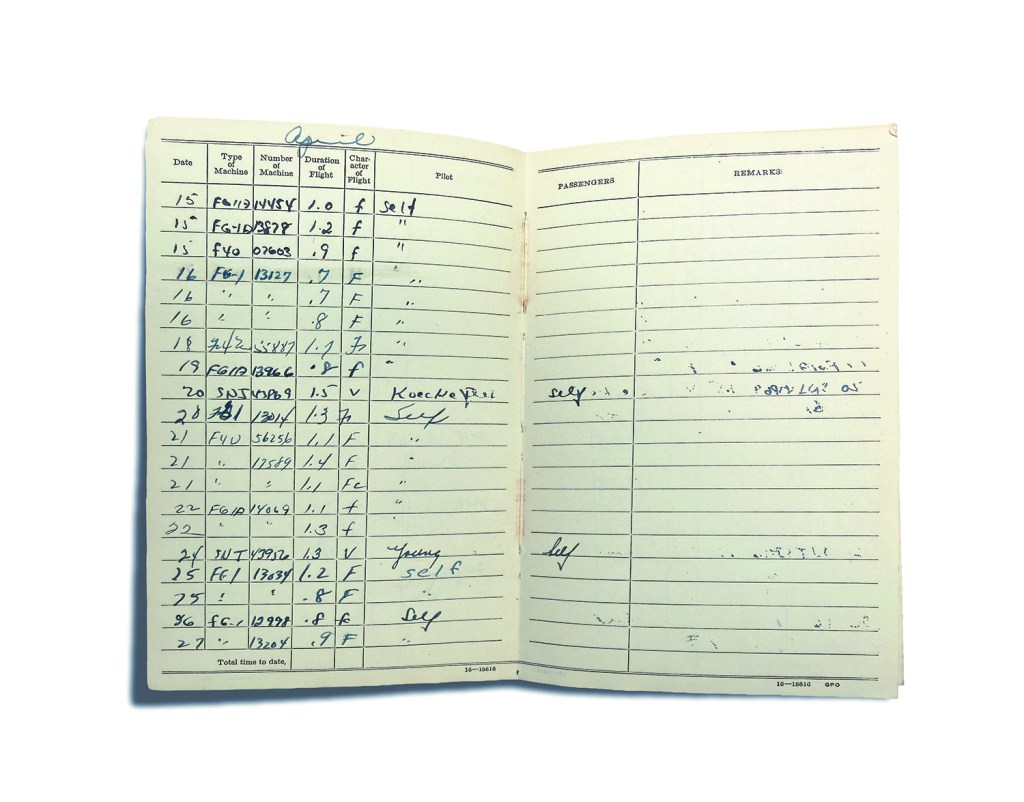
One snowy weekend morning in January, I was casually browsing my grandfather’s World War II logbook, accompanied by a tall mug of coffee.
Watching recently posted YouTube videos of F4U Corsairs being restored planted the seed of an idea. My basic plan was to search the internet for all known Corsair airframes either being flown or displayed in aviation museums. I collected their identification numbers and set about comparing those with the F4U Corsairs my grandfather had flown in WWII.
My hope was that I could go visit one of the surviving airframes, if any existed, and connect my family and I back to a brief moment in the past when my grandfather, at 21 years old, was training for aerial combat as a naval aviator in one of the world’s fastest airplanes.
If you're not already a subscriber, what are you waiting for? Subscribe today to get the issue as soon as it is released in either Print or Digital formats.
Subscribe Now
My grandfather died in 2020 after a long and full life. He fostered my love for aviation when I was a kid, introducing that world to me in a variety of ways, including the sponsoring of my flight training, which I began back in 1998.
He earned his Navy wings in 1944 and went all the way through his night carrier landing qualifications before being sent to Hawaii with his fighter squadron, VBF-98. The war in the Pacific ended while he was awaiting his orders to deploy, so he never saw combat, a fact he was careful to disclose when talking about his WWII experience.
- READ MORE: 10 Must-Read Books for Military Aviation History Fans
- READ MORE: New Statue Commemorates WWII ‘Triple Ace’ at Oshkosh
After he and my grandmother raised their five children, including my father, my grandfather went back to flying in his late 60s. He got checked out in a Boeing Stearman and earned his glider rating at Van Sant Airport (9N1) in Pennsylvania and continued flying gliders well into his late 70s.
Like all WWII pilots, he flew many different types of airplanes as part of his Naval aviator training. Using his military logbook, I tracked each airplane type and the airfield he flew from as he worked his way up from the docile J-3 Cub, then into the Navy’s version of the Boeing Stearman, the N2S, and then into the branch’s version of the T-6, the SNJ. The SNJ served the role of advanced trainer flown by all airmen who were hoping to fly fighter aircraft.
Only once my grandfather passed his stage checks in the SNJ was he given the opportunity to begin training in the F4U Corsair. Most of his training in the SNJ and Corsair was at the modern-day home of Navy fighter pilots at the Pensacola Naval Air Base in Florida before deploying to Los Angeles to conduct day and night aircraft carrier qualifications from naval airfields in the area.
Over the course of my first round of research, I could not find any F4U Corsairs in existence that shared either a serial or bureau number with the Corsairs in my grandfather’s logbook. I was surprised that he rarely flew the same airplane twice, and it was easy to picture airfields full of Corsairs he and his squadron used for their training sorties.
For WWII airplane enthusiasts, it must have been a sight to behold. Since my initial search for a surviving Corsair didn’t yield any results, I rested on the idea. It had not yet occurred to me to try looking for a J-3, Stearman, or SNJ that he may have flown.
Legends Warbird Experience
Soon afterward, I began planning for my company’s attendance at the Aircraft Owners and Pilots Association’s Buckeye Air Fair outside of Phoenix. When feasible, I typically look for an aviation activity in the surrounding area of any city I need to visit for work, and I stumbled upon a warbird flying experience based out of the Phoenix Goodyear Airport (KGYR) 15 miles due west of Phoenix Sky Harbor International (KPHX).
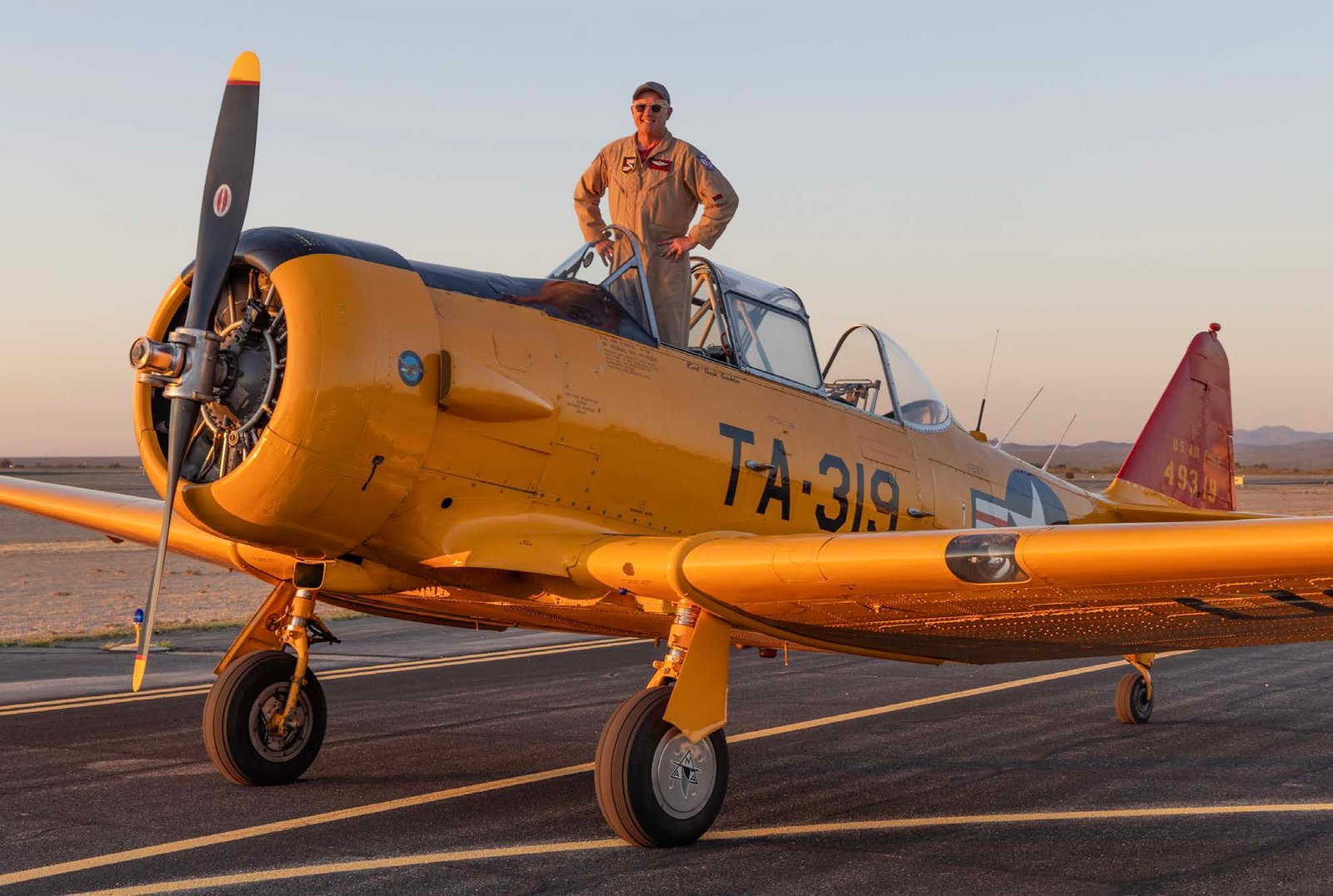
Legends Warbird Rides is owned and operated by Karl Gashler, call sign “Gash,” a former U.S. Air Force F-16 pilot who served worldwide for 21 years. After his military aviation career, Gashler became an airline captain who stayed close to general aviation and pursued his passion for warbirds. He acquired a period-correct and unique WWII-era T-6 in which he offers rides and flying experiences. Interested customers choose between a 20-minute ride, called the “Recruit” or a 40-minute ride, called the “Ace,” where the participant gets to experience a set of maneuvers that made up a typical first-day T-6 training flight for a WWII pilot.
Gashler’s schedule was open the following morning, and conditions were extremely CAVU. I met him at his hangar, where he had just raised the door to begin preparing the T-6 for our flight.
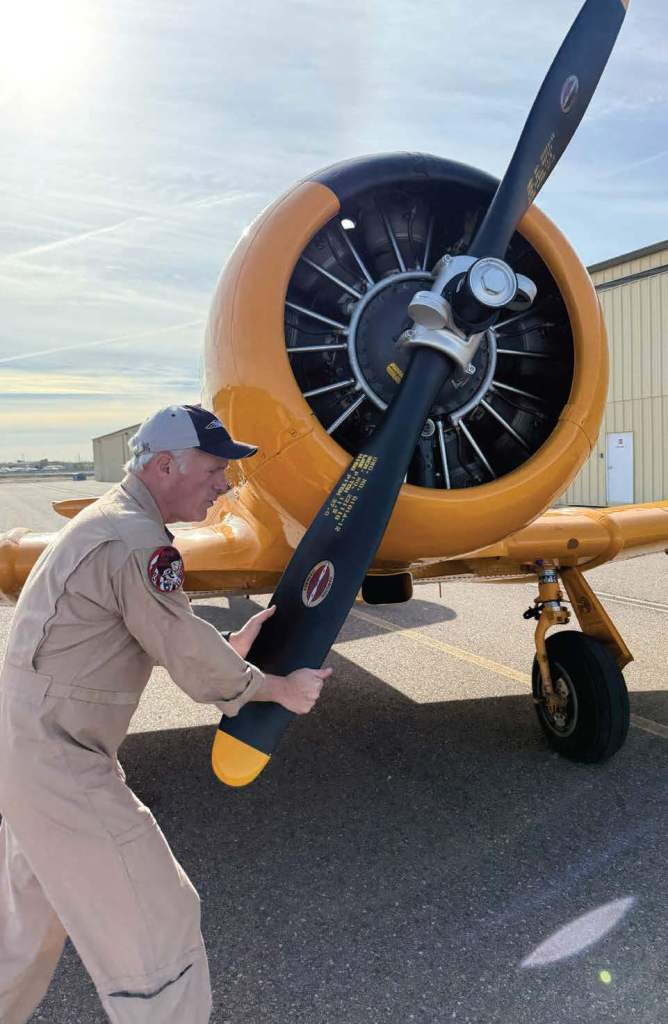
The aircraft stands tall and rather intimidating on its landing gear. At 5-foot-10, the top of my head doesn’t reach the propeller hub. Gashler talked me through the entire preflight with patience, giving me time to absorb the unique characteristics of his T-6. For example, I learned the tips of the two-bladed prop reach supersonic speed on the takeoff roll. He let me pull the propeller through, allowing me to feel the pressure and compression of the engine while the rotation checked for oil pooling in the lowest cylinders. We checked the massive stress plate that helps connect the wing roots to the fuselage. Although I was daunted by the sheer size of the T-6, checking the landing gear wasn’t much different than the Piper Arrow I had trained on. As we worked our way around the airplane, he shared interesting details about it.
Originally, this T-6 was an “F” model, delivered to the U.S. Army Air Forces in 1945. As the Army had all the airplanes it needed for training, Gashler’s T-6 was transferred to the U.S. Navy and fitted with guns and bomb racks to be used for surface attack training. At the time of transfer, it became an SNJ, and U.S. Navy pilots flew the airplane out of Pensacola Naval Air Station (NAS). It survived 12 years of training duties as a Navy SNJ until 1957 when it was flown to present-day Phoenix Goodyear Airport, then called Naval Air Field Litchfield Park, where it was parked and became part of the military surplus collection. In a remarkable coincidence, the airplane was purchased out of surplus in 1958 and made its way back to Phoenix Goodyear.
After the exterior preflight was complete, Gashler showed me how to climb into the rear seat and get strapped into the parachute, which doubled as the seat and back cushion. I paid attention to the safety briefing and how to slide back the canopy. Learning that I could do so any time, I could not wait to try opening the canopy during my flight, which would be another first.
With the preflight completed, we briefed the “Ace” flight maneuvers together. I planned to do as much of the flying as I was allowed to, eager to experience the full sequence of maneuvers that WWII fighter pilots would have needed to master in the T-6. Nicknamed the “Pilot Maker,” as an advanced trainer, the T-6 served as a bridge between the basic trainers and the high-performance fighters that pilots like my grandfather would go on to fly after completing training.
Gashler concluded the preflight briefing with some words of wisdom about flying the T-6. In his view, after training many pilots in the ways of the airplane, the fun comes from enjoying the “visceral, full-body experience that is flying a T-6,” with the goal for the pilot being to “become part of the airplane.”
Flying the T-6
With the flight sufficiently briefed, Gashler started the T-6 and handled the taxi and takeoff, allowing me to soak in the soundtrack and smell of the Pratt & Whitney radial engine. Once the airplane was cleaned up and we were departing the airspace, I was given the controls and allowed to explore, getting used to the sight picture of flying from the back seat, making coordinated inputs with the rudder, and testing the responsiveness of the flight stick in different roll-and-pitch attitudes.
Before any real maneuvers, I really wanted to get a feel for the T-6. I warmed up with some gentle turns and practiced some short climbs and descents. I noticed the T-6 built up speed and G-forces in the descents, scolding a lack of attentiveness by the pilot (me).
We began the WWII training profile with some steep turns. Gashler wound up the throttle and propeller, and the T-6 barely exerted itself while I attempted to hold my altitude and look through the support bars around his flight helmet as I tried to sight the horizon.
The T-6 banked cleanly without heavy effort on the stick. The steep turns were fun, and I could start to feel the size of the airplane. I noticed how it responded to my control inputs. It was rigged so well that if I closed my eyes, I would have sworn I was flying a much newer airplane. By the size of the T-6 alone, I assumed that larger control inputs would be required, but I only needed to make minute adjustments to keep it from rapidly climbing and descending.
At 3,000 feet agl, it was time for the first power-on stall. With Gashler on the throttle and my eyes fixed out into the brilliant blue desert sky, I gripped the flight stick and built a little airspeed by dipping the nose briefly below the horizon then into a smooth but rapid climb to simulate an aggressive takeoff attitude.
I immediately started gently pushing on both rudder pedals to try and gain a sense for whether I had the airplane balanced in the climb. I cheated with the briefest of glances using my peripheral vision to gauge whether I was climbing straight.
An experienced CFI, Gashler stayed silent. He wanted to create space for me to concentrate and hear and feel the airplane. But could a low-time pilot like me have a productive interaction with the T-6 in only my first 10 minutes of flight time?
I soon got my answer as the wings buffeted and exceeded their capacity to lift, and the nose of the T-6 dropped immediately as the right wing rotated under us to begin an incipient spin 180 degrees to the right in less than a second. I immediately felt the entire weight of the airplane making straight for the ground that was still a safe distance below. I had stalled the airplane without having the ball centered—and paid the price.
T-6 1, Sean 0.
The rapid descent surprised me, and Gashler and I talked about what happened. I struggled to feel the T-6’s attitude at the high angle of attack and didn’t look back at my instruments to see if I had the ball centered. Hoping I would detect the airplane’s attitude more deftly this time, I attempted power-on stall No. 2: Up we went into the stall, and the right wing cut under again, 180-degree rotation, and down we went.
T-6 2, Sean 0.
The truth was that I was too green to develop the subtle touch required, but the T-6 certainly now had my full and undivided attention.
For the next maneuver, Gashler took over and offered to demonstrate a turning accelerated stall. Letting me follow him on the controls, soon we were banking up over 60 degrees to the right and pulling into a tighter and tighter turn. The noise, vibration, and G-forces built as the airplane responded to his inputs.
This maneuver was another important primary aerobatic skill to be mastered by the student to demonstrate where the edges of controlled flight lay. Before I had time to fully process it, the wings stalled, and we snap-rolled to the right and were immediately pointing at the ground again.
After recovering, Gashler demonstrated a turning accelerated stall to the left. Again, the speed, noise, and G-forces built to the point where my vision began to narrow, and I
experienced the bright blue day and the yellow sun begin to get darker around the edges of my vision.
The Gs loaded up as we reached the stall, and even though we were turning tightly to the left, the wing stalled, and the airplane snap-rolled to the right, surprisingly, breaking the turn in an instant as we rolled toward the ground again. Gashler recovered quickly and safely.
Needing some fresh air after the Gs we pulled, I opened the canopy, sliding it gently into the full aft position. Immediately, fresh, cool desert air from 4,000 feet barreled into my face, and I let my fingers and palms out into the air stream to direct it across my chest.
With no plexiglass in the way, I took in an unrestricted view of the sky and desert below. I followed the hills out to the edge of the horizon, perhaps 100 miles in each direction. I reflected on how my grandfather, and thousands like him, had not only flown the maneuvers in the same type of airplane but had done so at half my current age.
Gashler knew I was a little winded, so he gave me the controls, and I was free to fly the T-6 as I wished. With the canopy open, I descended toward the desert floor and followed the remnants of an old and dried-up riverbed as it wound around the hills and undulations of the terrain below.
The T-6 was a tricky dance partner, and I felt like I was stepping on her toes as I searched for the correct amounts of input to conduct even simple maneuvers, such as coordinated turns, climbs, and descents.
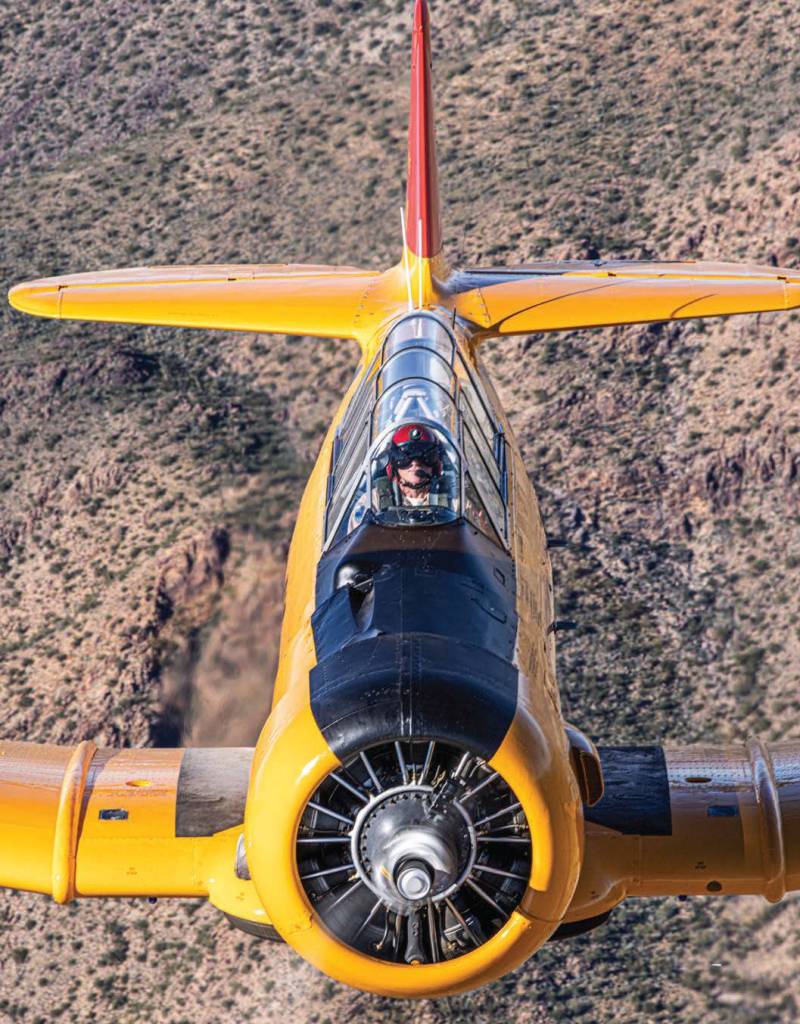
Gashler shared that I was just one of many pilots new to the T-6 challenges. In fact, during WWII, T-6s just like this one were flown south from nearby Luke Field to the same airspace we were in to practice this similar set of advanced training maneuvers.
Gashler suggested we were in good company here. Even though those flights occurred many decades ago, the desert canyons we were flying over still echoed with the sound of the flights of those past generations of pilots.
We were truly reliving history in Gashler’s special T-6.
“I spent my military career flying the future [in an F-16], and now I spend my retirement making sure people don’t forget the past,” said Gashler.
I reached back over my shoulder to close the canopy as Gashler took over the controls and pointed us toward nearby Estrella Mountain, where he demonstrated how the T-6 could hug the terrain, much like he did when he flew the F-16 and needed to stay close to the peaks and canyons as a tactic to avoid enemy radar.
We had time for a few more beginner aerobatic maneuvers, so I followed Gashler on the controls for a few aileron rolls and was surprised at the T-6’s nimble handling given its relative size. Then we tried an inside loop and a Cuban-8. That was the time in the flight where my decision to not eat a sufficient breakfast had caught up with me, and the perspiration I had acquired from the mental and physical effort turned from warm to cool sweat.
Slightly disappointed in my reduced tolerance for aerobatics, I agreed with Gashler when he announced it was time to head back to the airport. The 40 minutes in the air had elapsed quickly, and it was a most satisfactory flight experience.
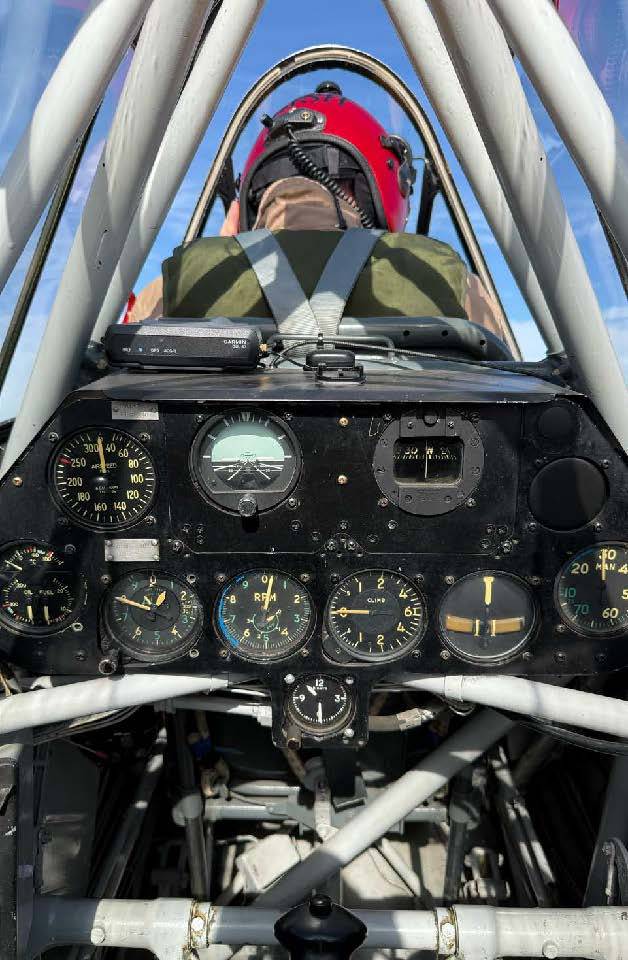
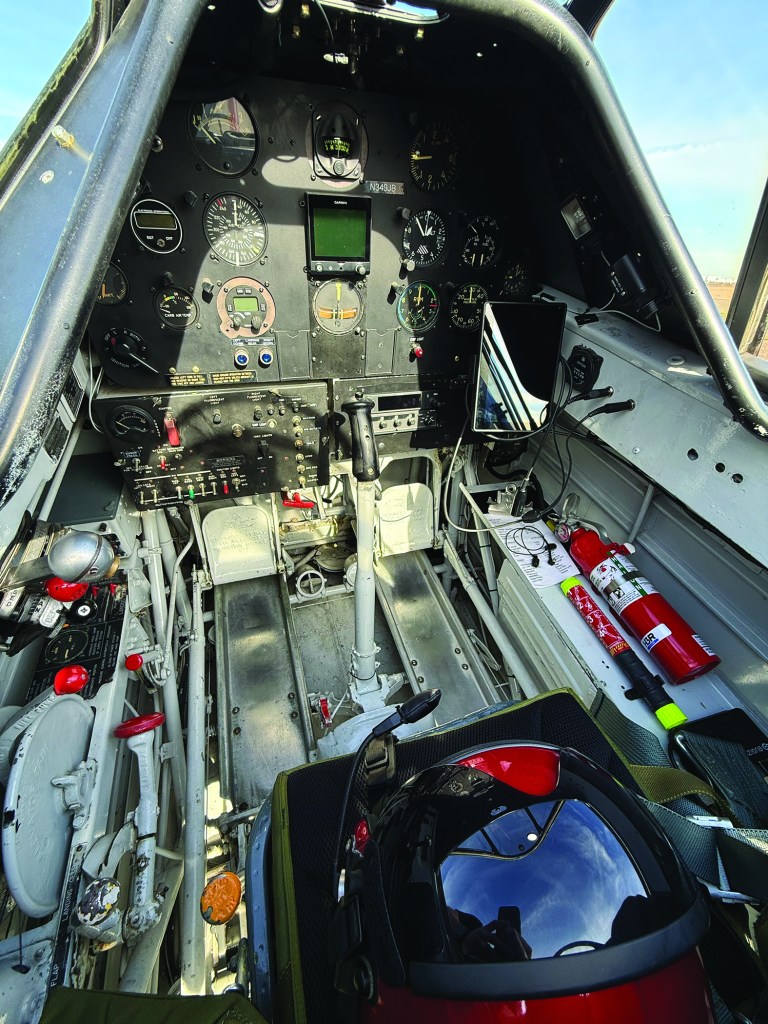
I relaxed for the last few minutes, taking in the scenery and many details of the cockpit, which were largely original from when it left the factory nearly 81 years ago.
After getting clearance from the tower, Gashler topped off the “Ace” experience with an overhead break into the short final. Pulling my last few Gs as we lost altitude with haste, he explained that this critical maneuver quickly gets fighters over a protected airfield “inside the wire” as well as getting lots of airplanes on the deck in the shortest possible time.
Unexpected Connection
After we taxied up to his hangar and shut down, I asked Gashler about how he got into aviation.
Gashler said his family owned and operated a dairy farm in central Wisconsin, and he spent a lot of time there looking skyward at airplanes, especially some Wisconsin Air National Guard A-10 Thunderbolt IIs. He eventually traveled to EAA AirVenture Oshkosh and found an A-10 pilot who told him how to join the Air Force and become a fighter pilot. He credits a cast of supportive adults who encouraged him to “work hard and never take ‘no’ for an answer.”
When he was 15 years old, he joined a Boy Scouts of America Aviation Explorer’s unit at his local airport, where he received his first general aviation flight and first flight lessons. That same year he and some friends were allowed to load up an early version of Microsoft Flight Simulator on their classroom’s Apple IIe computer and fly “only if their schoolwork was done.”
One day while hanging out at the airport, a beautiful Christen Eagle pulled up and parked. A nice middle-aged man came into the FBO and offered Gashler a ride. The pilot said he was going to be practicing his full aerobatic routine and made sure that was OK. Gashler had never experienced aerobatic maneuvers before and said he greatly enjoyed the experience. After the flight, the man fueled up and left.
A friend approached Gashler and said, “Do you know who that was?”
Turns out, it was Tom Poberezny, a member of the Eagles Aerobatic Demonstration Team, and years later the president of the Experimental Aviation Association. Astonished, Gashler never forgot what that flight meant to him.
“That’s why it’s still important for kids today to get rides in airplanes,” he said.
A few weeks after I returned home from Arizona, I pulled out my phone and began looking through the photos I had taken. I saw the one I took of the U.S. Navy’s acceptance plaque that was riveted to the inside left rail of the pilot’s seat and remembered how Gashler’s T-6 became an SNJ and served as an advanced training airplane at NAS Pensacola.
The plaque specifically listed June 19, 1945, as the date of acceptance, and it struck me like a lightning bolt. In a moment, I was on my feet and hastily making my way down into the basement toward my grandfather’s WWII logbook. I had recalled from my research weeks earlier that he had been flying T-6s at Pensacola before and during his transition into the F4U Corsair.
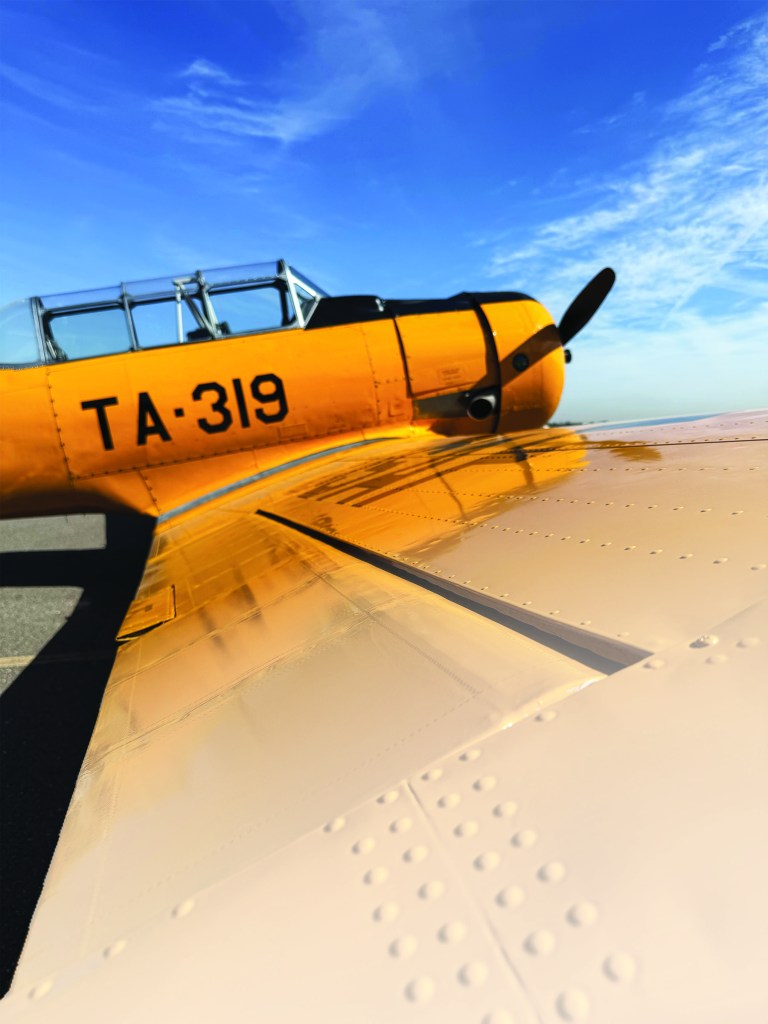
As I found out on my own flight, the T-6/SNJ “Pilot Maker” was the ideal trainer to prepare a pilot for faster and more demanding single-engine airplanes, and I knew my grandfather had been logging hours in Pensacola’s SNJs as he prepared for his first and subsequent flights in the F4U.
Since there were no two-seat trainer F4Us, the pilot had to train, complete ground school, and taxi the F4U until the instructor was satisfied they were ready to solo. Consequently, the SNJ was the ideal airplane to prepare pilots like my grandfather for the F4U Corsair.
In the end, after reviewing the tail numbers twice and the timeline of my grandfather’s training flights, it turned out that his squadron had left Pensacola in late May 1945, and he was flying out of NAS Jacksonville, 300 miles away, on June 19, 1945, when Gashler’s T-6/SNJ was received by the Navy at Pensacola.
Separated by less than a month, my grandfather’s training at Pensacola had nearly intersected with the arrival of Gashler’s T-6/SNJ. It was a near miss, and I don’t know if I will ever be able to get closer, short of finding an airplane that my grandfather actually flew.
Even so, Gashler’s T-6 is a living history time machine that a pilot or enthusiast can fly to experience the same in-air training environment that was shaping young aviators like my grandfather as they prepared to step into even faster and more powerful fighter airplanes en route to deploying in combat zones in Europe and the Pacific.
It was exciting to get as close as I did, and knowing that my grandfather once flew the same model of SNJ as I had was extremely satisfying.
Fortunately, there are aviators like Gashler who are doing the hard work of keeping these airplanes safe and flyable for pilots and enthusiasts who want a realistic WWII experience.
“I am a temporary caretaker of this T-6,” he said. “It is a special airplane. I protect it. I take care of it, and I want it around for the next 80 years.”
This feature first appeared in the September Issue 974 of the FLYING print edition.
