


Developer of composite 3D printing technologies Continuous Composites (CCI) has been awarded a Phase II Small Business Innovation Research (SBIR) contract with the U.S. Navy to advance its Continuous Fiber 3D Printing (CF3D) technology toward 3D printing UAV structures with electrical conductors embedded directly inside the composite material.
The program’s goal is load-bearing UAV components that double as power distribution systems, removing the need for traditional wire harnesses and simplifying the internal architecture of unmanned aircraft.
From Proof of Concept to Load-Bearing Parts
Phase I established the basic feasibility of the approach: CCI co-printed conductive elements, including copper wiring and fiber optics, inside fiberglass-reinforced composite panels, then ran mechanical and electrical testing to check what embedding those elements did to structural performance. The results showed minimal impact on mechanical integrity, giving the company grounds to pursue deeper integration in Phase II.
That next phase shifts from proving the concept works to engineering it for real structural use. CCI will work on incorporating higher-capacity conductive pathways into load-bearing components, using controlled material placement to keep the embedded conductors electrically isolated while preserving the surrounding structure’s mechanical performance.
The Phase II program runs for 30 months, covering materials work, process validation, and embedded conductor integration at the coupon and sub-scale structure level, followed by a one-year option period to deliver a functional, system-level demonstration.
Steve Starner, CEO of Continuous Composites, said, “This program represents a shift from printing structure alone to printing functionality directly into the structure.” He added that embedding electrical pathways into load-bearing parts is “enabling a new class of multifunctional UAV systems designed for real-world operational environments.”
Why the Navy Wants Fewer Wires
Removing separate wire harnesses has practical payoffs in the field. With power distribution built into the structure itself, CCI says damaged components can be swapped out faster, and there’s less risk of damaging wiring or connectors during handling or repair, cutting repair complexity, reducing downtime, and improving overall system reliability. For UAV platforms operating away from depot-level maintenance, that combination of durability and modularity matters as much as raw weight savings.
The contract also fits inside a wider Department of Defense push toward simplifying the systems it fields, aiming to cut complexity, improve maintainability, and speed the adoption of composite-enabled platforms across programs beyond this one.
Inside CF3D: How the Platform Works
The embedded-wiring work builds on CCI’s core CF3D Enterprise platform, which pairs a 6-axis robotic system with a proprietary end effector that deposits and impregnates continuous dry fiber with a snap-curing thermoset resin in a single pass. That motion platform is what allows precise 3D fiber steering around complex, load-bearing geometries, rather than laying material flat as conventional composite manufacturing does.
Toolpaths are generated through CF3D Studio, software that converts digital designs into fiber-aware paths with built-in finite element analysis for structural validation, and controls fiber placement, tension, and cure in real time as parts are 3D printed. On the materials side, CF3D combines continuous carbon and glass fibers with UV-curable resins, producing composites the company says rival metal in strength while cutting the waste and cost associated with traditional pre-preg manufacturing.
It’s that combination, robotic fiber placement, real-time process control, and tailorable resin systems, that gives CCI the manufacturing precision needed to route conductive pathways through a structural part without compromising it, the capability at the center of the new Navy contract.

Printing Function Into the Part
CCI’s strategy has been consistent across its recent defense contracts: treat the composite part itself as a place to put function, not just load-bearing shape. The Navy award follows a $1.9 million Air Force contract to refine simulation for anisotropic CF3D structures and a multi-year Army ManTech effort on next-generation missile components. Both efforts aimed at an underlying goal wherein printed composites can be trusted to carry stress and, increasingly, carry signal or power too.
On the wiring side specifically, UK firm Q5D built its CY1000 system around automating wire harness production for aerospace and other sectors, fixing conductors directly into 3D printed components to cut the weight, labor, and vibration-related failures that come with hand-built harnesses, the same problem CCI’s embedded-conductor approach is now aimed at for UAVs.
Across defense and space programs alike, the pattern signals additive manufacturing is being used to produce parts that are electronically functional, not just geometrically complex.
3D Printing Industry is inviting speakers for its 2026 Additive Manufacturing Applications (AMA) series, covering Energy, Healthcare, Automotive and Mobility, Aerospace, Space and Defense, and Software. Each online event focuses on real production deployments, qualification, and supply chain integration. Practitioners interested in contributing can complete the call for speakers form here.
To stay up to date with the latest 3D printing news, don’t forget to subscribe to the 3D Printing Industry newsletter or follow us on LinkedIn.
Explore the full Future of 3D Printing and Executive Survey series from 3D Printing Industry, featuring perspectives from CEOs, engineers, and industry leaders on the industrialization of additive manufacturing, 3D printing industry trends 2026, qualification, supply chains, and additive manufacturing industry analysis.
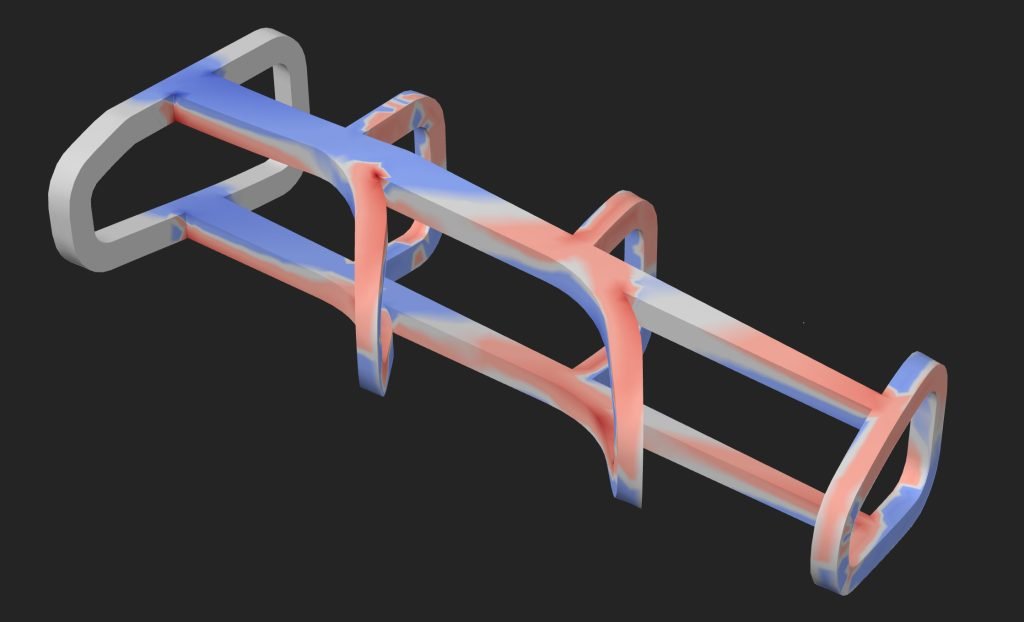
Featured image shows heat map showing stress and strain distribution across the geometry under the applied load. Image via Continuous Composites.
