


Ruling finds European Commission used flawed reasoning to keep executive aircraft manufacture out of classification system.
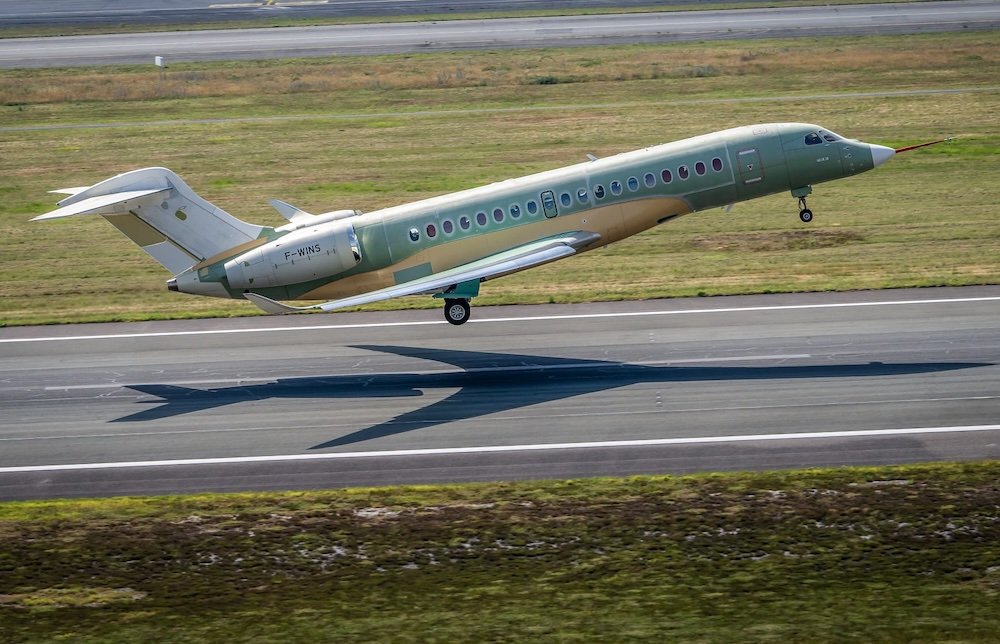
Dassault Aviation has secured a favourable court verdict on executive jet production, days after carrying out the first flight of its long-range Falcon 10X.
Dassault had sought annulment of a European Commission rule — laid down in 2023 — excluding business aircraft manufacturing from its taxonomic classification of environmentally-sustainable economic activities.
The harmonised classification system is intended to help investors identify which activities count as sustainable, particularly regarding contribution to mitigating climate change.
Air transport is considered a ‘transitional’ activity, meaning that it does not yet have a fully low-carbon alternative but is supporting the shift in this direction through use of cleaner technology or improved performance.
But the Commission’s classification rules explicitly excluded production of aircraft intended for “private or commercial business aviation” — including the Falcon models — because they generated higher carbon emissions per passenger-kilometre compared with other available modes of transport.
This left Dassault obliged to declare that its business aircraft manufacturing business was not aligned with the European ‘green taxonomy’ — potentially affecting investor perception — and it brought a case against the Commission, believing that the exclusion was unlawful.
The Commission disputed a claim by Dassault that the business aviation sector was a minimal contributor to carbon emissions, given the context of the relatively small number of people benefiting from the use of executive jets.
But five days after the Falcon 10X’s maiden flight, the General Court of the European Union in Luxembourg ruled that the Commission had used flawed reasoning in its assessment.
The judgement says the criterion of carbon footprint per passenger-kilometre “relates to the operation of aircraft…and not to their manufacture”.
It notes that the Commission failed to take into account other relevant factors, including the ability of business aircraft to operate using sustainable aviation fuel.
The court also found the Commission improperly compared business jets to other transport modes.
Its ruling points out that, while there are rail links for certain routes flown by business jets in the EU, “it does not follow” that trains constitute an alternative solution.
“These considerations also apply to buses and individual motor vehicles, which, even assuming they are ‘low carbon’, lack, respectively, the flexibility and speed of the latest generation of business jets,” it adds. The court, as a result, has annulled the exclusion on business aircraft manufacture.
Subscribe to gain access to all news
Already have a subscription? Log in.
Choose your subscription
Considering a corporate subscription? Contact us to find out more.
