


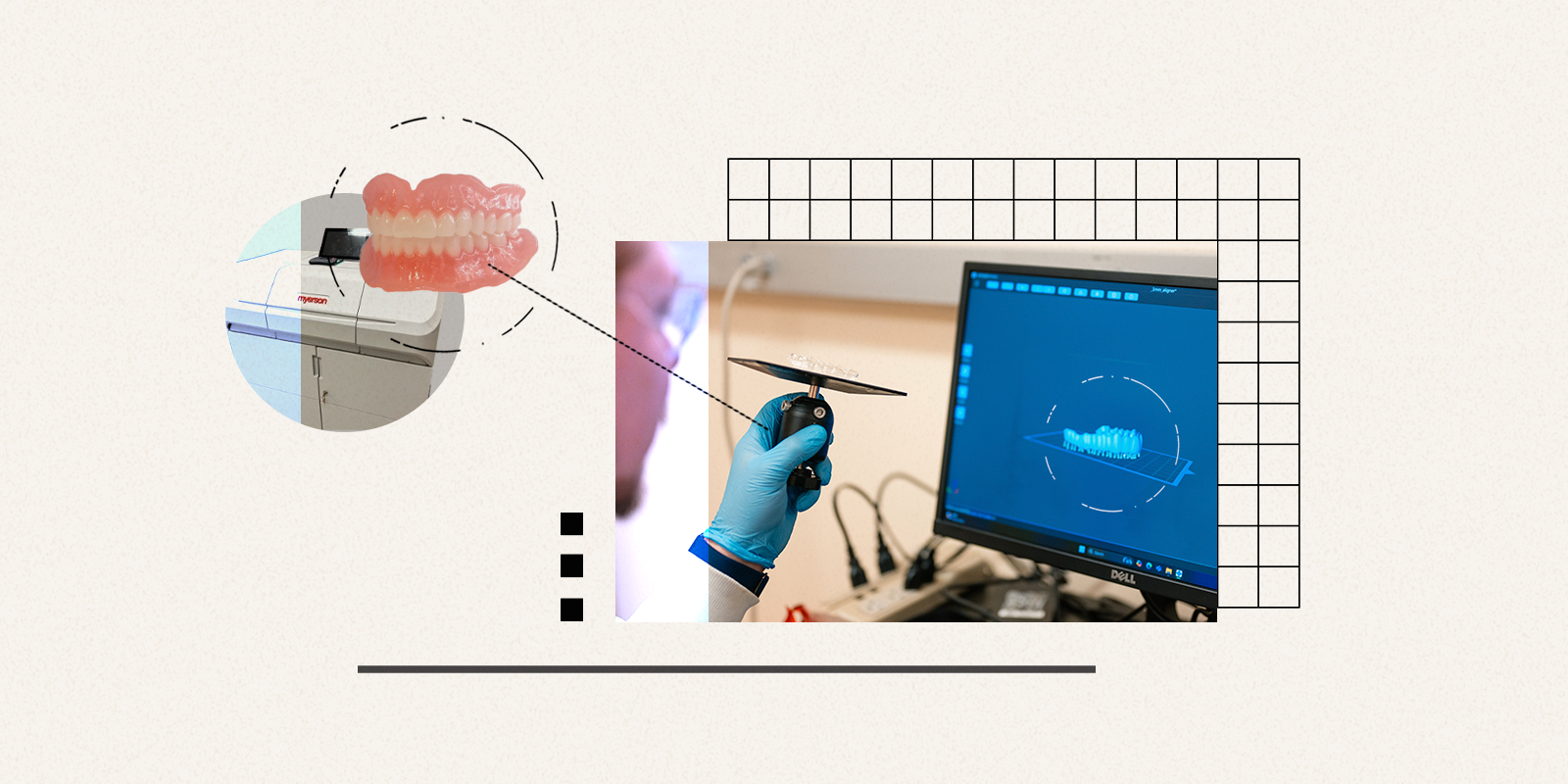
Researchers at the CU Anschutz School of Dental Medicine are investigating whether multimaterial inkjet 3D printing could reshape how dentures are designed and manufactured. Led by Jeffrey Stansbury, PhD, senior associate dean for research and professor of dental medicine, the team is developing photo-curable polymer materials intended to improve on current prosthetic performance, in durability, cost, production speed, and potentially antimicrobial protection, though several of the advances remain in research and regulatory stages.
“I’ve been a polymer chemist for decades,” said Stansbury. “The materials we are using to build potential future dentures are the best I’ve ever seen in my entire career. We’ve come up with a family of very high-performance photo-curable polymers that set new standards in material performance properties.”
A Process Overdue for Disruption
The denture has changed little over the past several decades. The dominant method, analog fabrication, involves multiple labor-intensive steps, each one introducing the risk of dimensional distortion. Impressions are taken, molds are cast, bases and teeth are manufactured separately from different materials, then bonded together. Adjustments and relinings are often still needed after the fact, and the cumulative cost of diagnostics, preparation procedures, and fabrication can run into the thousands of dollars.
The materials themselves carry trade-offs. Acrylic teeth, the budget option, wear relatively quickly, degrading the fit and the patient’s bite over time. Porcelain alternatives are more durable aesthetically but are brittle, heavier, and more expensive. Neither approach was designed with optimization in mind; both were designed around what manufacturing could practically deliver at scale.
Digital dentistry began shifting this picture roughly a decade ago, when intraoral scanning wands replaced physical molds, feeding patient geometry directly into design software. That opened the door to subtractive manufacturing, milling dentures from pre-formed material blocks, and later to vat-based 3D printing, where a light source cures liquid resin one thin layer at a time. Vat printing improved efficiency, but it still required teeth and bases to be printed separately and then bonded. The bond remained a weak point, and single-material constraints limited both aesthetics and performance.
One Piece, Locked at the Molecular Level
The CU Anschutz team’s focus is multimaterial inkjet printing, a process that deposits micro-droplets of different resins simultaneously, layer by layer, to build a complete denture as a single unified structure. Teeth material and base material are jetted to precisely the right location within each layer and immediately cured under light, eliminating the bonding step entirely and producing what the researchers call a monolithic device.
“That’s the distinction. It’s much faster, and much stronger. We’re eliminating those labor-intensive steps that still might not get the best fit for a patient. Now it’s one part, locked together at the molecular level and accurate to the patient’s mouth.”
Beyond structural gains, inkjet printing unlocks local material customization that was never possible before. Color gradients, translucency variation at the tooth edge, and opacity in the body can all be dialed in digitally, closely mirroring the optical complexity of natural teeth. The team can also engineer stiffness and toughness profiles across different zones of the denture, enabling thinner constructions that still provide strong tooth support.
In a collaboration with the laboratories of Devatha Nair, PhD and Michael Schurr, PhD, the group has developed a novel additive, incorporated in small proportions during printing and cured directly into the material, that inhibits the growth of harmful bacteria and fungi. Lab and in-vivo studies have shown significant reductions in microbial presence, though the additive will require separate FDA approval given its active biological function.
“As the technology moves through the regulatory review process, it marks an important step forward in the development of next-generation dental materials. We’re looking at a future where when patients lose some or even all their teeth, they’ll have faster, affordable access to high-performance dentures that are more comfortable to wear and good for their oral health,” concluded Stansbury.
The Race to Make Inkjet Dentures Real
The gap this research is closing is one the broader dental 3D printing industry has been converging on from the commercial side. The strategic question has been whether multimaterial jetting could be adapted to produce clinically cleared, end-use dental prosthetics at volume.
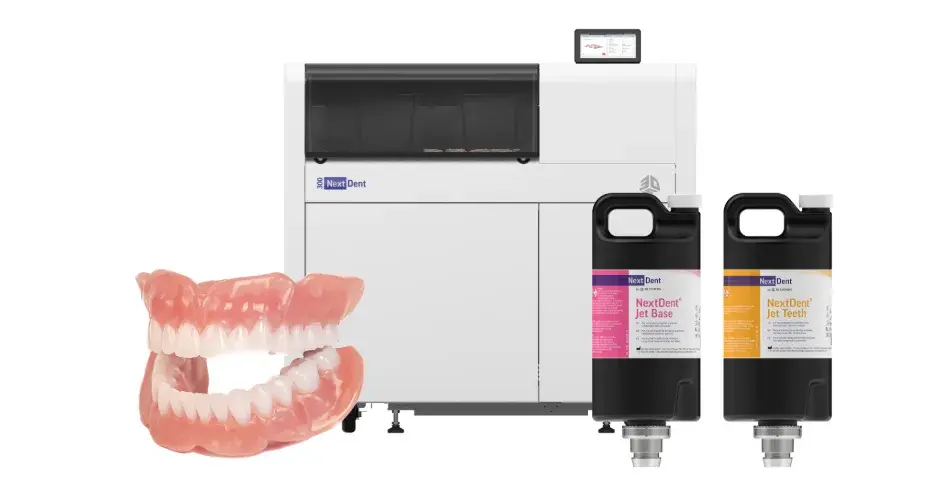
The most direct parallel comes from 3D Systems, which has moved aggressively into this space. The company’s NextDent jetted denture solution combines NextDent Jet Denture Teeth and NextDent Jet Denture Base materials into a single monolithic prosthetic, delivering enhanced break resistance and realistic aesthetics, and has received FDA 510(k) clearance confirming its safety and effectiveness.
The commercial push is substantial: roughly 180 million people worldwide wear dentures, generating annual production of around 13.7 million sets, and 3D Systems is now pursuing European expansion, with its NextDent Jetted Denture Solution slated for a European launch in summer 2026 following full EU MDR certification.
On the startup side, Netherlands-based Novenda Technologies secured $6.1 million in Series A funding to commercialize a multimaterial jetting dental 3D printing platform that integrates rigid and soft materials with an advanced color management algorithm, targeting mid-to-large dental labs capable of producing up to 8 dentures per hour.
Where commercial players race to scale, the CU Anschutz team is solving what comes next: dentures that actively protect oral health, something no cleared product currently offers.
3D Printing Industry is inviting speakers for its 2026 Additive Manufacturing Applications (AMA) series, covering Energy, Healthcare, Automotive and Mobility, Aerospace, Space and Defense, and Software. Each online event focuses on real production deployments, qualification, and supply chain integration. Practitioners interested in contributing can complete the call for speakers form here.
To stay up to date with the latest 3D printing news, don’t forget to subscribe to the 3D Printing Industry newsletter or follow us on LinkedIn.
Explore the full Future of 3D Printing and Executive Survey series from 3D Printing Industry, featuring perspectives from CEOs, engineers, and industry leaders on the industrialization of additive manufacturing, 3D printing industry trends 2026, qualification, supply chains, and additive manufacturing industry analysis.
Featured image shows 3D Printing and Dentures. Image via CU Anschutz School of Dental Medicine.
