


DHL has welcomed the Science Based Targets initiative’s (SBTi) acceptance of ‘book and claim’ as a mechanism for tracking emissions reduction.
In June, SBTi, which was founded as a partnership between the Carbon Disclosure Project, the United Nations Global Compact, the World Resources Institute and the World Wide Fund for Nature, published Version 2.0 of its Corporate Net Zero Standard.
The updated framework introduces book and claim as a credible mechanism for reducing transport emissions and contributing to corporate climate targets.
Book and claim allows companies to transfer emissions reductions amongst various parties through the use of a registry.
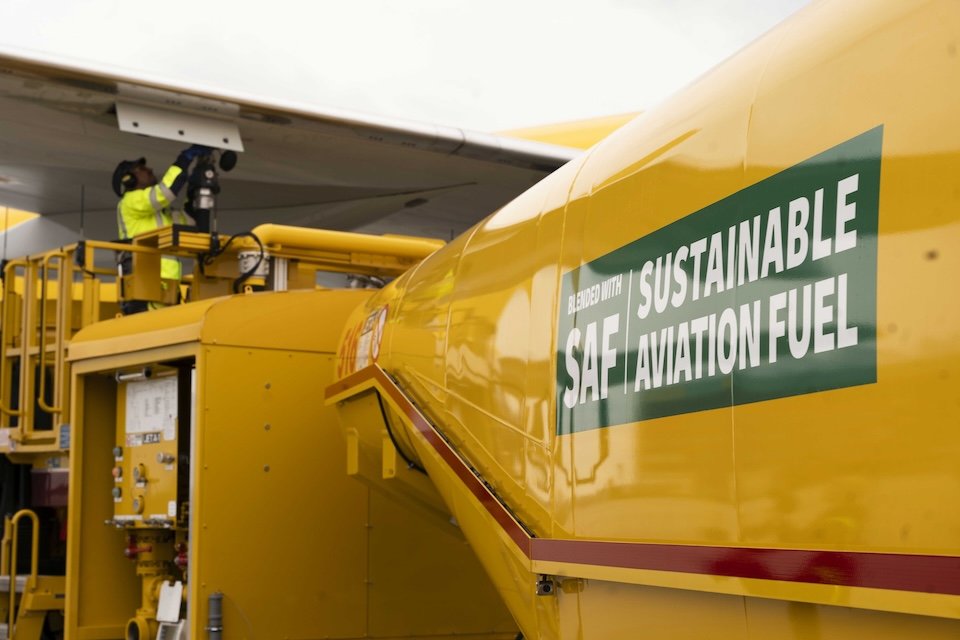
This solves a couple of problems: firstly, when one party reduces emissions on behalf of another and secondly, when the emissions reduction may not actually be connected to a specific shipment. For example, a shipper may request the use of Sustainable Aviation Fuel (SAF) for a certain shipment or route, but the airline actually uses the equivalent amount of SAF on another flight entirely.
“When a sustainable fuel supplier produces the product, they generate a certificate based on a certain quantity of sustainable fuel (e.g., one metric ton) they make from sustainable feedstock,” explained DHL.
“You receive that independently verified certificate when you purchase sustainable fuel attributes through a book and claim system or when you purchase a low-emission transport service powered by those fuels (or an electric vehicle).
“So, even though your package or freight might not have been shipped in a truck, plane or ship powered by sustainable fuel, somewhere in the network someone else’s shipment did. Your purchase has replaced fossil-based fuel and reduced overall transport emissions – and you get the credit for that.”
DHL said the new mechanism would enable it to transfer the environmental benefits of low-carbon fuels used within its network to customers whose shipments move through that network.
Tobias Meyer, chief executive of the DHL Group, said: “For years, DHL has championed practical, high-integrity solutions to decarbonise logistics at scale.
“Through the use of alternative, low-carbon fuels and GoGreen Plus, we have enabled thousands of customers across industries and geographies to reduce the emissions associated with their transportation activities.
“The continued evolution of industry standards and frameworks is an important step in helping accelerate the transition to lower-emission logistics worldwide.”
The Science Based Targets initiative was established in 2015 to help companies to set emission reduction targets in line with climate science and the Paris emissions reduction agreement goals.
